
Law & PolicyJuly 2026 · 6 min read

Are You Responsible for Your Parents' Debt When They Die?

In almost every case you are not responsible for your parents' debt when they die. Their estate pays what it can; if it can't, the debt usually goes unpaid, and a collector who says you must pay is often wrong.

In This Article

No. In almost every case you are not responsible for your parents' debt when they die, and you do not inherit it. If a debt collector tells you that you have to pay your dead mother's credit card or your father's medical bill out of your own money, they are usually wrong, and sometimes breaking the law.[1]

Debt belongs to the person who borrowed the money. When your parent dies, their debt becomes a claim against their estate, which is everything they owned. The estate pays what it can. What it can't pay usually goes unpaid. There are a few real situations where you can be liable, and this page names each one plainly so you can tell whether it applies to you. Most of the time, it doesn't.[3]
Are you responsible for your parents' debt when they die?

No, with narrow exceptions. Your parent's debt does not transfer to you because you are their child. It stays with the estate. The executor or administrator gathers what your parent owned, pays valid debts in the order your state sets, and distributes whatever is left to the heirs. If the estate has enough, creditors get paid. If it doesn't, creditors get part or nothing, and the shortfall is not yours to cover.[1]

The exceptions are specific: you co-signed the loan or were a joint account holder; you signed something agreeing to be financially responsible, which comes up with some medical and nursing-home admissions; or a state filial-responsibility law reaches you for a parent's unpaid long-term-care costs, which is rare. Each of these is covered below. If none of them describes you, you do not owe your parent's debt. For the wider picture of how debt is handled after any death, see what happens to debt when you die.[3]

Do you inherit your parents' debt?

No. You inherit assets, not debts. Inheritance is what is left after the estate pays its bills, not a bundle of the bills themselves. Creditors are paid before heirs, so if your parent owed more than they owned, you may inherit little or nothing, but you do not owe the difference.[1]

Being named in the will does not make you liable. Being the executor does not make you liable either; the executor manages the estate's money and pays the estate's debts from the estate's funds, not from their own. See what an executor actually does, and how probate works and how long it takes. The one way to make yourself personally responsible is to sign for it, so read anything a collector or a facility asks you to sign before you sign it.

Can debt collectors make you pay your dead parent's debt?

A collector is allowed to contact you as the next of kin, the executor, or the person handling the estate. They can ask about the estate and where to send a claim. What they cannot do is tell you that you personally have to pay a debt you never agreed to. Under the federal Fair Debt Collection Practices Act, a collector cannot make false statements about who owes a debt, cannot threaten action they can't take, and cannot harass you.[3]

You have the right to tell a collector, in writing, to stop contacting you. Once they receive that letter, they can contact you only to confirm there will be no more contact or to tell you they are taking a specific action. Sending that letter does not erase a debt that the estate genuinely owes, but it stops the calls to you.[4] Be careful about one thing: agreeing to pay even a small amount on a debt that isn't yours can, in some states, be treated as taking on the debt. Don't promise payment to make a collector go away.

Are you responsible for your parents' medical debt?

Generally no. Your parent's medical and hospital debt is paid by their estate like any other debt, and it does not become yours just because you are their child or their emergency contact. The exception is if you signed a hospital, hospice, or nursing-home form agreeing to be personally responsible for the bill. Some admission and guarantor forms include that language, and a signature on the wrong line turns their debt into your debt.[3]

Being listed as the next of kin, the emergency contact, or the health-care proxy is not the same as guaranteeing payment. Those roles are about decisions and contact, not money. Before you sign anything at an admission desk, read the part about financial responsibility. If a line asks you to personally guarantee the bill, you can decline to sign that line, and if you are unsure what a form makes you responsible for, ask the facility to point to the exact clause before you sign.

What are filial responsibility laws?

Filial-responsibility laws are old state laws that can make adult children responsible for a parent's basic support, most often an unpaid long-term-care or nursing-home bill. About half of US states have some version of one, but they are rarely enforced, and the details vary widely from state to state: who can be pursued, for what kind of debt, and whether the child had the means to pay.[3]

Two things keep this from being the threat it sounds like. First, most of these laws are aimed at unpaid care while the parent is still alive, not at collecting from you after they die. Second, courts and care facilities almost never use them. Where a child does get pulled in, it is usually because they also signed the admission paperwork as the responsible party. The specifics genuinely vary by state and are rarely tested, so if a facility or collector raises filial responsibility, ask them to name the statute in writing, and consider talking to a lawyer in your state before you agree to anything.

Are you responsible for a parent's credit card debt?

It depends on one thing: whether you were an authorized user or a joint account holder. An authorized user is someone allowed to use the card. You could make charges, but you never signed the credit agreement promising to repay, so you are not liable for the balance when the account holder dies. That debt belongs to your parent's estate.[2]

A joint account holder is different. You opened the account together and both agreed to repay it, so you are each responsible for the full balance, and that responsibility does not go away when your parent dies. That is a contract you signed, not an inheritance. If you were only an authorized user and a card company tells you that you owe the balance, they are wrong. The estate pays the card; if the estate can't cover it, the balance usually goes unpaid. For more on how card debt is handled, see what happens to credit card debt when you die.[1]

What should you do when a collector calls about a dead parent's debt?

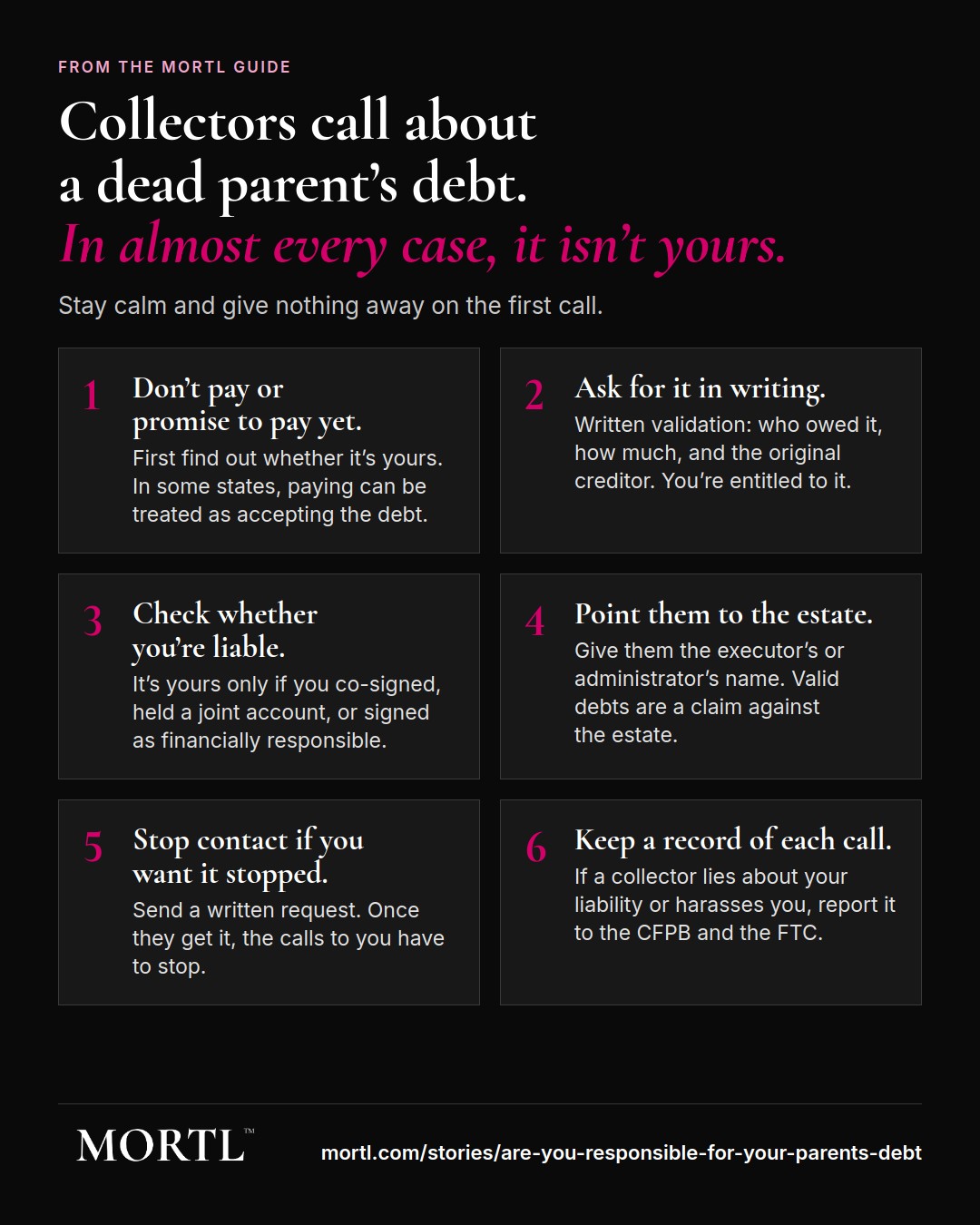
Stay calm and give nothing away on the first call. Here is what to do:

  1. Don't promise to pay. Do not agree to pay, and do not make a partial payment, until you know whether the debt is actually yours. In some states, paying can be treated as accepting the debt.
  2. Ask for it in writing. Tell the collector to send written validation of the debt: who owed it, how much, and the original creditor. You are entitled to this.[4]
  3. Check whether you are actually liable. You are liable only if you co-signed, were a joint account holder, or signed as financially responsible. If none of those is true, you are not the person who pays.
  4. Point them to the estate. Give them the name and contact for the executor or administrator. Valid debts are a claim against the estate, and that is where they belong.
  5. Stop contact if you want it stopped. You can send a written request to stop contacting you, and once they get it, the calls to you have to stop.[4]
  6. Keep records. Write down who called, when, and what they said. If a collector lies about your liability or harasses you, that is a violation you can report to the CFPB and the FTC.[3]

One last thing, and it matters most. Do not pay a dead parent's debt out of your own pocket out of guilt, or because a collector pressured you. If the debt is not legally yours, paying it does not honor your parent; it just moves their unpaid bill onto you. Grief makes people want to settle things, and some collectors count on that. Settle what the estate owes from the estate, and keep your own money out of it unless a debt is genuinely yours.


This page is general information, not legal or financial advice. Rules vary by state, filial-responsibility laws most of all, and whether you signed as a co-signer, joint account holder, or responsible party changes the answer. If a collector is pursuing you or you are unsure what you signed, talk to a lawyer in your state. For the government sources behind this page, see our Sources and Methodology.

Sources & References

Research & Citations

All factual claims in this article are sourced from peer-reviewed research, government data, and named institutions. Citations follow APA 7th edition format.

  1. [1]Consumer Financial Protection Bureau. (2024). *Can a debt collector still collect a debt after a person has died?* ↗ Source 2026-07-22
  2. [2]Consumer Financial Protection Bureau. (2024). *Am I responsible to pay off the debts of my deceased spouse?* ↗ Source 2026-07-22
  3. [3]Federal Trade Commission. (2024). *Debts and deceased relatives*. ↗ Source 2026-07-22
  4. [4]Federal Trade Commission. (2024). *Debt collection FAQs*. ↗ Source 2026-07-22
ShareX / Twitter

Keep Reading

Law & Policy

What Happens to Debt When You Die

Most debt does not pass to your family when you die. It is paid by your estate, and if the estate runs out, most of it goes unpaid. Here are the exceptions.

7 min read
Law & Policy

What Happens to Credit Card Debt When You Die

Credit card debt is paid by the estate, not by the family. If the estate can't cover it, the balance usually goes unpaid, and most relatives owe nothing. The exceptions are joint account holders, co-signers, and spouses in community-property states.

7 min read
Law & Policy

What Is Probate and How Long Does It Take?

Probate: the legal process that kicks in after you die, ensuring your stuff goes where it's supposed to. Or, where the state says it should.

12 min read
Planning

What Does an Executor Actually Do?

Being an executor is thankless, grinding paperwork. Here's the full, unvarnished truth about what the job entails, from death certificates to taxes.

13 min read

The Death Dispatch

More stories like this, weekly.

A newsletter about death you'll actually look forward to reading.