
Law & PolicyJuly 2026 · 10 min read

Living Trusts: What They Do, What They Cost, Who Actually Needs One

A living trust keeps your estate out of probate court, but only if you move your property into it. What it costs, what it cannot do, and who actually needs one.

Living Trusts: What They Do, What They Cost, Who Actually Needs One

In This Article

What a Revocable Living Trust Actually Is

A revocable living trust is a legal arrangement you create while you are alive. You sign a trust document, name yourself as trustee, and transfer your property into the trust's name. Nothing about your daily life changes. You still control the house, the accounts, all of it. You can sell trust property, spend the money, rewrite the terms, or revoke the entire thing tomorrow. Revocable means exactly that[1].

Three roles, and at the start you hold all of them. The grantor creates the trust. The trustee manages the property in it. The beneficiary gets the benefit of that property. While you are alive and competent, that is you, you, and you.

The document also names a successor trustee. That name does the real work. If you become incapacitated, the successor trustee takes over: managing the trust assets, paying your bills, making investment decisions, all without a court appointing anyone[1][2]. When you die, the successor trustee distributes the property to the beneficiaries you named, on the schedule you wrote. No probate court supervises any of it, provided the assets are actually titled in the trust. That last clause decides whether your trust works at all, and we will come back to it.

One thing a trust does not replace: a will. You still need a short pour-over will to catch anything you never moved into the trust[2]. And if you have minor children, the will is the document that names their guardian. A trust cannot do that[3]. Start with our complete guide to writing a will if you have neither document yet.
What a Living Trust Buys You: Probate Avoidance, Privacy, Incapacity

A living trust delivers three things, plus a fourth for people with property in more than one state.

Probate avoidance. Assets titled in the trust pass to your beneficiaries without a probate case. What that is worth depends entirely on your state. In California, probate attorney fees are set by statute as a percentage of the estate: 4% of the first $100,000, 3% of the next $100,000, 2% of the next $800,000, and 1% of the next $9 million[6]. A $500,000 estate generates a $13,000 statutory attorney fee, and the executor is entitled to the same schedule again. A funded trust means those fees never exist. In states with cheap, fast probate, the savings are smaller. Our breakdown of probate and estate attorney costs shows what the process actually charges.

Privacy. A will gets filed with the probate court when you die and becomes a public record. Anyone can read what you owned, who got it, and who got left out. A trust is not filed anywhere. Its terms stay private[3].

Incapacity management. If a stroke or dementia takes you out of your own finances, your successor trustee is authorized to manage the trust assets, pay your bills, and make investment decisions[2]. The alternative, for people with no planning in place, is a guardianship or conservatorship: a public court proceeding where a judge rules on your capacity and appoints someone to run your affairs. A funded trust can make that proceeding unnecessary[2].

Out-of-state real estate. A cabin or rental house in a second state normally triggers a second probate, called ancillary probate, in that state's courts. Real estate held in your trust transfers without the extra proceeding[3].

What a Living Trust Does Not Do

Trusts get sold hard, and the sales pitch routinely promises things a revocable trust cannot deliver. Maryland's Registers of Wills publishes a consumer fact sheet largely to push back on those pitches[3]. Two limits matter most.

It does not lower your taxes, and for almost everyone there is nothing to lower. The federal estate tax applies only to estates above $15 million per person for deaths in 2026[4]. Below that line, there is no federal estate tax to plan around, trust or no trust. And a revocable trust would not help anyway. Because you keep full control, the law treats the assets as yours: the trust is ignored for income tax purposes while you are alive, and everything in it is included in your taxable estate when you die[2][3]. A handful of states tax estates at lower thresholds, and a revocable trust does not beat those either. Anyone pitching a living trust as a tax shelter is selling you a document that does not do what they said. That claim sits at the top of our list of estate planning myths that cost people money.

It does not protect your assets from creditors while you are alive. Same logic. You can revoke the trust and take everything back at any moment, so your creditors can reach what is in it[2][3]. Lawsuit protection and asset shelter require irrevocable trusts, a different tool with a real price: you give up control of the property, permanently.

If a seminar, a mailer, or a door-to-door "estate planner" leads with tax savings or creditor protection on a revocable trust, walk away. State regulators warn about exactly this pitch[3].

Funding the Trust: The Step Everyone Skips

Signing the trust document accomplishes nothing by itself. A trust only controls property that has been transferred into it, and an unfunded trust does nothing. Your successor trustee has no authority over assets that were never retitled[1].

Funding means changing ownership, asset by asset. A new deed transferring your house to the trust, signed and recorded with the county. Bank and taxable brokerage accounts retitled in the trustee's name. Business interests formally assigned. Every asset that should skip probate has to be owned by the trust, on paper, before you die.

This is the step people skip, and the failure is expensive in a specific way. The Florida Bar warns that people who do not fully fund their trusts often end up paying for two proceedings: a probate administration for the assets left outside the trust, plus a trust administration for the assets inside it[2]. Both. Not neither.

Some assets stay out of the trust on purpose. Retirement accounts such as 401(k)s and IRAs pass by beneficiary designation, and retitling them has tax consequences, so the standard move is to leave them alone and keep the designations current. Life insurance pays its named beneficiary directly. Bank accounts can carry their own payable-on-death designations, which we cover in our guide to payable-on-death accounts.

Two practical rules. First, when you hire an attorney, get in writing whether the fee includes preparing and recording the new deed for your home. Second, treat funding as maintenance, not a one-time event. Every account you open and every property you buy after signing has to go into the trust too, or it lands in probate.

What a Living Trust Costs in 2026

Attorney-prepared: $1,500 to $4,000 for a living trust estate plan, and past $5,000 for complex estates[5]. That price should buy a package, not a single document: the trust, a pour-over will, a durable financial power of attorney, a healthcare directive, and the deed work to move your real estate into the trust. Confirm each item before you sign the engagement letter. These figures match what we verified in our probate and estate attorney cost breakdown.

Online or DIY: $400 to $1,000[5]. Online services generate the documents. They do not record your deed, retitle your accounts, or tell you that your blended family or your kid's disability benefits make a template dangerous. The document is a fraction of the job; funding is the rest of it.

Online is defensible when your situation is genuinely simple: one state, straightforward assets, everything going outright to adults. Pay for the attorney when any of these is true: a blended family, a beneficiary who receives government disability benefits, a business, staged payouts to children, or real estate in more than one state.

Put the cost next to what it prevents. A $3,000 trust package against a $13,000 statutory attorney fee on a $500,000 California probate estate[6], before the executor's matching fee and court costs. In a state like that, the trust pays for itself several times over. In a state with a $300 filing fee and an informal probate track, it may not.

Who Actually Needs One, and Who Does Not

A living trust is a tool for specific situations, not a default upgrade. You are a strong candidate if any of these describes you:

  • You own real estate in more than one state. A trust spares your family a separate ancillary probate in each state where you own property[3].
  • You own a home in a state with expensive probate. California's percentage-based statutory fees are the clearest example[6]. Homeowners there routinely clear the small estate threshold on the house alone.
  • You want your estate kept private. A probated will is a public court record. A trust is not[3].
  • Incapacity planning is a live concern. A diagnosis, advanced age, or no spouse who can step in. A funded trust puts a chosen manager in charge without a guardianship proceeding[2].
  • You have minor children and want staged distributions. A trust can hold money and release it on your schedule, at ages and milestones you pick, instead of handing a lump sum to a new legal adult. The trust holds the money; your will still names the guardian[3].

You probably do not need one if:

  • Your estate fits your state's small estate procedure. In California, estates up to $208,850 can skip formal probate with an affidavit, and a primary residence worth up to $750,000 can transfer through a simplified petition under the rules effective April 1, 2025[7]. Your state's numbers differ; check them before paying for a trust.
  • Your assets already pass outside probate. Retirement accounts and life insurance with named beneficiaries, joint accounts with survivorship, payable-on-death designations, and a transfer on death deed on the house can move an entire estate with no trust and no court.
  • You are young, renting, and your net worth is modest. A will, current beneficiary designations, and powers of attorney cover you for now.

Living Trust vs. Will: The Honest Comparison

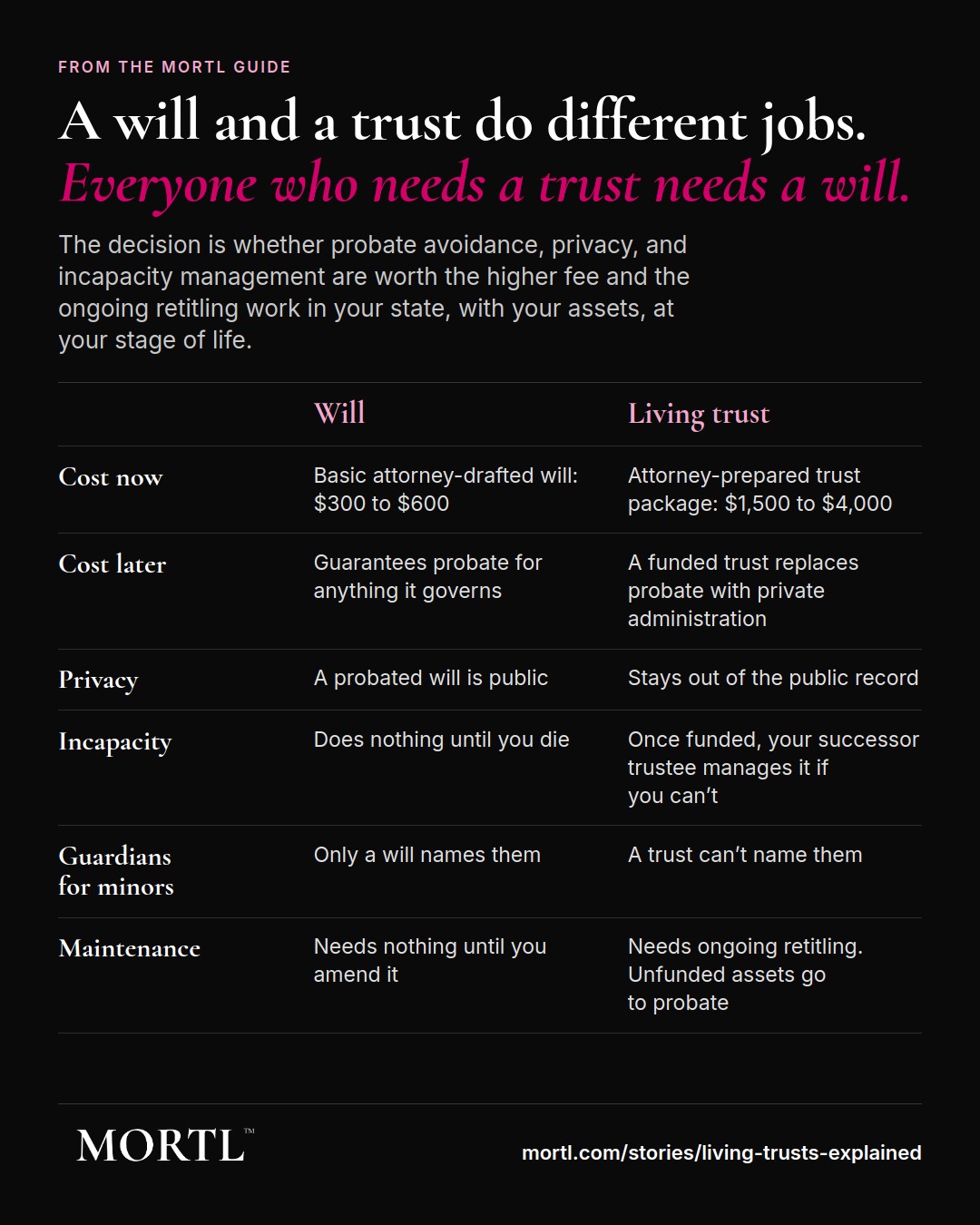
The two documents do different jobs, and most people with a trust have both. The real differences:

  • Cost now. An attorney-drafted basic will runs $300 to $600, with comprehensive plans at $1,000 or more[8]. A trust package runs $1,500 to $4,000[5]. The trust costs roughly five times more up front.
  • Cost later. A will guarantees probate for anything it governs, with that state's fees and timeline. A funded trust replaces probate with a private trust administration handled by your successor trustee.
  • Privacy. A probated will is public. A trust stays private[3].
  • Incapacity. A will does nothing until you die. A trust starts protecting you the day it is funded, because your successor trustee can take over if you cannot manage your own affairs[1][2].
  • Guardians for minor children. Only a will names them[3]. This alone means a trust can never be your only document.
  • Maintenance. A will sits in a drawer until you amend it. A trust demands funding discipline for the rest of your life. Every unfunded asset is a future probate case[2].

The decision is not trust versus will. Everyone who needs a trust also needs a will. The decision is whether probate avoidance, privacy, and incapacity management are worth the higher fee and the ongoing retitling work in your state, with your assets, at your stage of life. If you are starting from zero, write the will first. Our complete guide to writing a will is the place to begin, and the trust conversation can follow once the basics exist.

Sources & References

Research & Citations

All factual claims in this article are sourced from peer-reviewed research, government data, and named institutions. Citations follow APA 7th edition format.

  1. [1]Consumer Financial Protection Bureau. (n.d.). What is a revocable living trust? Consumer Financial Protection Bureau. https://www.consumerfinance.gov/ask-cfpb/what-is-a-revocable-living-trust-en-1775/ ↗ Source 2026-07-16
  2. [2]The Florida Bar. (n.d.). The revocable trust in Florida (Consumer pamphlet). The Florida Bar. https://www.floridabar.org/public/consumer/pamphlet028/ ↗ Source 2026-07-16
  3. [3]Maryland Registers of Wills. (n.d.). Revocable living trusts: Get the facts. Maryland Registers of Wills. https://registers.maryland.gov/main/publications/REV-TRUST-FACTS.pdf ↗ Source 2026-07-16
  4. [4]Internal Revenue Service. (2026). Estate tax. IRS.gov. https://www.irs.gov/businesses/small-businesses-self-employed/estate-tax ↗ Source 2026-07-16
  5. [5]LegalZoom. (n.d.). How much does a living trust cost? (2026 price guide). LegalZoom. https://www.legalzoom.com/articles/cost-to-set-up-a-living-trust ↗ Source 2026-07-16
  6. [6]California Probate Code § 10810. California Legislative Information. https://leginfo.legislature.ca.gov/faces/codes_displaySection.xhtml?lawCode=PROB&sectionNum=10810 ↗ Source 2026-07-16
  7. [7]Judicial Council of California. (2025). Transfer an estate with a small value. California Courts Self-Help Guide. https://selfhelp.courts.ca.gov/probate/simple-transfer ↗ Source 2026-07-16
  8. [8]LegalZoom. (n.d.). How much does a will cost? LegalZoom. https://www.legalzoom.com/articles/how-much-does-a-will-cost ↗ Source 2026-07-16
ShareX / Twitter

Keep Reading

Law & Policy

Probate and Estate Attorneys: When You Actually Need One, and What They Cost

Most estates do not need a probate lawyer. Some absolutely do. Here is how to tell the difference, and exactly what you will pay when you hire one.

9 min read
Planning

7 Estate Planning Myths That Are Costing People Money

"I'm too young." "I don't have enough assets." "My family will figure it out." These are the myths that leave families with nothing but a mess.

9 min read
Planning

How to Write a Will: The Complete Guide

Thinking about writing a will? It's not just for the rich or the old. This guide tells you exactly what a will does, what it costs, and what happens without one.

9 min read

The Death Dispatch

More stories like this, weekly.

A newsletter about death you'll actually look forward to reading.