
Law & PolicyBy Stephanie Werner · November 2026 · 7 min read

Inherited an IRA? The 10-Year Rule and What's Due by December 31

Most people who inherit an IRA have ten years to empty it. Some also owe a withdrawal every year, and that one is due December 31. How to tell which rules are yours, from the IRS's own publication.

A man reads a bank statement at a kitchen table while a financial planner points to a line on a form, in black and white

If someone left you a traditional IRA, the IRS sets the schedule for emptying it. For most people who inherit from an owner who died in 2020 or later, everything has to come out by the end of the 10th year after the death.[1] Some of them also owe a withdrawal every year before that, and the yearly deadline is December 31.[1]

The same 10-year rule covers inherited 401(k)s and other defined contribution plans when the participant died after December 31, 2019.[2] This page uses IRAs for the examples. Every rule below comes from IRS Publication 590-B, the 2025 edition, and the IRS's required minimum distribution FAQs.
Which kind of beneficiary are you?

The rules split on who you were to the person who died. The IRS calls five groups "eligible designated beneficiaries": the owner's surviving spouse, the owner's minor child, a disabled person, a chronically ill person, and anyone not more than 10 years younger than the owner.[1] Those beneficiaries can generally take withdrawals over their own life expectancy instead of emptying the account in ten years.[1]

A minor child gets that treatment only until reaching the age of majority. Then a 10-year clock starts, and it ends on December 31 of the year that holds the 10th anniversary of that birthday.[1]

Everyone else named on the account, an adult child, a niece, a friend, follows the 10-year rule.[1] [2]

The 10-year rule

A beneficiary under the 10-year rule has to empty the account by the end of the 10th year after the owner's death.[1] If the owner died in 2025, that's December 31, 2035.

Whether you also owe yearly withdrawals in the meantime depends on one date: the owner's required beginning date, the date the owner had to start taking their own required withdrawals. For an owner who reached age 72 after December 31, 2022, that's April 1 of the year after they turned 73. Older owners had earlier dates, at 72 or 70½.[1]

  • The owner died before that date. No withdrawal is required for any year before the 10th year.[1] You can take money out whenever you want, as long as the account is empty by the deadline.
  • The owner died on or after that date. You owe a required minimum distribution every year after the year of death, figured on the longer of your life expectancy or the owner's, and the account still has to be empty by the end of the 10th year.[1]

The custodian holding the account can tell you whether the owner had reached the required beginning date. Ask in writing, and keep the answer.

What's due by December 31

Two withdrawals can come due by the end of the year.

The owner's own withdrawal for the year they died. If the owner died on or after the required beginning date and hadn't taken that year's withdrawal, the beneficiaries are responsible for taking it.[1] The IRS figures that amount as if the owner had lived the whole year.[1]

Your yearly withdrawal. If you owe one under the rules above, it's due by December 31 each year, starting the year after the death.[1]

A required withdrawal can't be rolled over into another IRA once it's taken.[1] Custodians get busy in December, so ask yours now how long a withdrawal request takes to process.

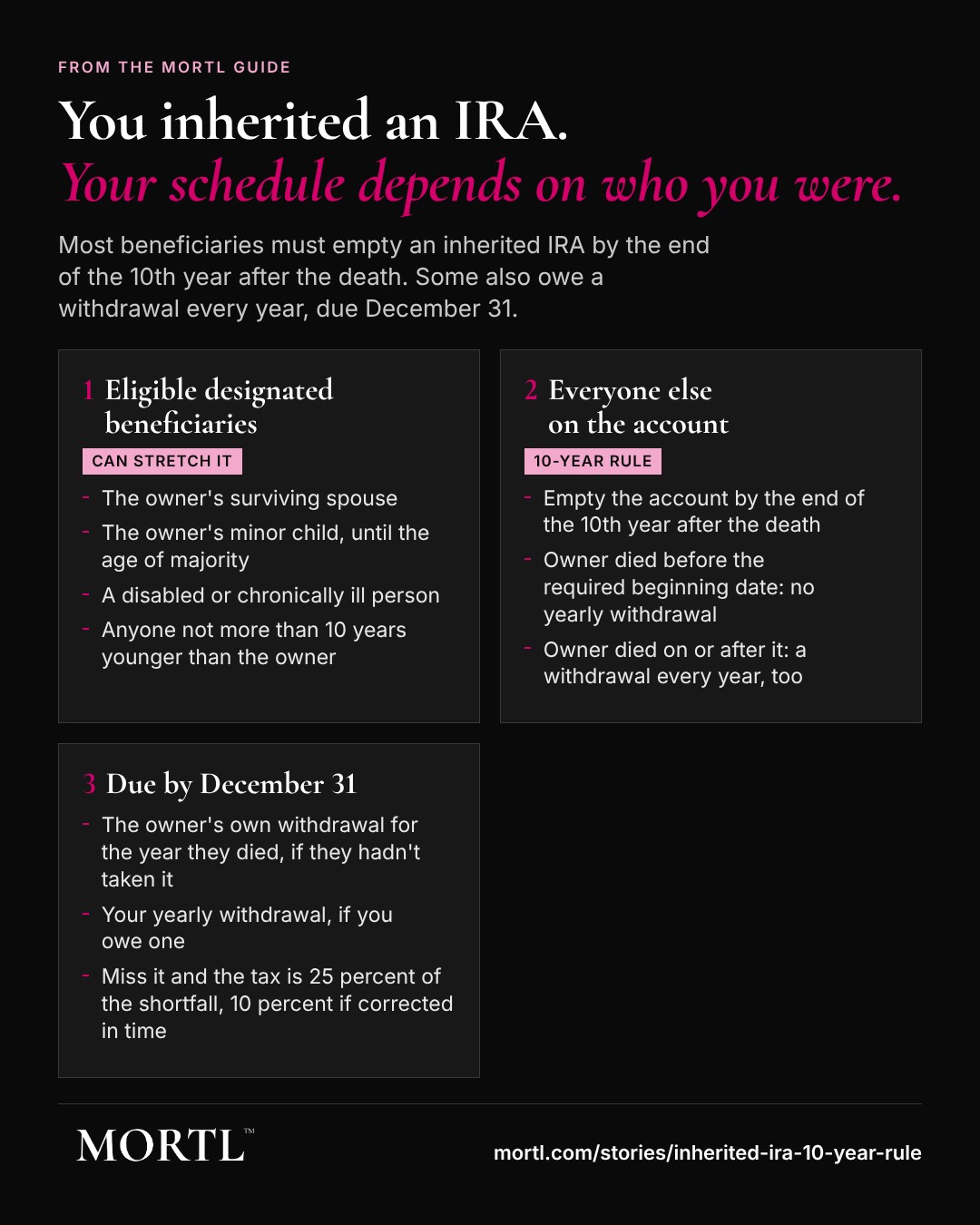
Inherited IRA rules in three groups: eligible designated beneficiaries who can stretch withdrawals, everyone else on the 10-year rule, and what's due by December 31.
Inherited IRA rules from IRS Publication 590-B, for anyone named on an account. Open the full-size image.

If you miss a withdrawal

The tax for a missed required withdrawal is 25 percent of the amount you should have taken and didn't.[1] It drops to 10 percent if you take the missed amount and file a return reporting the tax within the IRS's correction window.[1] You report it on Form 5329.[1]

If the shortfall came from a reasonable error and you're fixing it, you can ask the IRS to waive the tax by attaching an explanation to Form 5329.[1] The IRS also said it wouldn't assert the tax for certain missed 2024 withdrawals, under Notice 2024-35.[1]

If you inherited from your spouse

A surviving spouse has choices nobody else gets. You can treat the IRA as your own, roll it into your own IRA or certain employer plans, or stay a beneficiary.[1] If you're the only beneficiary, the IRS treats you as having made it your own if you put money into it, or if you skip a withdrawal you owed as a beneficiary.[1]

The choice matters most if you're under 59½. Money a beneficiary takes from an inherited IRA isn't hit with the 10 percent early-withdrawal tax. Once you treat the account as your own, withdrawals before 59½ can be.[1]

If you inherited from anyone else

You can't treat the account as your own. You can't add money to it, and you can't roll money into it or out of it.[1]

You can move it with a trustee-to-trustee transfer, as long as the receiving IRA is set up in the name of the person who died, for your benefit as beneficiary.[1] Custodians usually call this an inherited IRA. If the custodian offers to send you a check instead, that's a withdrawal, and it's taxable.

Taxes, and inherited Roth IRAs

Withdrawals from an inherited traditional IRA are taxed as ordinary income, except for any part that came from nondeductible contributions the owner made.[1] There's no 10 percent early-withdrawal tax for a beneficiary, at any age.[1]

Under the 10-year rule, withdrawals can land in as many as 11 tax years: the year of the death and the ten after it. Taking the money in pieces spreads the income across them, and a tax preparer can tell you whether that lowers your total bill before you take a large withdrawal.

An inherited Roth IRA follows the rules for an owner who died before the required beginning date, because a Roth owner never has to take withdrawals.[1] For most beneficiaries that means no yearly withdrawal, and the account empty by the end of the 10th year after the death.[1] Roth withdrawals aren't taxed as long as the account meets the IRS's conditions for a qualified distribution.[1]

What to do now

  1. Find the date of death and the owner's birth date.
  2. Call the custodian. Ask for the beneficiary claim form, ask them to open an inherited IRA by trustee-to-trustee transfer, and ask whether the owner had reached the required beginning date.
  3. Ask whether the owner took this year's required withdrawal. If not, and they'd passed the required beginning date, take it before December 31.
  4. Write down your own deadline: the end of the 10th year after the death, and December 31 every year if you owe yearly withdrawals.
  5. Talk to a tax preparer before any large withdrawal.

If you're the executor and the IRA named no beneficiary, the account may go to the estate, and different rules apply. Our guide to what an executor does covers the estate side.


This page is general information from IRS publications, read October 29, 2026. It isn't tax advice for your situation.

Sources & References

Research & Citations

All factual claims in this article are sourced from peer-reviewed research, government data, and named institutions. Citations follow APA 7th edition format.

  1. [1]Internal Revenue Service. (n.d.). Publication 590-B (2025), Distributions from individual retirement arrangements (IRAs). U.S. Department of the Treasury. ↗ Source 2026-10-29
  2. [2]Internal Revenue Service. (n.d.). Retirement plan and IRA required minimum distributions FAQs. U.S. Department of the Treasury. ↗ Source 2026-10-29

Share this story

Post it, or send it straight to the person who needs it. The link goes with it.

Keep Reading

Planning

What Does an Executor Actually Do?

An executor gathers records, protects estate property, handles probate, pays valid debts and taxes, reports to beneficiaries, and distributes what remains.

10 min read
Planning

Payable-on-Death Accounts: The Free Probate Shortcut

The bank will give you the form for free, and it beats your will for that account. That's the whole deal, and both halves of it matter.

9 min read
Planning

What Happens to Life Insurance When You Die?

A life insurance claim follows the policy contract and beneficiary designation. This guide explains the claim, common review issues, taxes, employer coverage, and how to locate a missing policy.

9 min read
Law & Policy

What Is an Estate? Everything You Own and Owe at Death

An estate isn’t a mansion. It's everything you own and owe on the day you die: the house, the car loan, the checking account, the photo library. Here's what counts, what skips probate, and why the estate tax will almost certainly never touch you.

8 min read