CultureJuly 2026 · 15 min read

Cremation vs. Burial: What Nobody Tells You

Forget the euphemisms. Let's talk about what really happens to your body, your wallet, and the planet when you choose cremation or burial.

Cremation vs. Burial: What Nobody Tells You

In This Article

Cremation vs. Burial: What Nobody Tells You

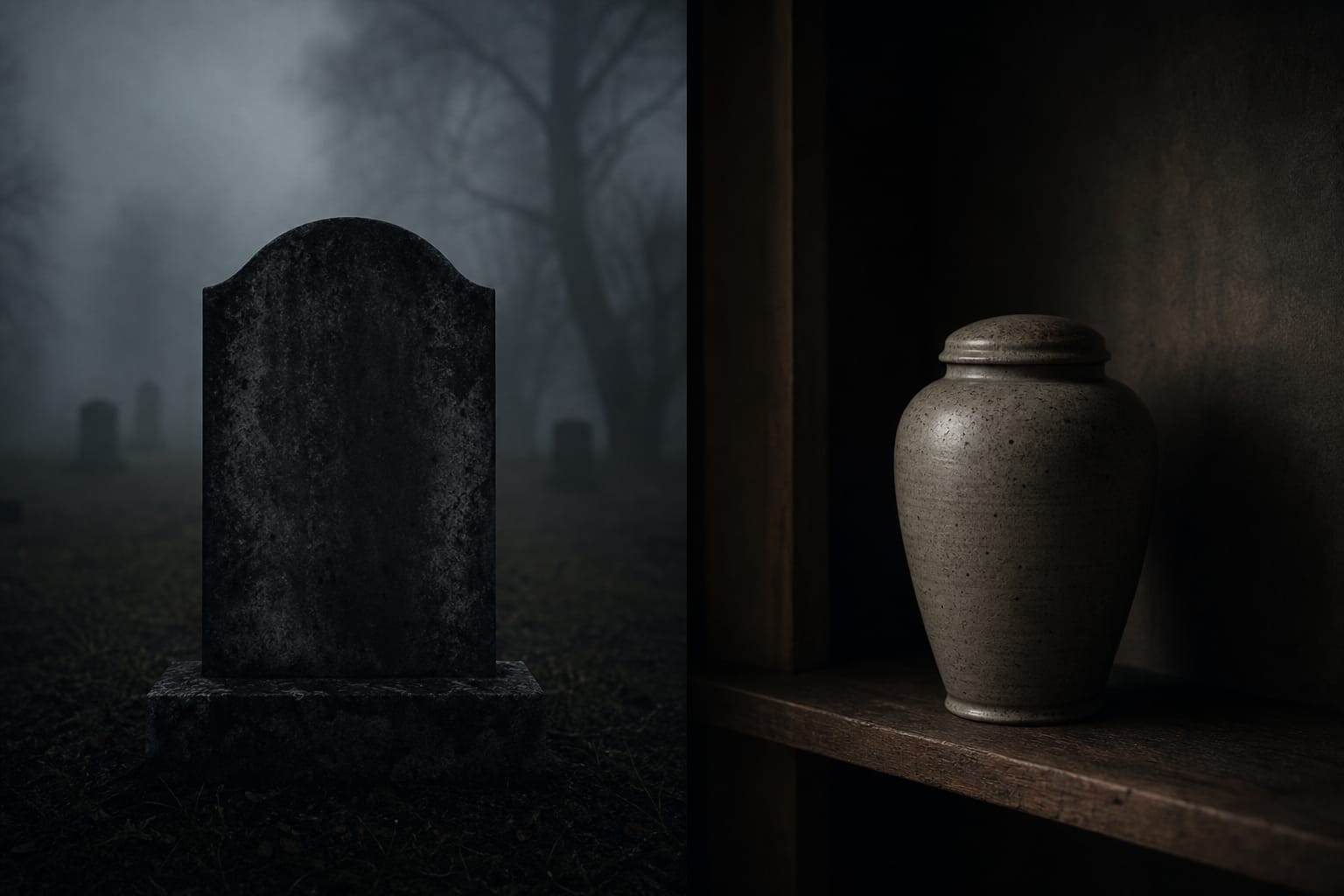
You're going to die. We all are. The full guide to how much a funeral costs in 2026 gives you the numbers for both options side by side. And if neither traditional burial nor cremation feels right, green burial is worth understanding. And when that happens, someone's got to do something with your body. For centuries, the default has been burial. But in recent decades, cremation has surged in popularity, often touted as the cheaper, greener, more modern option. But is it? When you strip away the euphemisms and the funeral industry's carefully crafted narratives, what's the real difference between putting a body in the ground and burning it to ash? Let's talk about the uncomfortable truths, the financial realities, the environmental consequences, and what actually happens to your physical form.

This isn't about telling you what to choose. It's about giving you the unvarnished facts so you can make an informed decision for yourself or your loved ones. Because with death, ignorance is not bliss; it's just expensive and often leaves a mess for someone else to clean up. We'll cover everything from the dollar signs to the decomposition, the carbon footprint to the legalities of scattering grandma's ashes.

Cremation and religion, plainly

Three religion questions come up constantly around cremation: what does the Bible say about cremation, is cremation a sin, and what does my tradition actually require. Plain answers, no theology-arguing.

The Bible does not forbid cremation. No verse prohibits burning a body. No verse commands burial as the only option. Burial was the standard Hebrew practice, but the Bible records cremation without condemning it: the men of Jabesh Gilead burned the bodies of Saul and his sons, then buried the bones (1 Samuel 31:11-13).[6] The Billy Graham Evangelistic Association states it directly: "The Bible does not give specific directions for the disposal of the body following death," and "at the resurrection it will not make any difference whether a person's body has been buried or cremated."[7] Is cremation a sin? No major Christian body teaches that it is, or that it blocks resurrection.

Catholic: permitted, with rules about the ashes. The Vatican lifted its ban in the 1963 instruction Piam et Constantem, and the 2016 instruction Ad resurgendum cum Christo sets the current rules. The Church raises no doctrinal objection because cremation "does not affect his or her soul," but it still prefers burial. Ashes must rest in a sacred place, a cemetery or a church. Scattering them, dividing them among relatives, keeping them at home, or wearing them as jewelry is not permitted.[8] If a Catholic funeral matters to you, plan for an urn in a cemetery niche or plot, not on the mantel.

Judaism: split. Orthodox Judaism prohibits cremation. Reform Judaism has permitted it since 1892; the Central Conference of American Rabbis affirms cremation as "an entirely proper procedure," though its recent guidance prefers burial and notes that cremation carries painful associations after the Holocaust.[9]

Islam: prohibited. Islamic law requires washing the body, shrouding it, praying the funeral prayer, and burying it promptly. Cremation is not permitted.[10] Hinduism expects cremation as the standard last rite, and cremation is common practice in Buddhism. The previous section covers the reasoning behind each of those stances.

The Cold, Hard Cash: Cremation vs. Burial Costs

Death is big business, and it's expensive. The primary driver for many choosing cremation is often cost, and for good reason. According to the National Funeral Directors Association (NFDA), the median cost of a traditional funeral with viewing and burial, including a vault, was around $9,420 in 2021. This figure doesn't even include the plot itself, which can add thousands more. For cremation with a viewing and funeral, the median cost was approximately $6,970. That's a significant difference, but it's crucial to understand what's included in those numbers.

A direct cremation, where the body is cremated shortly after death without embalming or a formal service, is often the cheapest option, ranging from $795 to $3,200. This is where the real savings lie. Traditional burial costs pile up quickly: embalming alone can be around $775, a metal casket averages $2,500, and a burial vault can add another $1,572. Funeral homes are masters of the upsell, and these costs can quickly balloon beyond initial estimates. While cremation can still involve expenses for urns, memorial services, and niches, it generally offers more flexibility to control costs and avoid the high-pressure sales tactics often associated with traditional funeral arrangements.

Your Body: The Afterlife of Flesh and Bone

What actually happens to your body after you die? In a traditional burial, if embalmed, your body is drained of blood and injected with chemicals like formaldehyde to temporarily preserve it. You're then placed in a casket, which is often sealed and lowered into a concrete or steel vault in the ground. Despite the embalming, decomposition is inevitable. It's a slower process, but over decades, your body will break down, the casket will eventually collapse, and you will return to the earth, albeit encased in man-made materials.

Cremation is a far more rapid and intense process. Your body, typically placed in a combustible container (often cardboard or a simple wooden box), is subjected to extreme temperatures, usually between 1,400 and 1,800°F, for 2-3 hours. During this time, soft tissues, organs, and fat are vaporized and oxidized. What remains are bone fragments, which are then cooled and processed in a machine called a cremulator to reduce them to the fine, granular substance we call 'ashes.' These 'ashes' are not soft powder but rather pulverized bone. It's a complete transformation, leaving behind only the mineralized remains.

Earth's Burden: The Environmental Impact

Many assume cremation is the 'green' choice, but the reality is more complex. Traditional burial, with its embalming fluids, non-biodegradable caskets, and concrete vaults, is undeniably harsh on the environment. Annually in the U.S., traditional burials introduce 2.5 million gallons of toxic embalming fluid (including nearly 100,000 gallons of formaldehyde, a known carcinogen) into the ground. They also consume vast amounts of resources: 20 million board feet of hardwood, 1.6 million tons of concrete, and 64,500 tons of steel. Cemeteries themselves occupy over 2 million acres of land, more than the combined area of Los Angeles, Chicago, New York City, and Houston.

However, cremation isn't without its own environmental footprint. The process requires immense energy, burning enough natural gas to heat a home for a week. A single cremation can release approximately 532 lbs of CO2 into the atmosphere. Annually, U.S. cremations release 360,000 tons of CO2, equivalent to powering 31,500 homes for a year. Furthermore, cremated remains themselves are not benign; they are highly alkaline (pH 11) and concentrated with sodium, making them toxic to plants and soil if scattered indiscriminately. Mercury from dental fillings can also be released into the air. While green burial, which involves no embalming, biodegradable shrouds or caskets, and no vaults, offers a truly eco-friendly alternative, both conventional burial and cremation have significant environmental costs.

God's Will: Religious Considerations

For many, the choice between cremation and burial is deeply intertwined with faith and tradition. Historically, most Christian denominations favored burial, rooted in the belief in the physical resurrection of the body. The Catholic Church, for instance, banned cremation for centuries, only lifting the prohibition in 1963, though it still prefers burial and requires cremated remains to be interred in a sacred place, not scattered or kept at home. Orthodox Judaism and Islam strictly forbid cremation, viewing it as a desecration of the body and contrary to their beliefs about the sanctity of human remains and the resurrection.

Conversely, some religions embrace cremation. Hinduism and Sikhism, for example, mandate cremation as a spiritual practice, believing it helps release the soul from the physical body and aids in the cycle of reincarnation. Buddhism generally accepts cremation, seeing the body as a vessel. Protestant denominations have largely become accepting of cremation, often leaving the choice to individual preference. It's essential to understand your own faith's stance, or that of your family, as these deeply held beliefs can significantly influence end-of-life decisions.

Where to Put the Ashes: Scattering Laws by State

So, you've got the ashes. Now what? Scattering a loved one's remains in a place that mattered to them sounds fitting, but the law isn't always on your side. The good news is that scattering ashes is legal in all 50 U.S. states, but the rules vary wildly depending on the location. Generally, you can scatter ashes on your own private property without a permit. If you want to scatter on someone else's private land, you need their explicit permission.

Public lands are trickier. National parks often require a permit and have designated scattering areas. State parks and other public lands have their own regulations, which can range from requiring permits to outright prohibitions. For scattering at sea, federal law requires it to be done at least three nautical miles from shore, and you must report the scattering to the EPA within 30 days. Scattering in inland waterways like rivers or lakes is typically governed by state environmental laws. Never scatter ashes near drinking water sources. Always check local and state regulations before you act, because a heartfelt gesture can quickly become a legal headache if you're not careful.

What You Can Do Right Now

The decision between cremation and burial is deeply personal, influenced by finances, environmental concerns, religious beliefs, and emotional comfort. The most important thing you can do is to talk about it. Don't leave your loved ones guessing or burdened with these choices during their grief. Here's how to take action:

  1. Educate Yourself: You've started that process by reading this. Keep researching, ask funeral directors direct questions, and don't be afraid to challenge assumptions.
  2. Talk to Your Family: Have an open, honest conversation with your family about your wishes. Make sure they understand your reasoning, whether it's cost, environmental impact, or spiritual beliefs.
  3. Document Your Wishes: Put your preferences in writing. This can be part of an advance directive, a will, or a separate document. Make sure someone you trust knows where to find it.
  4. Consider Pre-Planning: While not for everyone, pre-planning your arrangements can lock in costs and ensure your wishes are honored, relieving your family of significant stress and financial burden.
  5. Explore Alternatives: Look into green burial options or even aquamation if they align with your values and are available in your area. Death care is changing, and you have more choices than ever before.

Your death is inevitable. How your body is handled doesn't have to be a mystery or a source of conflict. Take control now, because you're going to die. Let's talk about it.

Sources & References

Research & Citations

All factual claims in this article are sourced from peer-reviewed research, government data, and named institutions. Citations follow APA 7th edition format.

  1. [1]National Funeral Directors Association. (2024). *NFDA cremation and burial report*. ↗ Source Retrieved July 2, 2026
  2. [2]Green Burial Council. (2024). *What is green burial?* ↗ Source Retrieved July 2, 2026
  3. [3]Cremation Association of North America. (2024). *Industry statistics*. ↗ Source Retrieved July 2, 2026
  4. [4]Federal Trade Commission. (2023). *The FTC Funeral Rule*. ↗ Source Retrieved July 2, 2026
  5. [5]Federal Trade Commission. (2024). *Funeral Industry Practices Rule (16 CFR Part 453)*. ↗ Source Retrieved July 20, 2026
ShareX / Twitter

Keep Reading

Planning

Green Burial: The Complete Guide to Eco-Friendly Death

From natural burial to human composting to aquamation. The alternatives to traditional burial and cremation are growing fast. Here's what's legal where.

12 min read
Grief

"Nobody Told Me There Would Be This Much Paperwork"

What actually happens in the 72 hours after someone dies. And why nobody prepares you for it.

8 min read
Planning

The Advance Directive: What It Is, Why You Need One, and How to Get It Done

An advance directive is the single most important document most people never write. Here's everything you need to know to actually complete one.

11 min read
Planning

How Much Does a Funeral Cost in 2026?

Planning for the inevitable? We break down the real costs of funerals and cremations in 2026, expose hidden markups, and arm you with the knowledge to avoid financial ruin.

10 min read
Culture

Body Donation to Science: What Actually Happens to Your Body

Considering donating your body to science? Let's cut through the euphemisms and talk about what really happens after you die.

10 min read
Planning

Cremation: What Actually Happens and What It Really Costs

A cremation takes about two hours at 1,400 degrees, and the price for the identical service varies by more than $2,000 within one city. Here is what actually happens and what you should pay.

9 min read
Planning

Water Cremation: How Alkaline Hydrolysis Works and Where It's Legal

Water cremation dissolves the body in water and potassium hydroxide instead of flame. Here is exactly how alkaline hydrolysis works, what it costs, and the 26 states where it is legal.

8 min read
Culture

What to Do With Cremated Ashes: Every Real Option

There is no deadline and no ranking. Every real option for cremated ashes, from the urn on the shelf to the EPA's three-mile rule at sea, with the laws attached.

9 min

The Death Dispatch

More stories like this, weekly.

A newsletter about death you'll actually look forward to reading.