End-of-Life CareJuly 2026 · 6 min read

Mottling and Skin Changes Before Death: What It Looks Like

The blotchy purple marbling on a dying person's feet and hands is called mottling. It looks alarming and it does not hurt them. Here is what it is, where it starts, what it means for timing, and how it looks on darker skin.

In This Article

Mottling is the blotchy, marbled purple-and-red discoloration that appears on a dying person's feet, knees, and hands in the last days or hours. It looks like something has gone badly wrong. It has not. It is a normal sign of circulation slowing down, and it does not hurt the person it appears on.

Families are often frightened by it because no one warned them. This page says plainly what mottling is, what causes it, where it starts, what it means for timing, and how it shows up on darker skin, where the marbling is harder to see. For the full picture of the last days, read what dying actually looks like.

What does dying skin look like?

In the last days, the skin changes in a few recognizable ways. It grows cool to the touch, starting at the hands and feet. It can turn pale or take on a waxy, yellowish look. And it develops mottling: blotchy, netlike patches of purple, red, and blue, most often on the feet, knees, and hands.[1][2]

These changes move inward over time, from the extremities toward the core, as the body pulls its remaining circulation to the vital organs. They are signs of the body shutting down, not of pain.

What is mottling before death?

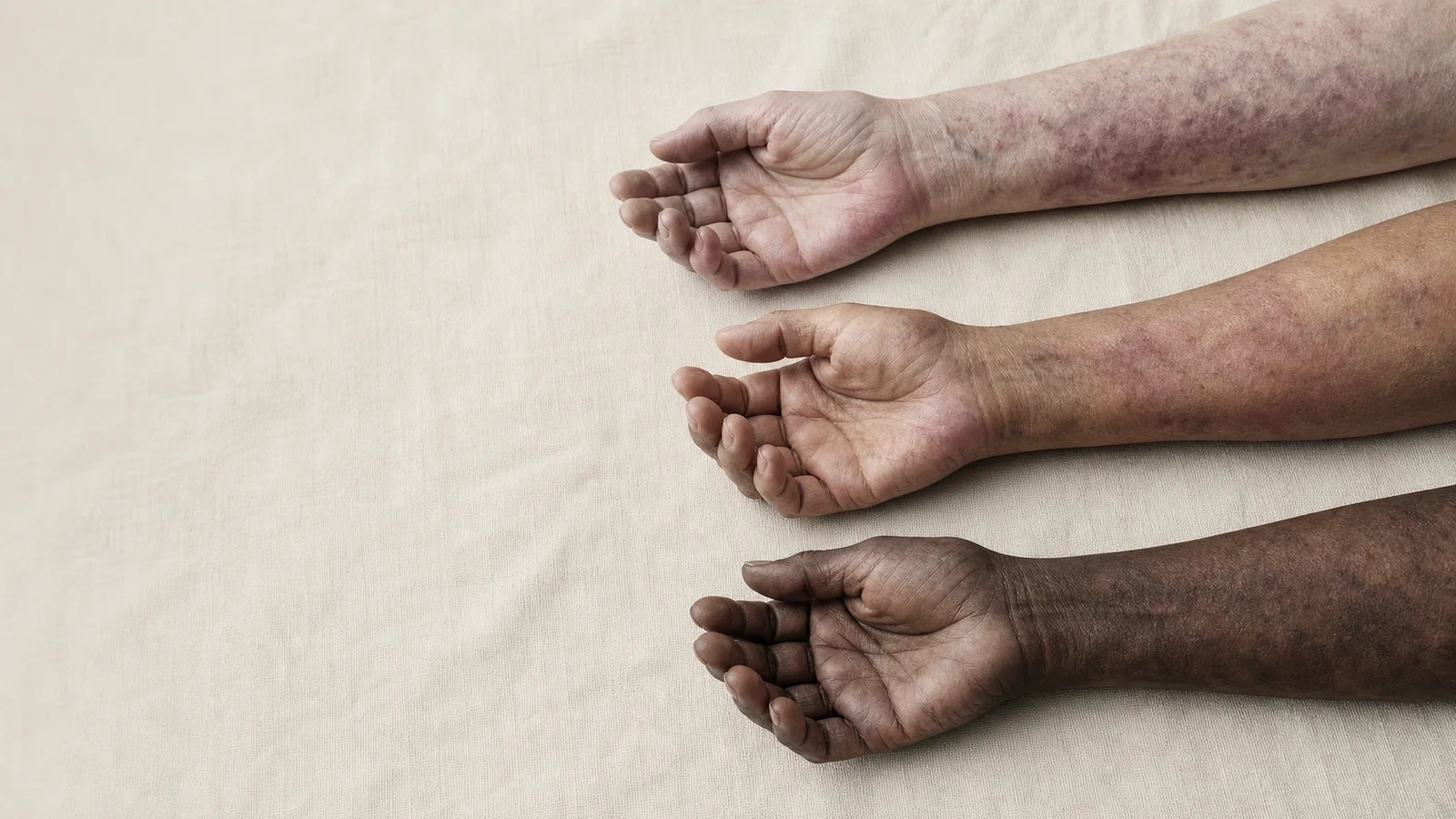
Mottling is a blotchy, marbled discoloration of the skin, purple, red, and bluish patches in a netlike pattern, that appears as a person nears death. The medical name for the color change is cyanosis when it is bluish, and the pattern is sometimes called livedo. On the feet and legs the blotches can be wide and dark, spread in a netlike pattern.[2]

It is one of the more reliable signs that a person has entered the active dying phase. It is also one of the most upsetting to see if you do not know what it is.

What causes mottled skin before death?

As the heart weakens near the end, it can no longer push blood strongly to the edges of the body. Circulation pulls inward to keep the vital organs supplied, so blood flow to the skin of the hands, feet, and knees drops. Blood pools and slows in those small surface vessels, and that pooling shows through the skin as the blotchy purple-red pattern.[1]

That is also why the mottled skin is cool: less warm blood is reaching it. It is a circulation change, not an infection, not a bruise, and not something that needs treating.

Where does mottling start?

Mottling usually starts at the feet and the knees, then the hands, because those are farthest from the heart and the first to lose steady blood flow. Over hours it can spread up the legs and arms toward the body.[2]

The soles of the feet often go first, turning dusky or purple. If you are watching for it, the feet and knees are where to look.

Does mottling mean death is near?

Usually, yes. Mottling most often appears in the last day or two of life, and once it spreads it is a sign that death is likely within hours to a couple of days. It is a rough marker, not a countdown; some people mottle earlier or for longer than others.[2]

If you are searching this at a bedside, mottling that is spreading is a signal to gather the people who want to be there and to keep the hospice team close. It is one of the clearer signs the body is in its final phase. For how the timing works overall, see how long the dying process takes.

What does mottling look like on darker skin?

On darker skin, mottling and the bluish color of cyanosis are much harder to see, and most descriptions and photos online show only light skin. On brown and Black skin the change often reads as darkening, an ashen or grayish tone, rather than an obvious purple marbling, so it can be missed.[3]

The reliable places to look are the areas with the least pigment: the palms of the hands, the soles of the feet, the lips, the gums and the inside of the mouth, the tongue, and the whites and inner lids of the eyes. On darker skin these areas may look gray, whitish, or dusky instead of pink. Pressing gently on a nail bed and watching the color return also helps. This is standard nursing guidance, and it matters: color changes that are easy to see on light skin are easy to miss on dark skin unless you know where to check.[3]

Does mottling hurt the dying person?

No. Mottling is a change in blood flow at the surface of the skin. It does not hurt, and the person, who is usually unresponsive by the time it spreads, is not aware of it.[1]

There is nothing you need to do to the skin itself. Keep the person comfortable and warm if they seem cold, and do not rub or massage the mottled areas hard. If anything about how they look worries you, the hospice nurse can tell you what is expected and what is not.

What other skin changes happen before death?

Alongside mottling, the skin usually turns cool, starting at the hands and feet and moving inward. It can become pale, or take on a waxy, slightly yellow cast. Some people sweat or feel clammy. Lips and nail beds may darken or turn dusky as oxygen levels fall.[1][2]

All of these are the outward signs of circulation and oxygen dropping as the body shuts down. None of them are emergencies, and none of them require you to do anything except keep the person comfortable. For the rest of what the last days look like, read what dying actually looks like.


This page is death education, not medical advice. Mottling is a normal sign of the body shutting down; if you are unsure what you are seeing, your hospice or palliative team can tell you. For where these facts come from, see our Sources and Methodology.

Sources & References

Research & Citations

All factual claims in this article are sourced from peer-reviewed research, government data, and named institutions. Citations follow APA 7th edition format.

  1. [1]National Institute on Aging. (2022). Providing care and comfort at the end of life. U.S. Department of Health and Human Services, National Institutes of Health. ↗ Source 2026-07-22
  2. [2]Hospice Foundation of America. (n.d.). Signs of approaching death. ↗ Source 2026-07-22
  3. [3]Sommers, M. S. (2011). Color awareness: A must for patient assessment. American Nurse Journal, 6(1). ↗ Source 2026-07-22
ShareX / Twitter

Keep Reading

End-of-Life Care

What Dying Actually Looks Like

The final days follow a pattern hospice nurses know by heart. The breathing changes. The eating stops. Here's what's normal, what's not, and why knowing the difference matters for the people in the room.

9 min read
End-of-Life Care

Breathing Changes and the Death Rattle at the End of Life

Near the end, breathing changes: long pauses, fast shallow breaths, and the wet gurgle called the death rattle. It frightens the room, not the dying person. Here is what each pattern is and what quiets it.

7 min read
End-of-Life Care

How Long Does the Dying Process Take?

The honest answer is a range, not a clock. Here are the real timeframes hospice families ask about: the long decline, the last weeks, the active dying phase, and how long after the death rattle or after eating stops.

7 min read
End-of-Life Care

Hospice: What Nobody Tells You Until You're In It

Hospice is one of the most misunderstood parts of end-of-life care. Most families say they wished they'd started it sooner. Here's what it actually is.

9 min read

The Death Dispatch

More stories like this, weekly.

A newsletter about death you'll actually look forward to reading.