
Law & Policy

Small Estate Affidavit: How to Collect a Bank Account Without Probate

When an account named no beneficiary and the estate is small, most states let an heir collect it with a sworn affidavit instead of a court case. How it works, the limits and waiting periods in six states, and when you need probate anyway.

A man fills out paperwork at a bank counter, in black and white

Someone died with money in a bank account in their name alone, and nobody was named on it. That money belongs to their estate, and the bank needs to know who has the right to collect it. If the estate is small, most states give the family a shortcut: a sworn statement called a small estate affidavit, which lets an heir collect the property without opening a probate case.

The rules are set state by state. Each state picks its own dollar limit, its own waiting period after the death, and what the person signing has to swear to. This page walks through how it works, with the statutes from six states, and points you to your own state's figures.
Check the account first

Before any affidavit, ask the bank one question: did the account name a payable-on-death beneficiary, or have a joint owner? If it did, the money goes to that person directly, and none of this applies. Our guide to payable-on-death accounts explains how that works.

An affidavit is for property that's still in the dead person's name alone, with no one named to receive it.

What you swear to

An affidavit is a statement you sign under oath. The person collecting the property gives it to the bank or whoever holds the property, and that institution can pay out on it. The statements differ by state, but they follow a pattern. In Washington, the person signing swears that:[1]

  • the property subject to probate, less liens and encumbrances, is worth $100,000 or less
  • 40 days have passed since the death
  • no one has applied to be appointed personal representative, or been appointed, anywhere
  • all of the person's debts, including funeral and burial expenses, have been paid or provided for

Minnesota and Virginia ask for a similar list with their own limits and waiting periods.[2][3] Virginia adds a requirement worth knowing before you start: the affidavit has to be made by all of the known successors.[2]

Read every line before you sign. You're swearing that the debts are handled and the estate is under the limit, so check both first.

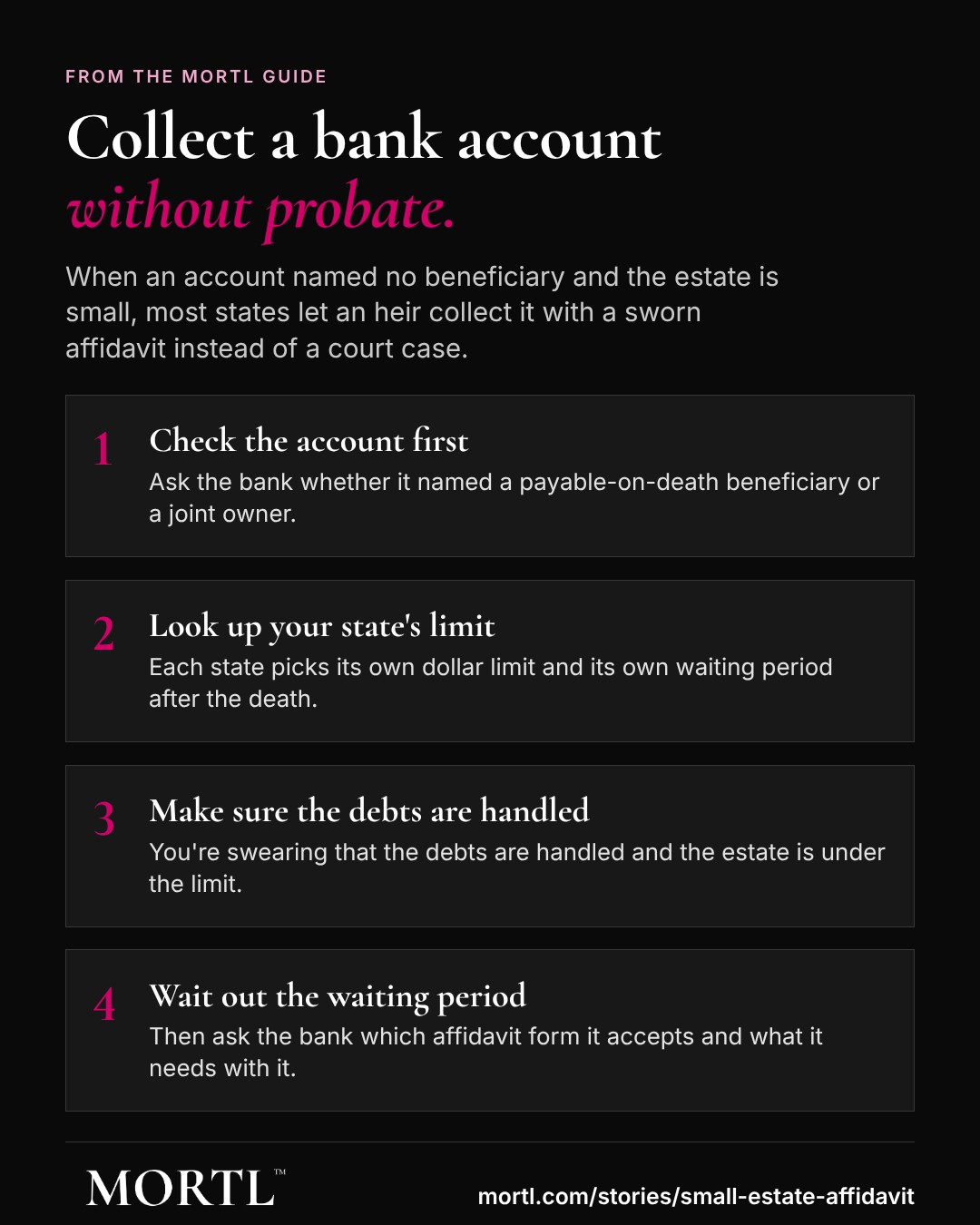
Four steps to collect a bank account without probate: check the account for a named beneficiary, look up your state's limit, make sure the debts are handled, and wait out the waiting period before giving the bank the affidavit.
The small estate affidavit in four steps. Your state guide has your limit and waiting period. Open the full-size image.

Limits and waiting periods

Here's how six states set it, from their statutes, read November 4, 2026:

  • Missouri: an estate of $40,000 or less, less liens, debts and encumbrances, 30 days after the death. When the property listed is worth more than $15,000, the clerk publishes a notice to creditors in a local newspaper.[4]
  • Minnesota: a probate estate of $75,000 or less, 30 days after the death.[3]
  • Virginia: a personal probate estate of $75,000 or less, 60 days after the death.[2]
  • Washington: $100,000 or less, 40 days after the death.[1]
  • Wyoming: $400,000 or less, 30 days after the death, the highest limit of the 51 jurisdictions in MORTL's state guides.[6]
  • Florida: no affidavit. A short court process called summary administration covers an estate of $150,000 or less, after property exempt from creditors is set aside, or any estate when the person has been dead more than 2 years.[5]

Every state's limit, waiting period and form are in its state guide. Some states use an affidavit you hand to the bank. Others, like Florida, use a quick court filing instead. A few count only certain kinds of property toward the limit, so read your state's note before you add things up.

What it covers, and what it doesn't

In Washington, Virginia and Minnesota, the affidavit collects personal property: bank accounts, money someone owed the person, and other belongings.[1][2][3] Many states leave real estate out of the shortcut, so an estate with a house in it can need probate even when its total value is modest. Missouri is one that reaches real estate: the affidavit is recorded with the recorder of deeds in each county where the property sits.[4] Your state guide says how your state handles a house.

The affidavit also stops working once someone has applied to be personal representative. Every statute above requires that no appointment is pending or has been granted.[1][2][3][4][6]

When the estate is over the limit

If the probate estate is worth more than your state's limit, or it includes property the affidavit can't move, someone has to open a probate case and be appointed personal representative before the bank will release the money. Our guides to how probate works and what an executor does cover that process.

Not sure whether the estate is over the limit? The free Do I need probate? checker walks through the basic questions.

What to do now

  1. Ask the bank whether the account had a payable-on-death beneficiary or a joint owner.
  2. If it didn't, look up your state's limit and waiting period in your state guide.
  3. Add up what's in the person's name alone, the property that would go through probate.
  4. Make sure the debts, including the funeral, are paid or provided for.
  5. Wait out the waiting period, then ask the bank which affidavit form it accepts and what it needs with it.

This page is general information from the state statutes it cites, read November 4, 2026. It isn't legal advice for your situation. If the estate is close to the limit, includes real estate, or the family disagrees, talk to a probate attorney in the state where the person lived.

Sources & References

Research & Citations

All factual claims in this article are sourced from peer-reviewed research, government data, and named institutions. Citations follow APA 7th edition format.

  1. [1]Washington State Legislature. (n.d.). RCW 11.62.010: Disposition of personal property, debts by affidavit, proof of death. ↗ Source Retrieved November 4, 2026
  2. [2]Virginia General Assembly. (n.d.). Code of Virginia § 64.2-601: Collection of personal estate by affidavit. Virginia's Legislative Information System. ↗ Source Retrieved November 4, 2026
  3. [3]Minnesota Office of the Revisor of Statutes. (n.d.). Minn. Stat. § 524.3-1201: Collection of personal property by affidavit. ↗ Source Retrieved November 4, 2026
  4. [4]Missouri Revisor of Statutes. (n.d.). Mo. Rev. Stat. § 473.097: Small estates, affidavit. ↗ Source Retrieved November 4, 2026
  5. [5]The Florida Legislature. (2026). Fla. Stat. § 735.201: Summary administration; nature of proceedings. ↗ Source Retrieved November 4, 2026
  6. [6]Wyoming State Legislature. (n.d.). Wyo. Stat. § 2-1-201: Collection of personal property by affidavit (Title 2, Wills, Decedents' Estates and Probate Code). ↗ Source Retrieved November 4, 2026

Share this story

Post it, or send it straight to the person who needs it. The link goes with it.

Keep reading on MORTL

Planning

Payable-on-Death Accounts: The Free Probate Shortcut

The bank will give you the form for free, and it beats your will for that account. That's the whole deal, and both halves of it matter.

9 min read
Law & Policy

How Long Does Probate Take? The Deadlines That Set the Clock

Probate timing depends on state law, creditor periods, assets, taxes, disputes, and court workload. This FAQ explains the milestones that control the calendar.

12 min read
Planning

What Does an Executor Actually Do?

An executor gathers records, protects estate property, handles probate, pays valid debts and taxes, reports to beneficiaries, and distributes what remains.

10 min read
Planning

How to Close Accounts After a Death: What Every Company Actually Requires

Closing accounts after a death is one of the most exhausting parts of settling an estate. Every company has different rules, some are helpful, and some aren’t. This guide tells you exactly what to expect and how to track it all.

10 min read