PlanningJuly 2026 · 7 min read

Who to Notify When Someone Dies

The calls you have to make after a death, grouped and in priority order. Family and the funeral home first, then government, money, the credit bureaus, and everything else, including the one call that stops thieves from opening accounts in the dead person's name.

In This Article

Nobody hands you the list. In the days after a death you are expected to know who to call, in what order, and which call is the one that stops fraud before it starts. Here is that list, grouped and in priority order.

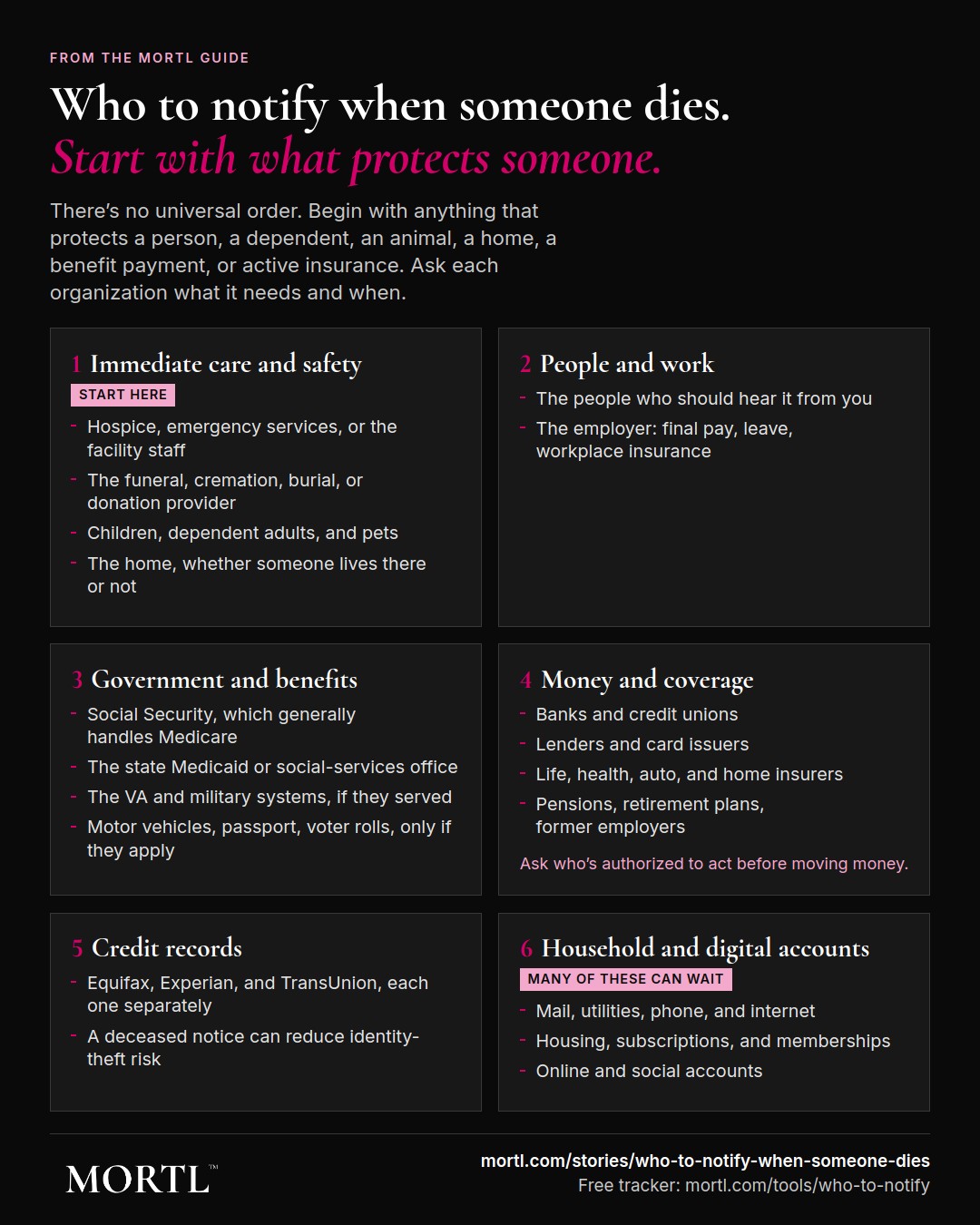
Start with the people, then the funeral home. Then work through government, then money, then the credit bureaus, then everything else. If you have been named executor, read what an executor actually does first, because most of these calls are yours to make. MORTL's checklist for when someone dies walks the same steps in the same order, and it stays free.

Who do you need to notify when someone dies?

Here is the whole list, in the order that matters. Work top to bottom. The first two groups are urgent; the rest can wait days or weeks.[2]

  1. First: people and the funeral home. Close family, then a funeral home or cremation provider. They collect the body and order the certified death certificates you will need for almost everything below.
  2. Government. Social Security first, then the VA if the person was a veteran, the state DMV, your local election office, and Medicare or Medicaid.
  3. Money. Banks and credit unions, mortgage and other lenders, credit card companies, life insurance, health, auto and home insurers, any pension or retirement plan, and both the former and current employer.
  4. Credit bureaus. One of Equifax, Experian, or TransUnion. This is the step that stops identity theft against the estate. Do not skip it.
  5. Everything else. Utilities, phone and internet, subscriptions and memberships, the post office for mail forwarding, and online and social accounts.

The sections below take each group in turn. For the mechanics of closing or transferring each account once you have made contact, see how to close accounts after a death.

Who do you call first when someone dies?

People first. Call the immediate family and anyone who needs to hear it from a person, not a group text. There is no agency deadline in the first hours. The only real task is telling the people closest to the death.

Then call a funeral home or cremation provider. If the death happened at home without hospice, call 911 first so the death can be pronounced; the checklist for when someone dies covers that order. The funeral home or crematory collects the body and, in most states, files the paperwork that produces the certified death certificate. Ask them directly how many certified copies they will order, and order more than they suggest. See how many you need below.

How do you report a death to Social Security?

Social Security has to be told, and told early. In most cases the funeral home reports the death to the Social Security Administration for you, using the deceased's Social Security number. It is not automatic and it is not guaranteed. Confirm the funeral home did it. If you are not sure, report it yourself by calling 1-800-772-1213 or visiting a local office. You cannot report a death to Social Security online.[1]

Once Social Security has the death on file, benefits stop. A person has to live the entire month to be owed that month's payment, and Social Security pays in the month after it is due, so a payment that arrives after the death usually has to be returned. Do not spend it. If benefits were direct-deposited, the bank is typically instructed to return the funds; if paper checks arrive, do not cash them.[1]

The same call is where survivor money starts. A surviving spouse or dependent child may qualify for monthly survivor benefits, and a surviving spouse who was living with the person, or an eligible dependent child, may receive a one-time lump-sum death payment of $255.[1] Reporting the death through Social Security also covers Medicare, so you do not have to notify Medicare separately.[2]

What government agencies do you notify when someone dies?

After Social Security, work through the rest of the government list. USA.gov keeps the full roster; these are the ones that matter for most families.[2]

  • Department of Veterans Affairs. If the person served, notify the VA. Surviving spouses and dependents may qualify for burial benefits, a survivor pension, or Dependency and Indemnity Compensation.
  • State DMV. Cancel the driver's license so it cannot be used for identity theft.
  • Local election office. Cancel the voter registration so the name comes off the rolls.
  • Medicare and Medicaid. Usually handled through the Social Security report above. Return any plan cards for Medicare Advantage or Part D.

The IRS is a government agency too, but you do not call it now. It is dealt with later, through the final tax return, covered below.

Which financial companies do you need to notify?

Money is the biggest group and the one where a written list pays off. You are notifying, and in some cases filing a claim or closing an account. Contact:[2]

  • Banks and credit unions. Checking, savings, and any safe deposit box.
  • Lenders. Mortgage, home equity, auto, student, and personal loans.
  • Credit card companies. Report the death and close the accounts.
  • Life insurance. This one is a claim, not a cancellation. Call to start it; the payout can cover funeral costs and bills.
  • Health, auto, and home insurers. Do not cancel auto or home coverage until the car is sold or the house is settled.
  • Pensions, retirement plans, and the former employer. Ask about survivor benefits and any unpaid balance.
  • The current employer. Final pay, unused leave, and any workplace life insurance or benefits.

Each of these has its own proof requirements and hold times. The step-by-step for banks, cards, insurers, and lenders is in how to close accounts after a death.

How do you notify credit bureaus when someone dies?

This is the call that prevents fraud, and most people miss it. Thieves use the Social Security numbers of people who have recently died to open credit cards and loans, because the accounts can sit unwatched for months. Flagging the credit file shuts that down.[3]

You do not have to contact all three bureaus. Notify one of Equifax, Experian, or TransUnion in writing, include a copy of the death certificate and proof that you are the executor or surviving spouse, and ask them to place a "deceased" flag on the file. The bureau you contact is required to pass the notice to the other two.[3][5]

A few weeks later, request a copy of the credit report to confirm the flag is on the file and no new accounts have appeared. If you want certainty instead of trusting the hand-off, there is no harm in sending the death certificate to all three. Report anything you do not recognize to the FTC at IdentityTheft.gov.[3]

Do you need to notify the IRS when someone dies?

Yes, but not by phone and not this week. The IRS is notified through the deceased's final income tax return, which reports income from January 1 through the date of death. The executor, or the surviving spouse on a joint return, files it on the normal schedule, by April 15 of the year after the death.[4]

If a refund is owed and you are not the surviving spouse, you may need IRS Form 1310 to claim it. If the estate earns income while it is being settled, that is a separate return. A death does not have to be reported to the IRS the day it happens; it is handled with the rest of the estate's paperwork.[4]

How many death certificates do you need?

More than you think. Order at least 10 certified copies, and order more if the person owned property, ran a business, or held accounts in several places. Many organizations, most banks, insurers, and government agencies among them, require an original certified copy with a raised or printed seal, not a photocopy, and they keep it.[2]

The funeral home or crematory usually orders the first batch when it files the death certificate. You can request more later from the state or county vital records office, but that takes time and costs more per copy, so it is cheaper and faster to over-order at the start. Utilities, subscriptions, and most online accounts will accept a scan or photocopy, so save your originals for the accounts that demand them.


This page is general information, not legal or financial advice. Rules on benefits, taxes, and credit reporting change, and some vary by state; confirm the current details with Social Security, the IRS, and the credit bureaus directly, or with an attorney. For the sources behind this guide, see our Sources and Methodology.

Sources & References

Research & Citations

All factual claims in this article are sourced from peer-reviewed research, government data, and named institutions. Citations follow APA 7th edition format.

  1. [1]Social Security Administration. (2025). *Survivors benefits: If a beneficiary dies*. ↗ Source 2026-07-22
  2. [2]USAGov. (2025). *What to do when someone dies*. ↗ Source 2026-07-22
  3. [3]Federal Trade Commission. (2024). *Identity theft*. ↗ Source 2026-07-22
  4. [4]Internal Revenue Service. (2025). *Deceased person*. ↗ Source 2026-07-22
  5. [5]Federal Trade Commission. (2024). *Credit freeze or fraud alert: what's right for your credit report?*. ↗ Source 2026-07-22
ShareX / Twitter

Keep Reading

Planning

How to Close Accounts After a Death: What Every Company Actually Requires

Closing accounts after a death is one of the most exhausting parts of settling an estate. Every company has different rules, some are helpful, and some are not. This guide tells you exactly what to expect and how to track it all.

10 min read
Planning

What to Do When Someone Dies at Home

What you do when someone dies at home depends on one thing: whether it was expected. If the person was on hospice, you call the hospice line, not 911. Here is what happens either way.

6 min read
Digital Legacy

Your Subscriptions Will Outlive You

Streaming, storage, software, the gym. Autopay doesn't know you're dead, and it keeps charging until someone makes it stop. Here's how estates end up paying for a dead person's Netflix.

5 min read
Planning

What Does an Executor Actually Do?

Being an executor is thankless, grinding paperwork. Here's the full, unvarnished truth about what the job entails, from death certificates to taxes.

13 min read

The Death Dispatch

More stories like this, weekly.

A newsletter about death you'll actually look forward to reading.