PlanningJuly 2026 · 6 min read

What to Do When Someone Dies at Home

What you do when someone dies at home depends on one thing: whether it was expected. If the person was on hospice, you call the hospice line, not 911. Here is what happens either way.

In This Article

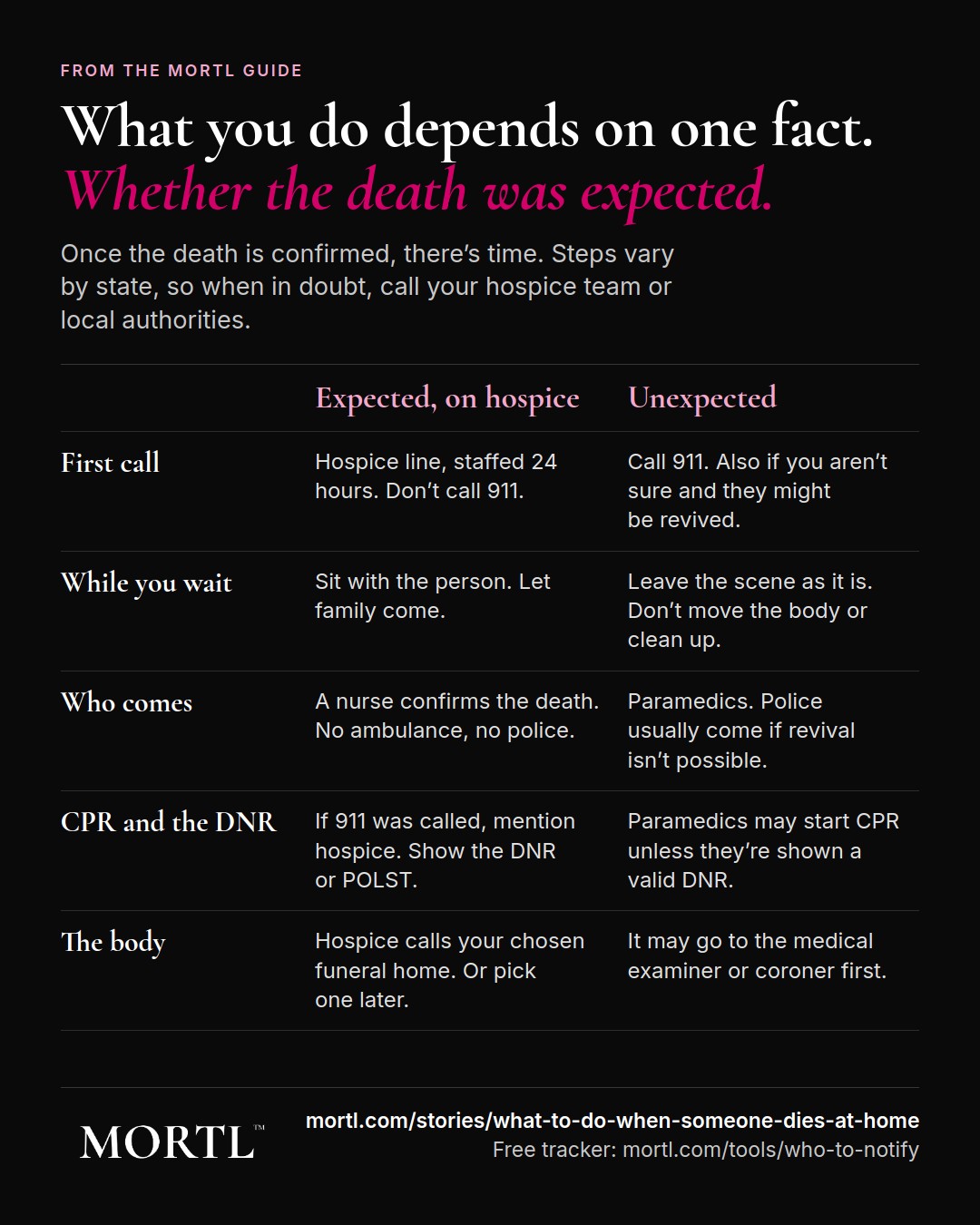
The first thing to know is that what you do depends on one fact: whether the death was expected. If the person was on hospice or under a doctor's care for a terminal illness, you do not call 911. If the death was sudden and nobody was expecting it, you do.

That one distinction changes who you call, who comes to the house, and how fast any of it happens. This page walks through both, plus the calmer things that are true either way: you are usually not on a clock, you choose who takes the body, and a lot of what feels urgent can wait an hour while you sit with the person. Steps vary by state, and where they do, this says so.
What do you do when someone dies at home?

Start by answering one question: was this expected? A death is expected when the person was on hospice or being treated by a doctor for a terminal illness, and the people around them knew it was coming. It is unexpected when it is sudden, an apparent heart attack, an accident, a person found dead, and no doctor was managing an end-of-life illness.[1]

If it was expected and the person was on hospice, call the hospice line. It is staffed 24 hours a day. Do not call 911. If it was unexpected, or you are not sure and the person might still be revived, call 911.

Either way, you do not have to move fast on everything. Once the death is confirmed, there is time. You can sit with the person. You can call family. The paperwork and the funeral home come after, and they can wait an hour or two.

Do you call 911 when someone dies at home?

Call 911 only if the death was unexpected, or if there is any chance the person can still be revived and you want them revived. When you call 911, paramedics respond, and unless there is a valid do-not-resuscitate order in front of them, they may start CPR and take the person to a hospital.[1]

If the person was on hospice, 911 is the wrong number. It can trigger a resuscitation attempt and an ambulance ride the person specifically chose to avoid. Call the hospice line instead. If someone has already dialed 911 out of reflex, tell the dispatcher the person was on hospice and have the DNR or POLST form ready to show the crew.[2]

What happens when someone dies at home on hospice?

Call the hospice team's number. It is answered around the clock. Tell them the person has died. They will talk you through what happens next and send a nurse to the house.[2]

There is no ambulance and no police. The hospice nurse comes to confirm the death, note the time, and contact the physician who will sign the death certificate. If you have chosen a funeral home or cremation provider, the nurse or the hospice office will call them to come collect the body; if you have not chosen one yet, you have time to decide. The nurse can also handle the person's medications, including controlled drugs, so they are disposed of properly.[3]

Until then, there is nothing you have to do. Sit with the person. Let family come. Hospice does not put you on a clock. If you want to understand what the days before this look like, read what nobody tells you about hospice.

What do you do when someone dies unexpectedly at home?

Call 911 first. Dispatch will send paramedics, and depending on what they find they may try to revive the person or confirm that they have died. If the person cannot be revived, police usually come to the house as well.[1]

When a death is sudden, unattended, or has no clear cause, the case is often referred to the county medical examiner or coroner. That office decides whether to examine the body to determine how the person died, and in many cases it will take the body for that before it goes to a funeral home.[4]

Until responders arrive, leave the scene as it is. Do not move the body, clean up, or throw anything away. If there will be an investigation, that matters. This is procedure, not suspicion.

Why do the police come when someone dies at home?

When a death happens outside a hospital and was not expected, police response is standard. An officer confirms what happened, secures the scene, and waits for the medical examiner or coroner if one is being sent. In most places this is required any time someone dies without a doctor already attending a known illness.[4]

The police being there is routine procedure for a death at home, not a sign that anyone is suspected of anything. You may be asked plain questions: when you last saw the person alive, what medications they took, whether they had been ill. Answer plainly. It helps the medical examiner sign the cause of death without a longer investigation.

Who pronounces someone dead at home?

It depends on who is there and on the laws of your state. A hospice nurse can confirm and record a death at home for a patient on their service. Paramedics can pronounce death in the field in many places. A physician can do it. When a medical examiner or coroner is involved, that office makes the official determination.[2]

The rules for exactly who is allowed to pronounce death, and what has to happen next, are set state by state, and sometimes county by county. There is no single national rule. If you are unsure who to call in your state, your hospice team knows, and so does the non-emergency line for your local authorities.[4]

How long can a body stay at home after death?

You are not on a deadline measured in minutes. After the death is confirmed, most families spend some time with the person and then call a funeral home or cremation provider, who usually arrive within a few hours. Nothing bad happens because you waited an hour to make that call.[1]

A body does begin to change after death, and without cooling that becomes noticeable within roughly a day. Some families choose a home vigil and keep the person at home longer, using cooling to slow those changes; whether and how you can do that is set by state law. If it is something you want, ask the funeral home or a home-funeral guide about the rules where you live.[3]

What happens to the body after a home death?

You decide who takes the body. A funeral home or cremation provider comes to the house, moves the person, and holds them while you make arrangements. You are not required to use whoever the responders suggest, and you do not have to have picked one before the death; you can decide afterward.[1]

If a medical examiner or coroner took the body to determine the cause of death, they release it to the funeral home you choose once they are done. Someone may also raise organ or tissue donation, especially if the person was registered; that decision has a short window, and the hospice team or hospital can tell you what is possible.[3]

From there the logistics begin. Our guide to arranging a funeral covers what comes next, and closing accounts after a death covers the paperwork. For a step-by-step list you can work through in order, use the when someone dies checklist.


This page is general information, not legal or medical advice. Steps vary by state; when in doubt, call your hospice team or your local authorities. For our sources and how we check them, see our Sources and Methodology.

Sources & References

Research & Citations

All factual claims in this article are sourced from peer-reviewed research, government data, and named institutions. Citations follow APA 7th edition format.

  1. [1]USAGov. (2024). *Dealing with the death of a loved one*. ↗ Source 2026-07-22
  2. [2]Hospice Foundation of America. (2024). *When death happens at home*. ↗ Source 2026-07-22
  3. [3]NHPCO CaringInfo. (2024). *After a death: What to do*. ↗ Source 2026-07-22
  4. [4]Centers for Disease Control and Prevention, National Center for Health Statistics. (2024). *Death investigation systems*. ↗ Source 2026-07-22
ShareX / Twitter

Keep Reading

Planning

How to Close Accounts After a Death: What Every Company Actually Requires

Closing accounts after a death is one of the most exhausting parts of settling an estate. Every company has different rules, some are helpful, and some are not. This guide tells you exactly what to expect and how to track it all.

10 min read
Planning

How to Arrange a Funeral, Step by Step

Somebody has to make the calls. Here is the order that saves money and second trips, and what the law requires versus what the funeral home wants you to think it requires.

9 min read
End-of-Life Care

What Dying Actually Looks Like

The final days follow a pattern hospice nurses know by heart. The breathing changes. The eating stops. Here's what's normal, what's not, and why knowing the difference matters for the people in the room.

9 min read
End-of-Life Care

Hospice: What Nobody Tells You Until You're In It

Hospice is one of the most misunderstood parts of end-of-life care. Most families say they wished they'd started it sooner. Here's what it actually is.

9 min read

The Death Dispatch

More stories like this, weekly.

A newsletter about death you'll actually look forward to reading.