Law & PolicyJuly 2026 · 5 min read

The Funeral Rule: The Federal Law Funeral Homes Hope You've Never Heard Of

Since 1984, federal law has required funeral homes to hand you itemized prices and let you buy only what you want. Most people have no idea it exists. Which is exactly how overspending happens.

A price tag containing an itemized list, illustrated in bone white on a dark background

In This Article

You are never a worse shopper than in the week someone you love dies.

You’re exhausted, guilty, on a deadline, and sitting across a desk from a professional who sells this product every day. You will never have less leverage in any purchase in your life. The funeral industry knows this. So, in 1984, did the Federal Trade Commission.

That’s why the Funeral Rule exists. It’s a federal regulation that hands you a specific set of rights the moment you ask a funeral home about anything. Most people have never heard of it, which means most families never learn they can push back on the price at all.

Here’s the whole rule, translated.

Where it came from

Before 1984, the FTC’s investigations of the funeral industry documented a pattern: families told embalming was legally required when it wasn’t, refusal to give itemized prices, bundled packages that forced you to buy things you didn’t want, and a lock on casket sales that kept prices high.

The Funeral Rule, formally the Funeral Industry Practices Rule, 16 CFR Part 453, was built to dismantle exactly those practices. It applies any time you deal with a funeral provider, whether you’re planning ahead or someone just died.

Your rights, itemized

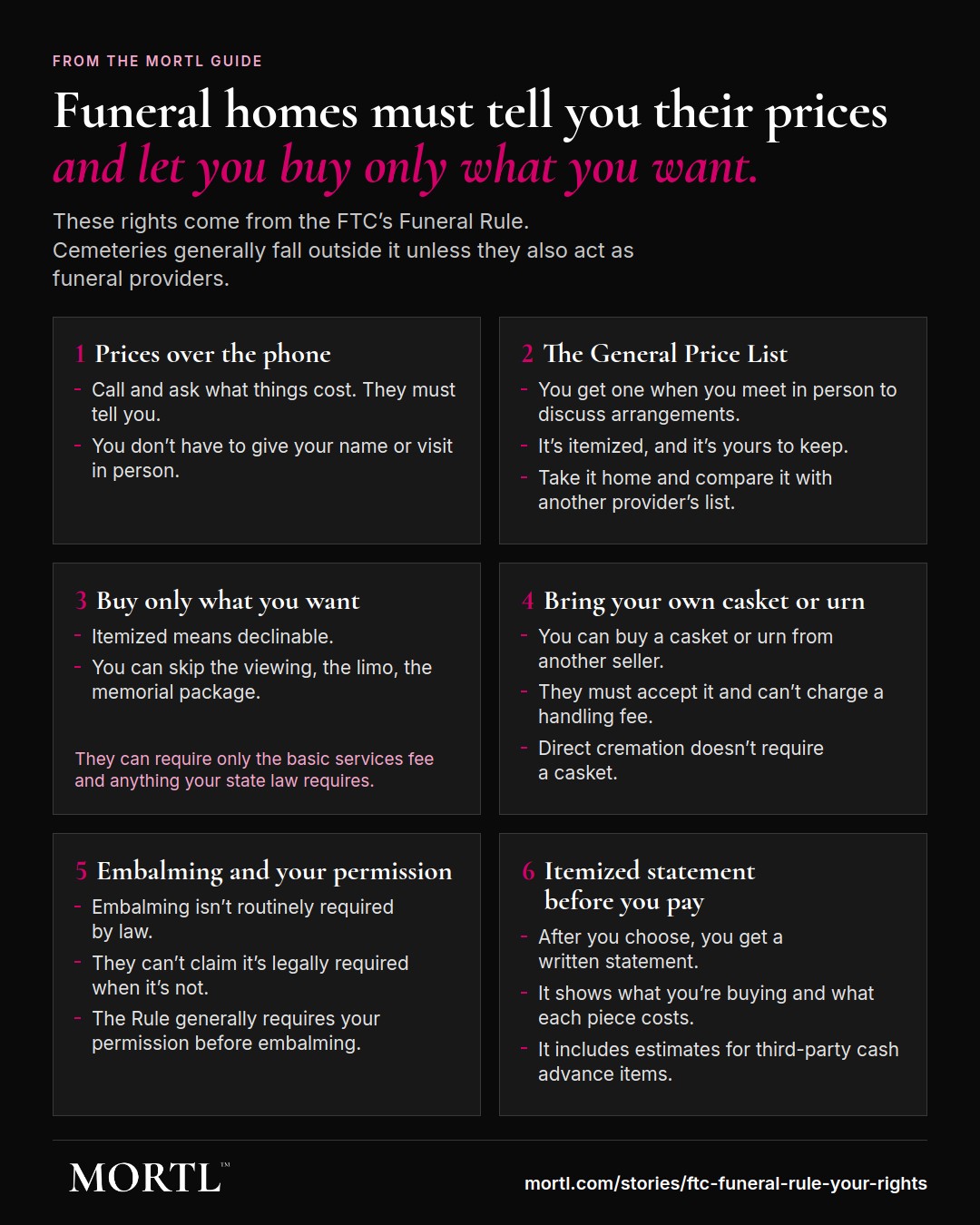
Prices over the phone. Call any funeral home and ask what things cost, and they must tell you. You don’t have to give your name. You don’t have to come in. This single right is the foundation of comparison shopping, and a 2023 FTC undercover phone sweep targeted providers who dodge it.

The General Price List, yours to keep. Walk in and ask about arrangements and they must hand you a printed, itemized price list at the start of the conversation. Not a brochure. Not a package menu. Every good and service, individually priced. You can take it home and put it next to the other funeral home’s list.

Buy only what you want. Itemized means declinable. You can skip the viewing, the limo, the “memorial package.” The only fee they can make non-declinable is the basic services fee, plus anything your state law actually requires, which must be cited on the price list by name.

Bring your own casket, fee-free. The casket is historically the biggest markup in the building. The Rule says you can buy one anywhere, including online at a fraction of the price, and the funeral home must accept it without charging a handling fee or being difficult about it. Same for urns.

No embalming lies. Embalming is rarely required by law. The Rule prohibits claiming otherwise, requires disclosure that you usually have the right to decline it, and generally requires permission before they embalm. Direct cremation and direct burial don’t need it, and for cremation they must offer an inexpensive alternative container. Nobody needs a mahogany casket for a fire.

An itemized statement before you pay. After you choose, you get a written Statement of Funeral Goods and Services Selected showing exactly what you’re buying and what each piece costs, including estimates for third-party “cash advance” items.

Violations carry civil penalties that currently run over $50,000 per violation, and the FTC runs undercover inspection sweeps to catch them.

The hole in the rule

Now the part MORTL exists to say out loud: the Funeral Rule was written in 1984 and still assumes you shop by telephone and handshake.

As of 2026, it does not require funeral homes to post prices online. The FTC has had a proceeding open since 2022 considering exactly that amendment, and consumer research has repeatedly found that only a small minority of funeral home websites display a full price list. The industry has lobbied on this for years. Until the rule changes, the price list you’re legally owed lives behind a phone call or a visit, which is precisely where a grieving person is least likely to push.

Two more gaps. Cemeteries generally fall outside the Rule unless they’re also functioning as funeral providers, so plots, vaults, and “perpetual care” fees live in a thinner regulatory world. And pre-need contracts, where you pay now for a funeral later, are governed by state law, which ranges from strict to barely there.

How to actually use it

The median cost of a funeral with viewing and burial runs north of $8,000 before the cemetery, per the industry’s own surveys. Cremation-based funerals typically run less but still thousands. The spread between funeral homes in the same city can be enormous for identical services. So:

Call three funeral homes minimum. Ask for prices on the specific things you want. They must answer.

Get the General Price List from any you visit. Take it home. Decisions made outside the building are better decisions.

Decline freely. Packages are a bundling strategy, not a kindness.

Price caskets independently before you look at theirs.

If a provider refuses phone prices, won’t produce the list, or claims embalming is legally required, leave, then report them at ReportFraud.ftc.gov. You’d be doing the next family a favor.

And if you want the shopping done before anyone is crying, that’s the entire argument for planning ahead. You can also start from our directory of providers, sorted by state.

The bottom line

The Funeral Rule is forty years old, imperfect, and still the strongest protection you have: itemized prices, phone quotes, outside caskets, no forced bundles, no embalming myths. It only works if you know it exists. Now you do. Use it while you’re calm, or hand this article to whoever will be making the calls for you.


Sources: FTC Funeral Industry Practices Rule, 16 CFR Part 453; FTC, “Complying with the Funeral Rule”; FTC Funeral Rule review and ANPR proceedings (2020-2022, open as of 2026); FTC undercover sweep announcements (2023-2024); NFDA member price surveys; Consumer Federation of America funeral pricing studies. See our Sources & Methodology.

This article is education, not legal advice. For disputes with a funeral provider, contact your state funeral board or the FTC.

ShareX / Twitter

Keep Reading

Culture

Cremation vs. Burial: What Nobody Tells You

Forget the euphemisms. Let's talk about what really happens to your body, your wallet, and the planet when you choose cremation or burial.

15 min read
Planning

The Real Cost of Dying Unprepared: A Financial Breakdown

Ignoring death leaves a colossal mess for your loved ones. This article breaks down what dying without a plan actually costs.

10 min read
Grief

"Nobody Told Me There Would Be This Much Paperwork"

What actually happens in the 72 hours after someone dies. And why nobody prepares you for it.

8 min read
Planning

Cremation: What Actually Happens and What It Really Costs

A cremation takes about two hours at 1,400 degrees, and the price for the identical service varies by more than $2,000 within one city. Here is what actually happens and what you should pay.

9 min read
Planning

How to Arrange a Funeral, Step by Step

Somebody has to make the calls. Here is the order that saves money and second trips, and what the law requires versus what the funeral home wants you to think it requires.

9 min read
Planning

Casket Prices: What They Cost and Why the Markup Is Legal

The median metal casket at a funeral home is $2,500. The same gauge of steel sells online for $1,199, and the funeral home has to accept it. Here is how casket pricing actually works.

9 min read

The Death Dispatch

More stories like this, weekly.

A newsletter about death you'll actually look forward to reading.