
Planning

How to Choose and Compare Funeral Homes: Services, Prices, and Trust Checks

The same funeral can cost thousands more at one funeral home than at the next. How to get every home's prices, compare them line by line, and check who you're trusting with the body.

A woman at a kitchen table at night comparing two funeral home price lists, in black and white

Consumer groups that collect funeral home price lists have found differences of up to 400 to 500 percent for the same services.[1] Federal law gives you what you need to compare: every funeral home has to quote prices over the phone and hand you an itemized price list.[2] Few families shop around.

In a May 2022 Ipsos survey cited by the Funeral Consumers Alliance and the Consumer Federation of America, 20 percent of the 1,146 people who had helped plan a funeral said they’d visited more than one funeral home to get price lists.[1]

Here’s how to compare funeral homes in an afternoon, on the phone, before anyone signs anything.
Why compare funeral homes at all?

Because the price of the same thing moves a lot from one business to the next. The National Funeral Directors Association’s most recent price study put the national median for a funeral with viewing and burial at $8,300, and for a funeral with viewing and cremation at $6,280.[3] Neither figure includes the cemetery, a grave marker, or cash advance items such as flowers or an obituary.[3]

Direct cremation shows the spread most clearly, because the service is close to identical everywhere.[5] US Funerals Online, citing Funeralocity’s 2026 price data, puts the national average at $2,202, with state averages from $1,264 in Oregon to $3,183 in North Dakota. Data from its sister cremation network shows the same direct cremation can differ by more than $2,000 within one city.[4]

What do funeral home services include?

A funeral home sells services and goods, and the Funeral Rule makes it list both on its General Price List. Read the list and you’ll see what the funeral home does.[2]

  • Basic services of the funeral director and staff. The arrangements conference, planning the funeral, getting the permits, and placing obituary notices, plus the funeral home’s overhead. This is the one fee a funeral home can make non-declinable.[2]
  • Moving the body. Transfer of the body to the funeral home, and forwarding a body to or receiving one from another funeral home.[2]
  • Care of the body. Embalming, and other preparation such as dressing, grooming and cosmetology.[2][3]
  • Facilities and staff. For a viewing, a funeral ceremony or a memorial service, and equipment and staff for a graveside service.[2]
  • Vehicles. A hearse and a limousine.[2]
  • Simple arrangements. Direct cremation and immediate burial, each listed with a price range if the funeral home offers them.[2]
  • Goods. Caskets and outer burial containers, priced on their own lists or in full on the General Price List.[2]

Funeral homes also arrange things they buy from someone else on your behalf, such as flowers, the obituary or a clergy honorarium. Those are cash advance items, and the written statement you get has to list them.[2]

Decide what you’re comparing first

A quote only means something next to a quote for the same arrangement. Pick one before you call:

  • Direct cremation. Cremation without a viewing or a ceremony with the body present.
  • Immediate burial. Burial without a viewing or ceremony first.
  • Cremation with a viewing and service.
  • Burial with a viewing and service.

The first two are easy to compare because the Funeral Rule makes every funeral home that offers them print their prices on its General Price List.[2] For the other two, write down the pieces you want (viewing, ceremony, hearse, casket) and ask each home to price the same pieces.

How do you get a funeral home’s prices?

Four ways, from fastest to slowest:

  • Check the website. Federal law doesn’t require online prices. California requires online posting, though some homes there use a loophole in the law to avoid it.[1] When the Consumer Federation of America and the Funeral Consumers Alliance checked 1,046 funeral home websites in 35 state capitals in 2022, 191 of them, 18 percent, posted their price lists.[1]
  • Call. A funeral home has to tell anyone who asks by phone accurate information from its price lists.[2] You don’t need an appointment.
  • Visit. When you ask in person about arrangements or prices, the funeral home has to give you its General Price List to keep.[2] Take it home.
  • Look for a local price survey. Funeral Consumers Alliance affiliates publish price surveys built from funeral homes’ General Price Lists. The alliance lists surveys covering all or part of 18 states and Washington, D.C., with statewide surveys in Arizona, Colorado, Georgia, Idaho, Maryland, Delaware, North Carolina, Utah and Washington.[5]

Compare the price lists line by line

Every General Price List itemizes the same categories, because the Funeral Rule names them.[2] Line the lists up side by side and compare each row. The national medians below come from the NFDA’s 2023 study.[3]

Line on the price listWhat it pays forNFDA 2023 median
Basic services feeArranging the funeral, permits, overhead. The one fee you can’t decline.$2,495
Transfer of remainsBringing the body to the funeral home$395
EmbalmingChemical preservation, usually for a public viewing$845
Other preparationDressing, cosmetics, casketing$295
Facilities and staff for viewingThe room and staff for a visitation$475
Facilities and staff for the ceremonyThe room and staff for the funeral$550
HearseCarrying the casket to the cemetery$375
Service car or vanErrands and transport$175
Metal burial casketThe casket, if you buy it here$2,500
Cremation feeThe cremation itself$400
Alternative cremation containerThe box used for cremation$160

NFDA’s burial table prints the basic services fee as $2,459. The cremation table prints $2,495 with the same 8.5 percent change from 2021, and the burial items add up to the $8,300 median only with $2,495, so this guide uses $2,495.[3]

The basic services fee is the only charge the Funeral Rule lets a funeral home make non-declinable.[2] Every other line is optional unless a law, your cemetery or the crematory requires it, and the funeral home has to explain any such requirement in writing.[2] So compare two totals for each home: the total for exactly what you want, and the basic services fee alone. The second number tells you what the home charges before you buy anything.

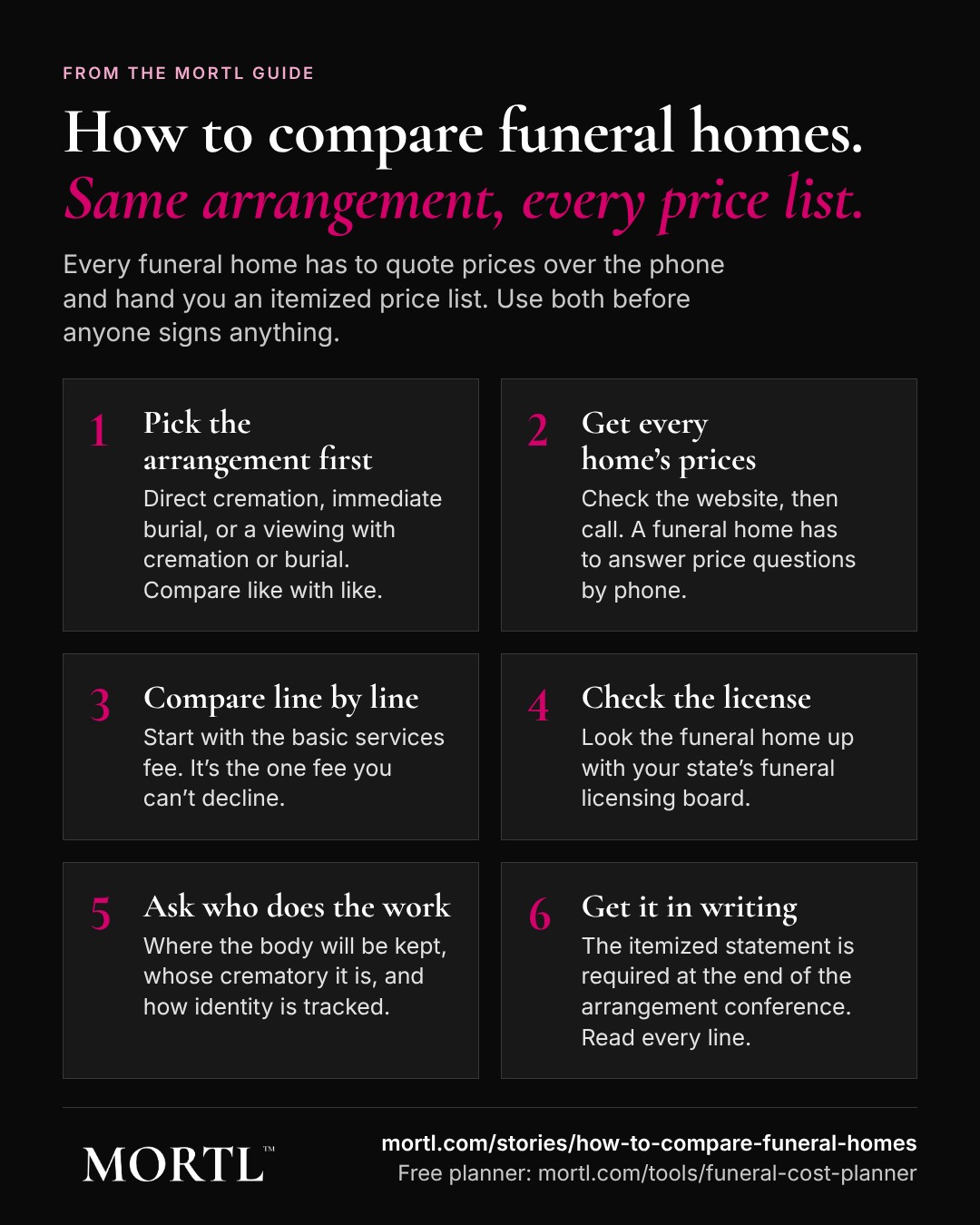
Card with six steps for comparing funeral homes: pick the arrangement first, get every home’s prices by website or phone, compare line by line starting with the basic services fee, check the license with the state funeral board, ask who does the work, and get the itemized statement in writing.
The six steps in one image. Send it to whoever is making the calls. Open the full-size image.

Check the license and who owns it

Price is half of the decision. The other half is who will have custody of the body.

  • The license. Look the funeral home up with your state’s funeral licensing board or the agency that registers funeral establishments. The agency’s name varies by state. Confirm the license is active and ask whether there’s any disciplinary record.
  • Who owns it. In 2022, Service Corporation International, which owns the Dignity Memorial brand, controlled about 10 percent of the roughly 19,000 funeral homes in the U.S., and none of the 102 Dignity Memorial homes in the consumer groups’ website review posted prices online.[1] Ask who owns the business before you sign.
  • Who does the work. Ask where the body will be kept, whether the crematory is the funeral home’s own or a third party’s, and how the body’s identity is tracked from pickup to the return of the remains.

What to ask each funeral home on the phone

  • What’s your total price for [the arrangement you picked], and what does it include?
  • What is your basic services fee?
  • What cash advance items should I expect, such as death certificates and an obituary, and what are your estimates for them?
  • Do you require embalming for a viewing, and is embalming required by law for what I’m planning?
  • If I buy a casket or urn somewhere else, will you charge anything to use it?
  • Is your crematory on site? If not, whose is it?
  • When is payment due, and will I get an itemized written statement before I pay?

Write the answers next to each home’s name. The written statement is required: at the end of the arrangement conference, the funeral home has to give you an itemized statement of every good and service you chose and its price.[2]

Red flags, and where to report them

Each of these breaks the Funeral Rule:[2]

  • Refusing to give prices over the phone, or refusing to give you the General Price List when you ask in person.
  • Saying a casket is required for direct cremation, or not offering an alternative container.
  • Embalming for a fee without your approval when no law required it.
  • Making you buy one item to get another, or charging fees beyond the basic services fee, what you chose, and what a law, cemetery or crematory requires and the home explains in writing.

If you run into one, call the next funeral home on your list, and report it to the FTC at ReportFraud.ftc.gov and to your state’s funeral board.

Where MORTL fits

MORTL’s funeral home directory lists funeral homes by state after checking each one’s phone and address against its own website. A listing isn’t an endorsement, and MORTL doesn’t check funeral home licenses, so do that step yourself. The free funeral cost planner prices the same lines a General Price List does, so you can see what a fair total looks like before you call. For the full cost picture, read how much a funeral costs in 2026, and for every right the Funeral Rule gives you, read the Funeral Rule guide.

Common questions

Do funeral homes have to post prices online?

Federal law doesn’t require it. The Funeral Rule requires prices by phone and a General Price List you can keep when you ask in person. California requires online posting, and in a 2022 review of 1,046 funeral home websites in 35 state capitals, 18 percent posted them.

Can a funeral home refuse to give prices over the phone?

No. The Funeral Rule requires a funeral home to give anyone who asks by phone accurate information from its price lists. You don’t have to visit first.

What services does a funeral home provide?

The basic services of the funeral director and staff, transfer and care of the body, facilities and staff for a viewing, ceremony or memorial service, a hearse and limousine, direct cremation and immediate burial, and caskets and burial containers. Each of these has to appear on its General Price List if the funeral home offers it.

What is the basic services fee?

It’s the funeral home’s charge for its basic services, such as the arrangements conference, planning the funeral, getting permits and placing obituary notices, plus its overhead. It’s the one fee the Funeral Rule lets a funeral home make non-declinable. The NFDA’s 2023 median was $2,495.

Can I bring a casket or urn I bought somewhere else?

Yes. The Funeral Rule bars a funeral home from making you buy one item to get another, and from charging any fee beyond the basic services fee, the items you chose and the items a law, cemetery or crematory requires and the home explains in writing. A handling fee for your own casket or urn falls outside those.

Is a cheaper funeral home a worse one?

Price alone doesn’t tell you. Check the license with your state’s funeral board, ask who will care for the body and where, and get every price in writing before you sign.

Sources & References

Research & Citations

All factual claims in this article are sourced from peer-reviewed research, government data, and named institutions. Citations follow APA 7th edition format.

  1. [1]Consumer Federation of America & Funeral Consumers Alliance. (2022, June 21). Only 18 percent of 1,046 funeral homes in 35 cities post price lists online [Press release]. ↗ Source Retrieved November 4, 2026
  2. [2]Funeral Industry Practices, 16 C.F.R. Part 453. Electronic Code of Federal Regulations. ↗ Source Retrieved November 4, 2026
  3. [3]National Funeral Directors Association. (2023, December 8). 2023 NFDA General Price List Study shows inflation increasing faster than the cost of a funeral [Press release, PDF]. ↗ Source Retrieved November 4, 2026
  4. [4]US Funerals Online. (2026). What is the average cost of a cremation in 2026? State pricing guide. ↗ Source Retrieved November 4, 2026
  5. [5]Funeral Consumers Alliance. (n.d.). Funeral prices in various states. ↗ Source Retrieved November 4, 2026

Share this story

Post it, or send it straight to the person who needs it. The link goes with it.

Keep reading on MORTL

Planning

How Much Does a Funeral Cost in 2026? The Complete US Guide

What a funeral costs in the US, line by line: the national medians for burial and cremation, what they include and leave out, regional prices, what drives the total, and how to budget.

14 min read
Law & Policy

The Funeral Rule: Your Federal Funeral-Price Rights

Federal law gives you rights to itemized prices, telephone quotes, individual services, and outside caskets and urns. Here’s how to use them.

5 min read
Planning

How to Arrange a Funeral, Step by Step

Somebody has to make the calls. Here’s the order that saves money and second trips, and what the law requires versus what the funeral home wants you to think it requires.

9 min read
Planning

How Much Does Cremation Cost? 2026 Prices, and What Actually Happens

A cremation takes about two hours at 1,400 degrees, and the price for the identical service varies by more than $2,000 within one city. What happens, and what you should pay.

11 min read
Planning

Casket vs Coffin: The Difference, and How Much a Casket Costs

A coffin tapers at the shoulders; a casket is a rectangle with a split lid. The median metal casket at a funeral home is $2,500. Comparable steel sells online for $1,399 to $1,599, and the funeral home has to accept it.

9 min read
Planning

What Is a Prepaid Funeral Plan? How It Works, What It Covers, and What to Check in 2026

A prepaid funeral plan may lock in prices for covered items or help with Medicaid planning. Contract protections, refunds, transfers, and guarantees vary, so review the terms before paying.

10 min read