
Planning

What to Do When an Employee Dies: The Complete HR Guide

The calls, the announcement, the final paycheck, benefits, COBRA, the tax forms, and the team that keeps working. What HR does after an employee dies, in order, with the federal rules that set the deadlines.

A manager and an HR colleague sit across a conference table with a laptop between them, in black and white

When an employee dies, HR has two jobs at once: take care of a family and a team, and get the money, the benefits and the paperwork right. Several of those steps have federal deadlines, and some run from the day of the death.

Here’s the order to work in. MORTL’s first 48 hours checklist is the one-page version to print.
The first day: confirm, contain, tell the team

  • Confirm the death through the family’s chosen contact or the employee’s emergency contact before anyone acts on it.
  • Name one HR contact for the family, and give them that one name and number.
  • Tell the immediate team first, in person or on a call, before a company-wide message. Keep it to the facts the family has agreed to share. Never share the cause of death without the family’s permission.
  • Secure access and records. Work with IT and legal to lock the employee’s accounts and keep the business records you’re required to keep. Don’t delete the account automatically.
  • Update what runs on its own: recurring meetings, email auto-replies, client routing and payroll.
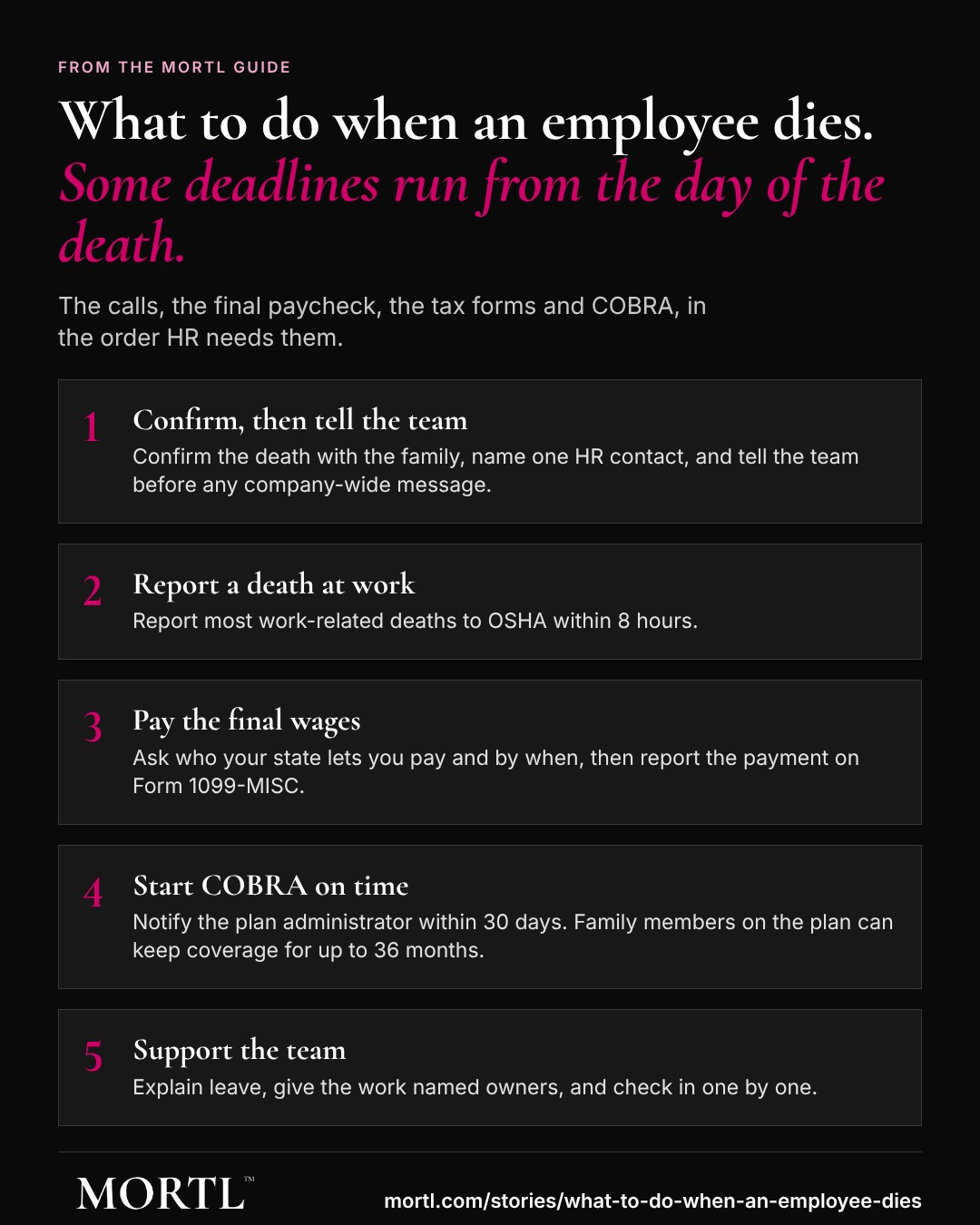
Card with five steps for HR after an employee dies: confirm and tell the team, report most work-related deaths to OSHA within 8 hours, pay final wages and report them on Form 1099-MISC, notify the COBRA plan administrator within 30 days, and support the team.
The five steps in one image, for the HR team. Open the full-size image.

If the death happened at work

Employers covered by OSHA have to report a work-related death within 8 hours of the death, or of learning about it, to the nearest OSHA area office, by calling 1-800-321-6742, or online.[2] The rule, 29 CFR 1904.39, doesn’t require a report for a crash on a public road outside a construction zone, a death on a plane, train, subway or bus, or a death more than 30 days after the incident.

Those deaths still go in your injury records if you keep them.[2] Preserve the scene and the records, and bring in counsel and your workers’ compensation carrier the same day.

The final paycheck

Before you cut the final check, ask your payroll provider or counsel two questions: who your state lets you pay a deceased employee’s wages to, such as a surviving spouse or the estate, and by when. The check covers the wages owed at death plus any accrued vacation pay your state or policy requires, and any other compensation, and the IRS treats all of it the same way on the tax forms below.[1]

The W-2 and the 1099-MISC

The IRS rule for wages paid after a death depends on the year you pay them:[1]

  • Paid in the same year as the death: withhold Social Security and Medicare tax, and report the payment on the employee’s W-2 only as Social Security wages in box 3 and Medicare wages in box 5, with the taxes withheld in boxes 4 and 6. Don’t include it in box 1.
  • Paid in a later year: don’t report it on a W-2 and don’t withhold Social Security or Medicare tax.
  • Either way: report the payment in box 3 of Form 1099-MISC, in the name and taxpayer identification number of the estate or beneficiary who received it. A reissued paycheck that was already available to the employee while alive is the exception and doesn’t go on a 1099-MISC.

Wages earned and paid before the death go on the W-2 as usual.[1]

Life insurance, retirement and other benefits

Notify the group life insurer, the retirement plan administrator and any other benefit providers, and send the family the claim forms with the name of a person they can call. Each plan pays its named beneficiaries under its own terms, so check the beneficiary on file before you tell the family who is owed what.

Health coverage and COBRA

The death of a covered employee is a COBRA qualifying event.[5] If your group health plan is covered by COBRA, a surviving spouse or dependent child who was on the plan the day before the death can elect to continue coverage for up to 36 months from the death.[4][7] The deadlines are short:

  • The employer has 30 days from the death to notify the plan administrator, or longer if a multiemployer plan’s terms allow.[6]
  • The administrator then has 14 days to notify the family of their rights, with the same multiemployer exception.[6]

Federal COBRA doesn’t apply to a group health plan in a year when every employer maintaining it normally had fewer than 20 employees during the year before.[3] Check whether your state has its own continuation law for smaller employers. Tell the family in writing what happens to their coverage, on which date, and what their options cost.

The team that keeps working

  • Explain leave clearly. Apply your bereavement policy consistently and check state and local requirements. Bereavement leave laws by state lists the states that require it.
  • Redistribute the work on purpose, with named owners and realistic deadlines, so it doesn’t fall on one person.
  • Check in one by one. Managers offer individual time without assuming who was closest.
  • Share support, including your employee assistance program if you have one.

MORTL’s manager card has the words for talking one on one with anyone on the team who’s grieving, and the return-to-work plan builder lays out a 30, 60 and 90-day plan for an employee coming back after a death.

Where MORTL fits

MORTL for Employers gives HR a first 48 hours checklist, a bereavement policy template, and manager scripts, and gives every employee MORTL Premium all year. For the employee’s family, MORTL’s free guide for when someone dies covers the first days. See what’s included.

Common questions

Who gets a deceased employee’s final paycheck?

Ask your payroll provider or counsel who your state lets you pay, such as a surviving spouse or the estate, and by when, before you issue it. Include accrued vacation pay and any other compensation owed.

How do you report wages paid after an employee dies?

If you pay in the same year as the death, withhold Social Security and Medicare tax and report the payment on the W-2 as Social Security and Medicare wages only, not in box 1. Paid in a later year, it goes on no W-2. Either way, report it in box 3 of a Form 1099-MISC to the estate or beneficiary.

Does the family get COBRA when an employee dies?

Yes, if the employer’s group health plan is covered by COBRA, which generally excludes employers that normally had fewer than 20 employees in the prior year. The death is a qualifying event, and a surviving spouse or dependent child who was on the plan the day before the death can continue coverage for up to 36 months.

Do I have to report an employee death to OSHA?

Yes, within 8 hours, if the death came from a work-related incident within the past 30 days. A crash on a public road outside a construction zone and a death on a plane, train or bus don’t have to be reported, though they still go in your injury records if you keep them.

What should the announcement to coworkers say?

The employee’s name, that they died, what the family has agreed may be shared, and what happens next for the team. Don’t share the cause without the family’s permission, and tell the immediate team before any company-wide message.

Sources & References

Research & Citations

All factual claims in this article are sourced from peer-reviewed research, government data, and named institutions. Citations follow APA 7th edition format.

  1. [1]Internal Revenue Service. (2026). General instructions for Forms W-2 and W-3 (2026). ↗ Source Retrieved November 4, 2026
  2. [2]Occupational Safety and Health Administration. Reporting fatalities, hospitalizations, amputations, and losses of an eye as a result of work-related incidents to OSHA, 29 C.F.R. § 1904.39. Electronic Code of Federal Regulations. ↗ Source Retrieved November 4, 2026
  3. [3]Continuation coverage, 29 U.S.C. § 1161. Legal Information Institute, Cornell Law School. ↗ Source Retrieved November 4, 2026
  4. [4]Period of coverage, 29 U.S.C. § 1162. Legal Information Institute, Cornell Law School. ↗ Source Retrieved November 4, 2026
  5. [5]Qualifying event, 29 U.S.C. § 1163. Legal Information Institute, Cornell Law School. ↗ Source Retrieved November 4, 2026
  6. [6]Notice requirements, 29 U.S.C. § 1166. Legal Information Institute, Cornell Law School. ↗ Source Retrieved November 4, 2026
  7. [7]Definitions, 29 U.S.C. § 1167. Legal Information Institute, Cornell Law School. ↗ Source Retrieved November 4, 2026

Share this story

Post it, or send it straight to the person who needs it. The link goes with it.

Keep reading on MORTL