Planning

How to Plan a Funeral Budget in 2026: A Line-by-Line Worksheet

A funeral budget starts with the arrangement, then the funeral home's lines, then everything the funeral home doesn't set. The national figures for each line, the help that offsets the bill, and a worksheet to fill in.

An older man works an adding machine beside a handwritten list and his reading glasses, in black and white

A funeral budget is built from the arrangement up. The National Funeral Directors Association’s most recent study put the 2023 national median for a funeral with viewing and burial at $8,300, and that figure leaves out the cemetery, the grave marker, and cash advance items such as flowers and the obituary.[1] So the budget has two parts: the funeral home’s lines, and everything around them.

Here’s how to build it, step by step. The worksheet at the end puts every line in one place.

Step 1: Pick the arrangement

The arrangement sets the size of the budget more than any other choice. The national reference points:

ArrangementNational figureWhat it covers
Direct cremation$2,202 average, 2026Cremation with no viewing or ceremony with the body present[2]
Funeral with viewing and cremation$6,280 median, 2023The funeral home’s charges, including the cremation, a container and an urn[1]
Funeral with viewing and burial$8,300 median, 2023The funeral home’s charges, including a metal casket[1]
The same, with a vault$9,995, NFDA’s total with a vault, 2023Adds the outer burial container many cemeteries require[1][3]

The direct cremation figure comes from Funeralocity price data reported by US Funerals Online, which puts state averages between $1,264 in Oregon and $3,183 in North Dakota.[2] The NFDA figures are medians from its survey of member funeral homes.[1] Immediate burial skips the viewing too, but the cemetery’s charges still apply.

Step 2: Price the funeral home’s lines

Every funeral home has to answer price questions by phone and give you an itemized General Price List when you ask in person.[3] Write down each line you want next to the national median, then replace the median with that funeral home’s price.

Line on the General Price List2023 national median
Basic services fee$2,495
Transfer of the body to the funeral home$395
Embalming$845
Other preparation of the body$295
Facilities and staff for a viewing$475
Facilities and staff for a funeral ceremony$550
Hearse$375
Service car or van$175
Printed memorial package$195
Metal casket$2,500
Cremation fee$400
Alternative cremation container$160
Urn$295
Vault$1,695

NFDA’s burial table prints the basic services fee as $2,459. Its cremation table prints $2,495 with the same 8.5 percent change from 2021, and the burial lines add up to the $8,300 median only with $2,495, so this guide uses $2,495.[1]

Three rules change the math. The basic services fee is the only charge a funeral home can make non-declinable.[3] Except in certain special cases, embalming isn’t required by law, and you usually have the right to choose an arrangement without it, such as direct cremation or immediate burial.[3]

And a funeral home can’t charge any fee beyond the basic services fee, the items you choose, and items a law, cemetery or crematory requires, so a handling fee for a casket or urn you bought somewhere else is off the table.[3]

Step 3: Add the costs the funeral home doesn’t set

The NFDA medians don’t include the cemetery, a monument or marker, or cash advance items.[1] Budget each one on its own line:

  • The cemetery. The plot and the charge to open and close the grave come from the cemetery. Get both in writing. What a burial plot costs has the ranges.
  • A vault or grave liner, if the cemetery requires one. Funeral homes have to tell you that in most areas no state or local law requires one, and that many cemeteries do.[3]
  • The marker. See what headstones and grave markers cost.
  • Cash advance items. Things the funeral home pays someone else for on your behalf, such as cemetery or crematory services, clergy honoraria, flowers, musicians, obituary notices, gratuities and death certificates.[3] If the funeral home adds its own charge to any of them, its written statement has to say so.[3]
  • Death certificates. Each state sets its own fee. Every state’s first-copy price is listed here.
  • The gathering. Food, a venue, and travel for family. Get those prices in writing too.
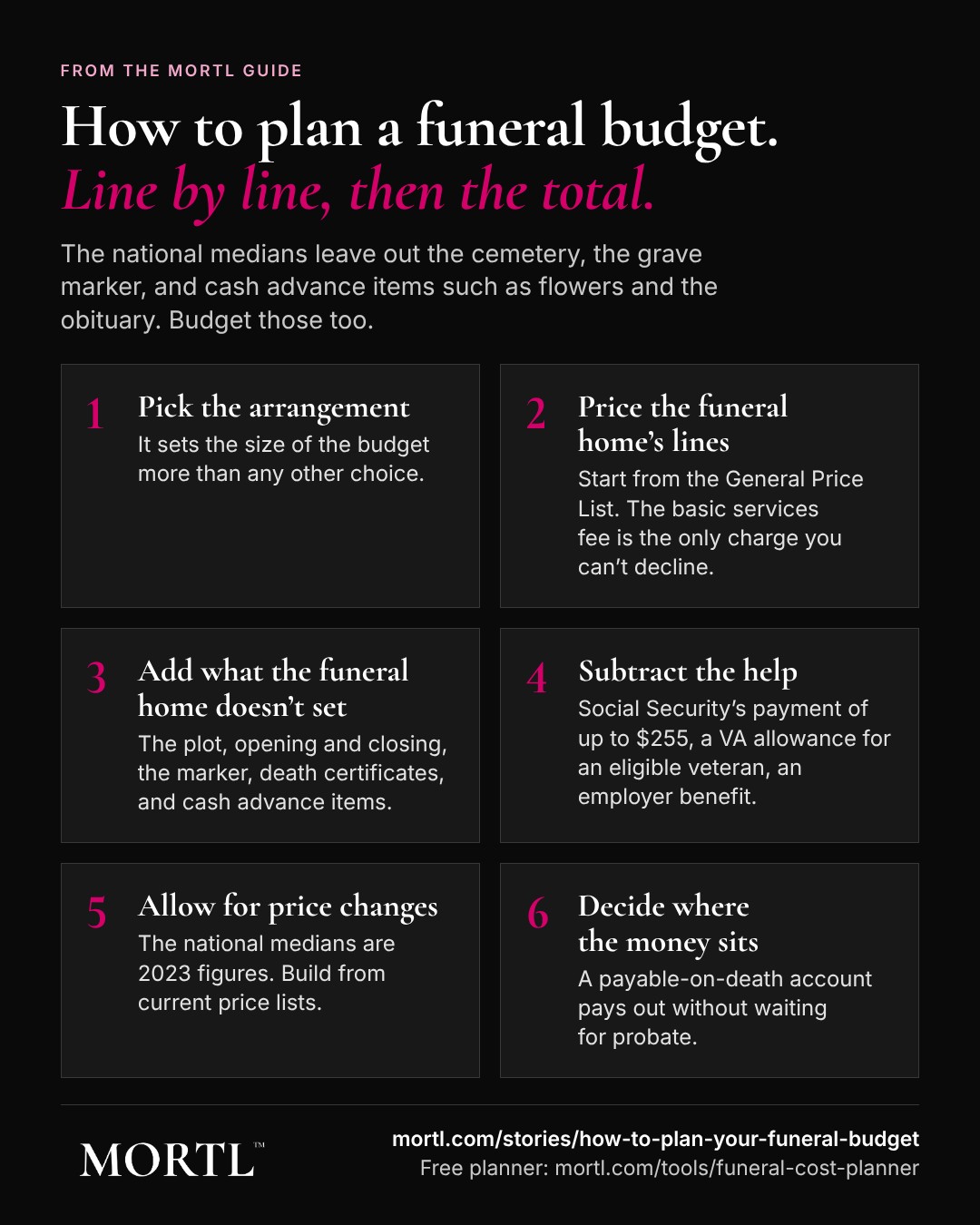
Card with six steps for planning a funeral budget: pick the arrangement, price the funeral home’s lines from the General Price List, add the cemetery, marker, death certificates and cash advance items, subtract benefits such as Social Security’s payment of up to $255, allow for price changes since 2023, and decide where the money sits.
The six steps in one image. Fill in the worksheet in the guide. Open the full-size image.

Step 4: Subtract the help that applies

  • Social Security. If the person who died had worked long enough to be insured, a one-time payment of up to $255 goes to a surviving spouse who lived with them. If there isn’t one, it can go to a widow, widower or child who qualifies for survivor benefits on the person’s record. The application has to be filed within two years of the death, unless the spouse was already getting spouse’s benefits on that record.[6]
  • Veterans benefits. For an eligible veteran who died on or after October 1, 2026, the VA pays up to a $1,032 burial allowance, plus $1,032 toward a plot in some cases, and up to $2,000 when a death on or after September 11, 2001 was service connected.[5] An eligible veteran can also be buried in a national cemetery with no charge for the grave or the headstone.[4] Who qualifies, and what the family still pays.
  • An employer or a union. Some pay survivor or funeral benefits. Ask.[4]
  • State and county programs. Some states help with funeral costs for homicide victims and some accident victims through their victim compensation programs. Some states and counties help with funeral costs for people with no money or on Medicaid or SSI, though the amount is usually small.[4]

The Funeral Consumers Alliance strongly advises against taking out a loan for a funeral and calls borrowing a last resort.[4]

Step 5: Allow for price changes

The national medians are 2023 figures. Between 2021 and 2023, the NFDA’s burial median rose 5.8 percent and its cremation median 8.1 percent.[1] Build the budget from current price lists, and if you’re planning years ahead, leave room for prices to rise.

Step 6: Decide where the money sits

  • A payable-on-death bank account. The money stays yours while you’re alive, and the bank releases it to the person you name after your death without waiting for probate.[4] How payable-on-death accounts work.
  • Life insurance. Pays your named beneficiaries soon after death, outside probate. The Funeral Consumers Alliance cautions against burial and preneed insurance, because buyers usually pay as much in premiums as the policy pays out, or more.[4]
  • A prepaid funeral contract. You pay the funeral home now. Read prepaid funeral plans for the protections and the risks before you sign.

Then tell the person who’ll handle the arrangements where the money is. How to pre-plan a funeral covers naming that person.

The funeral budget worksheet

Copy this into a notebook or a spreadsheet and fill in the right-hand column from real price lists.

LinePrice comes fromYours
Basic services feeGeneral Price List
Transfer of the bodyGeneral Price List
Embalming and preparation, for a viewingGeneral Price List
Viewing and ceremonyGeneral Price List
Hearse and other vehiclesGeneral Price List
Casket, or cremation fee, container and urnCasket Price List, General Price List
Vault or grave linerOuter Burial Container Price List, or the cemetery
Plot, opening and closingThe cemetery
MarkerThe cemetery or a monument dealer
Cash advance itemsThe written statement
Death certificatesYour state’s fee
Gathering and travelYour own quotes
Minus benefitsVA, Social Security, employer or union
Total

The Funeral Rule requires a funeral home to give you a General Price List, its casket and outer burial container prices on separate lists or in full on the General Price List, and, at the end of the arrangement conference, an itemized written statement of everything you chose and its price.[3] If you choose direct cremation or immediate burial, the funeral home’s price for it already includes the basic services fee, so don’t count the fee twice.[3]

Where MORTL fits

The free funeral cost planner prices a funeral item by item, in the categories the Funeral Rule requires funeral homes to quote, with no account. Check its total against real price lists with how to compare funeral homes, and see the full national picture in how much a funeral costs in 2026.

Common questions

How much should I budget for a funeral?

Start from the arrangement. The NFDA’s 2023 national medians were $8,300 for a funeral with viewing and burial, $9,995 with a vault, and $6,280 for a funeral with viewing and cremation. Direct cremation averaged $2,202 in 2026 in Funeralocity data reported by US Funerals Online. Cemetery and cash advance costs come on top.

What do funeral cost estimates usually leave out?

The NFDA medians leave out the cemetery plot and its opening and closing charge, the grave marker, and cash advance items such as flowers, the obituary, clergy honoraria and death certificates.

Does Social Security help pay for a funeral?

If the person who died was insured under Social Security, it pays a one-time death payment of up to $255 to a surviving spouse who lived with them. If there isn’t one, it can go to a widow, widower or child who qualifies for survivor benefits. The application has to be filed within two years of the death, unless the spouse was already getting spouse’s benefits on that record.

How much does the VA pay toward a veteran’s funeral?

For an eligible veteran who died on or after October 1, 2026, up to a $1,032 burial allowance, plus $1,032 toward a plot in some cases. When a death on or after September 11, 2001 was service connected, the allowance is up to $2,000.

Do I have to pay for embalming?

Usually not. Except in certain special cases, embalming isn’t required by law, and you usually have the right to choose an arrangement without it, such as direct cremation or immediate burial. It may be necessary if you choose certain arrangements, such as a funeral with a viewing.

Sources & References

Research & Citations

All factual claims in this article are sourced from peer-reviewed research, government data, and named institutions. Citations follow APA 7th edition format.

  1. [1]National Funeral Directors Association. (2023, December 8). 2023 NFDA General Price List Study shows inflation increasing faster than the cost of a funeral [Press release, PDF with item and regional tables]. ↗ Source Retrieved November 4, 2026
  2. [2]US Funerals Online. (2026). What is the average cost of a cremation in 2026? State pricing guide. ↗ Source Retrieved November 4, 2026
  3. [3]Funeral Industry Practices, 16 C.F.R. Part 453. Electronic Code of Federal Regulations. ↗ Source Retrieved November 4, 2026
  4. [4]Funeral Consumers Alliance. (n.d.). How to pay for a funeral or other arrangements. ↗ Source Retrieved November 4, 2026
  5. [5]U.S. Department of Veterans Affairs. (2026). Veterans burial allowance and transportation benefits. ↗ Source Retrieved November 4, 2026
  6. [6]Old-age and survivors insurance benefit payments, 42 U.S.C. § 402(i). Legal Information Institute, Cornell Law School. ↗ Source Retrieved November 4, 2026

Share this story

Post it, or send it straight to the person who needs it. The link goes with it.

Keep reading on MORTL

Planning

How Much Does a Funeral Cost in 2026? The Complete US Guide

What a funeral costs in the US, line by line: the national medians for burial and cremation, what they include and leave out, regional prices, what drives the total, and how to budget.

14 min read
Planning

How to Pre-Plan a Funeral Without Overpaying: A Step-by-Step Guide

Pre-planning a funeral means three decisions: what happens to your body, who's in charge of it, and where the money comes from. You can make all three without paying a funeral home anything.

9 min read
Planning

How to Choose and Compare Funeral Homes: Services, Prices, and Trust Checks

The same funeral can cost thousands more at one funeral home than at the next. How to get every home's prices, compare them line by line, and check who you're trusting with the body.

9 min read
Planning

Payable-on-Death Accounts: The Free Probate Shortcut

The bank will give you the form for free, and it beats your will for that account. That's the whole deal, and both halves of it matter.

9 min read
Planning

What Is a Prepaid Funeral Plan? How It Works, What It Covers, and What to Check in 2026

A prepaid funeral plan may lock in prices for covered items or help with Medicaid planning. Contract protections, refunds, transfers, and guarantees vary, so review the terms before paying.

10 min read
Planning

Why a Funeral Calculator Says $16,000 When the NFDA Says $8,300

Two numbers for the same funeral. One is the funeral home's bill in 2023 dollars. The other adds the cemetery, the vault, the paperwork, and an inflation factor. How to read any funeral cost calculator before you trust it.

8 min read