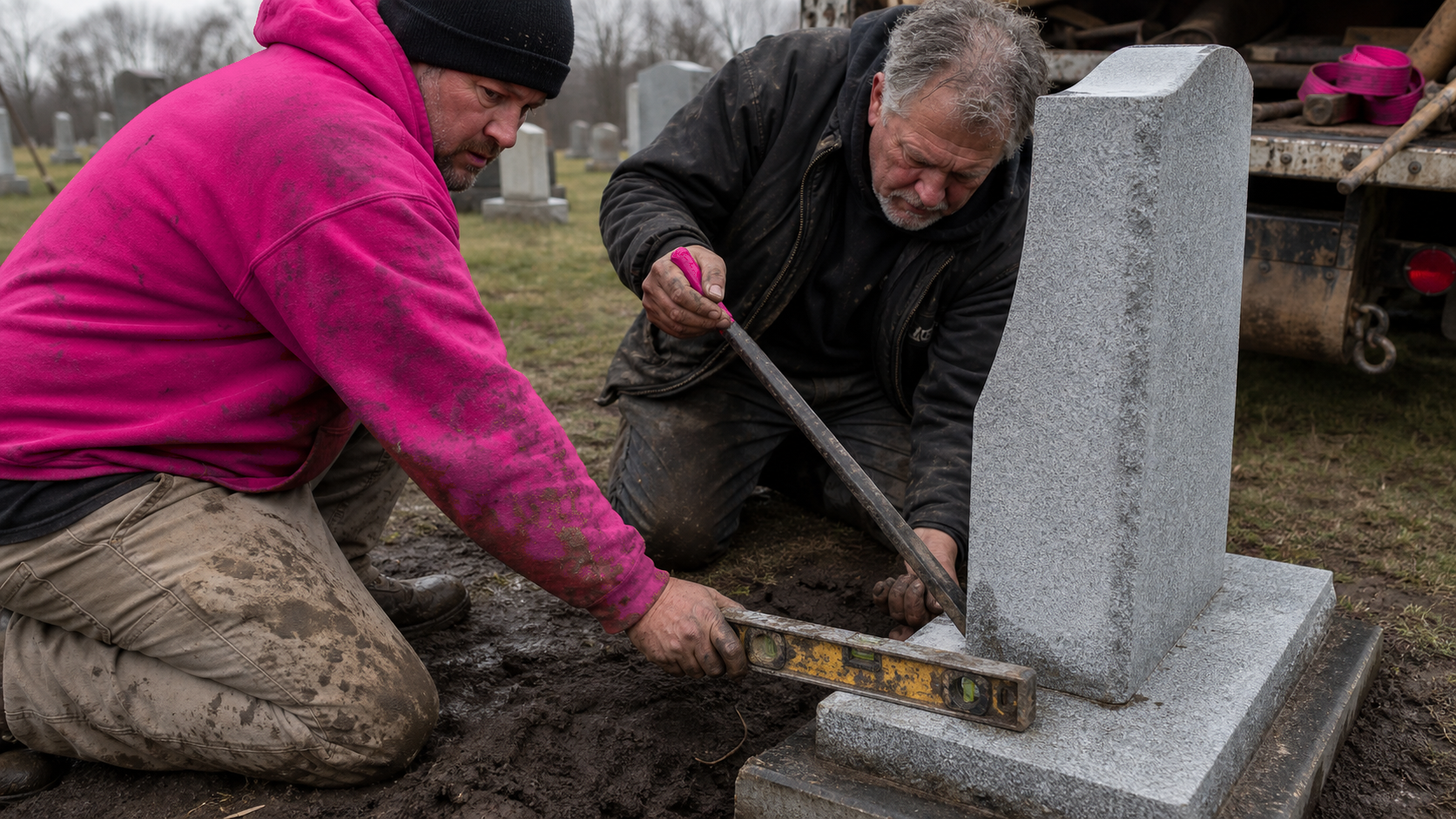
The VA furnishes, on request and at no charge to the applicant, a government headstone or marker for the unmarked grave of any deceased eligible veteran, in any cemetery in the world, regardless of date of death.[1] That includes private cemeteries.
If the grave is already marked with a privately purchased headstone, two options exist and they're mutually exclusive. A government headstone or marker may be provided for eligible veterans who died on or after November 1, 1990. A government medallion, affixed to the private stone, may be provided for eligible veterans who served on or after April 6, 1917.[1] Eligible veterans get one or the other, not both.[2]
What's available. Flat markers in granite, marble, and bronze, and upright headstones in granite and marble. Bronze niche markers mark columbarium niches, where cremated remains are kept.[1] Sizes: upright granite and marble are 42 by 13 by 4 inches at roughly 230 pounds; flat granite and marble are 24 by 12 by 4 inches at roughly 130 pounds; flat bronze is 24 by 12 inches with a 3/4 inch rise at roughly 18 pounds; the bronze niche marker is 8 1/2 by 5 1/2 inches.[2]
Medallions come in small, medium, and large bronze, plus Medal of Honor versions in medium and large.[2] The style you choose has to be permitted by the officials in charge of the private cemetery.[1]
What the family still pays at a private cemetery. The VA's language is exact: "There is no charge for the headstone or marker itself, however arrangements for placing it in a private cemetery are the applicant's responsibility and all setting fees are at private expense."[1] Specifically:
- The foundation and setting. Portland, Maine charges $150 for a government marker including setting.[15] Quincy, Massachusetts sets a veteran's granite marker at no charge and charges $50 to set a bronze one.[13] Provo waives its inspection fee for military markers ordered from the VA.[14] Every cemetery is different, which is why you ask first.
- The base under a bronze marker. The VA supplies anchor bolts, nuts, and washers for fastening a flat bronze marker to a base, and states that "the government does not furnish a base."[2] Beloit requires a veteran's family choosing bronze to purchase a granite blank to mount it on, in every section except the dedicated bronze section.[16]
- Everything else the cemetery charges. The plot and the vault or grave liner are separate,[4] and so are opening and closing and perpetual care: Provo charges $750 to open and close an adult grave,[14] and Quincy charges $1,000 per lot for perpetual care.[13]
National, state, and military cemeteries work differently. Cemetery staff at national, military post, and military base cemeteries set the headstone or marker at no cost to the applicant, and the marker is ordered by cemetery officials from inscription information the next of kin provides. Some state veterans cemeteries may charge a nominal setting fee.[1]
Spouses and dependents. Only an eligible veteran can receive a government-furnished headstone, marker, or medallion for placement in a private cemetery. Spouses and dependent children aren't eligible there. They are eligible in a national, state veterans, or military post or base cemetery.[4][1]
How to apply. VA Form 40-1330 for a headstone or marker, VA Form 40-1330M for a medallion. Submit the veteran's military discharge documents and death certificate to speed processing, and send copies rather than originals, which aren't returned.[3] Families planning ahead can complete the form in advance and store it with the discharge papers.[4]
One rule that surprises people: after the National Cemetery Administration inscribes a headstone or marker, it doesn't authorize any other party to add inscriptions or emblems, and there's no authority to reserve space for future inscriptions by private or local contractors.[3] Decide the full inscription before you file.