PlanningBy Stephanie Werner · August 9, 2026 · 13 min read

How Much Does a Burial Plot Cost?

A burial plot runs from about $1,000 at a small city cemetery to $32,000 in Brooklyn. Then the cemetery bills you again for opening the grave, the vault, the marker, the marker's foundation, and perpetual care. Real published prices, cited line by line.

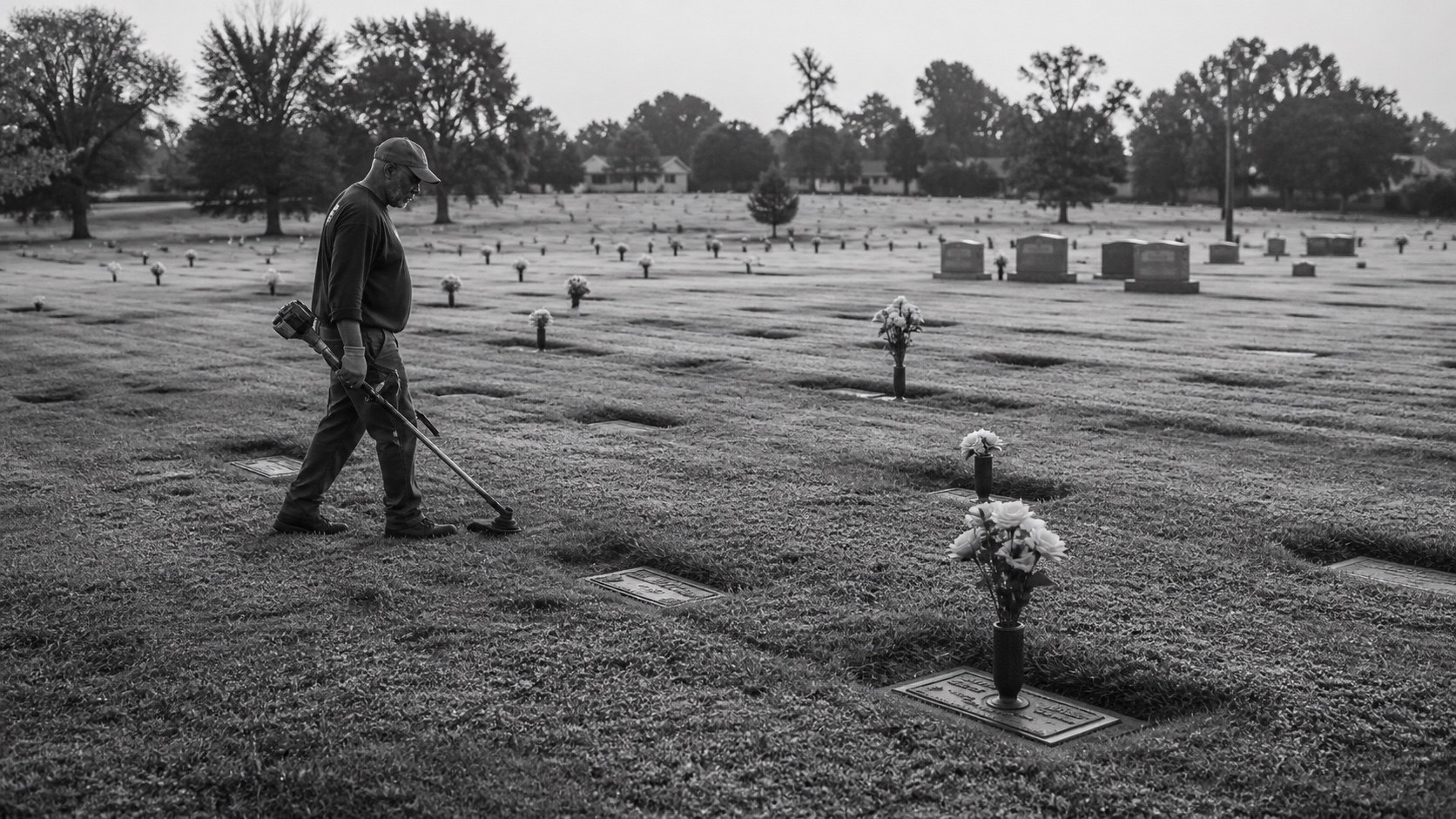
A cemetery groundskeeper walks a mown section of newer graves in flat morning light

What a burial plot costs

A burial plot costs about $1,000 at a small city-run cemetery and $21,000 to $32,000 at a large private cemetery in an expensive metro.[4][9] The plot is one line on the cemetery bill. Opening and closing the grave, the vault or grave liner, the marker, the marker's foundation, and perpetual care are billed separately, and together they often cost more than the plot did.

The number most people have heard about funerals doesn't include any of this. The National Funeral Directors Association put the national median cost of a funeral with viewing and burial at $8,300 in 2023, and NFDA states in the same release that the figure "does not take into account interment in a cemetery, monument or grave marker costs, or cash-advance charges, such as for flowers or an obituary."[1] The cemetery is a second business sending a second bill.

It's also a business with fewer federal rules. The FTC Funeral Rule gives you the right to an itemized price list and the right to buy only what you want, but the FTC says plainly that "the Rule does not apply to third-party sellers, such as casket and monument dealers, or to cemeteries that lack an on-site funeral home."[2]

A standalone cemetery isn't covered by the Rule at all, so nothing federal makes it hand you a price list. New York makes its cemeteries publish one anyway, and both of the New York cemeteries priced below print that on their own price pages.[8][9] Our Funeral Rule explainer covers what the Rule does reach.

NFDA's national survey excludes cemetery costs entirely, so its figure can't tell you what a plot costs.[1] Every price below comes from a price list the cemetery or the city published itself.

Real published plot prices

Six published price lists, covering nine cemeteries. Some of these graves hold one person and some hold up to three, so read the line and not only the number:

  • Hazelwood Cemetery, Springfield, Missouri (city-published). Adult grave: $412.80 base plus $619.20 perpetual care, $1,032.00 total, plus a $27 recording fee. Effective July 1, 2026.[4]
  • Quincy, Massachusetts (city). Single lot $1,500, perpetual care $1,000, right to interment $25. Total $2,525.[6]
  • Salt Lake City Cemetery (city). Doesn't publish a lot price at all. It does publish perpetual care on its own line: $726 per adult grave for residents, $1,289 for non-residents. Effective July 1, 2026.[5]
  • Associated Catholic Cemeteries, Archdiocese of Seattle. Full-body graves run $2,705 to $14,225 depending on which of the four cemeteries and which section. Endowment care is included in that price and itemized on the purchase agreement. Effective June 1, 2025.[7]
  • Mount Carmel Cemetery, Queens, New York. "Generally, grave prices range from $7,500 to $19,500 each, dependent upon location and availability." The 2026 prices are approved by the New York State Cemetery Board.[8]
  • The Green-Wood Cemetery, Brooklyn. Single graves, holding up to three burials: $21,000 to $32,000, plus a foundation cost of $999 to $1,206. Premium one-grave lots are $38,000 or $43,000. A sarcophagus site is $300,000.[9]

That's a spread of 20 to 30 times between a grave in Springfield and a standard grave in Brooklyn, and both prices are current and public. Where the cemetery is drives more of that spread than anything else in these six price lists.

How much of the bill the plot actually is

Take Quincy, Massachusetts, and add up only what its own fee schedule charges for a resident adult burial: lot $1,500, perpetual care $1,000, right to interment $25, interment charge $1,100, installation of the vault $200. That's $3,825, and the plot itself is 39% of it.[6] The vault, the marker, and the marker's foundation are all still to come, and the foundation alone runs $125 per square foot for a flush marker or $200 per square foot for an upright monument.[6]

Same exercise in Seattle, cheapest grave available: grave $2,705, opening and closing for a concrete box or vault $1,645, single concrete box $860, memorial setting $420, memorial care fund $345. That's $5,975 before you buy the memorial itself, which starts at $1,220 for the smallest flush granite marker the list gives for a full-body grave and runs to $3,570.[7] The grave is 45% of the pre-marker total, and under 40% once you add a mid-priced marker.

In Springfield the plot and the labor are almost the same number: the adult grave is $1,032 and opening and closing an adult casket or vault is $1,006.[4]

The expensive-metro cemetery works differently, because the land costs so much that every other charge is small next to it. A $21,000 Green-Wood single grave plus its $999 foundation and its $2,588 adult interment fee comes to $24,587, and the grave is 85% of that.[9] In the Quincy and Seattle stacks above, the plot came to under half of what the cemetery charged.[6][7]

Opening and closing the grave

This is the fee to dig the grave, set the equipment, lower the casket, and fill the grave back in. It's charged at the time of burial, which is why a plot bought decades ago still produces a four-figure bill on the day.

Published adult rates, weekday, no extras:

  • Springfield, Missouri: $1,006 for an adult casket or vault.[4]
  • Quincy, Massachusetts: $1,100 for a resident, $1,300 for a non-resident, plus $200 to install the vault.[6]
  • Salt Lake City: $1,172 for a resident, $1,676 for a non-resident. A double-depth grave is $1,347 for the initial burial.[5]
  • Archdiocese of Seattle: $1,375 for a lawn crypt, $1,645 for a concrete box or vault, $1,900 oversize, and $3,475 at St. Patrick Cemetery.[7]
  • Mount Carmel, Queens: $2,207 for a casket up to 26 inches wide, $2,264 over 26 inches.[8]
  • Green-Wood, Brooklyn: $2,588 for an adult, including the lowering device and grass lining.[9]

Cremated remains cost less to inter but they aren't free: $592 at Green-Wood, $586 for a resident in Salt Lake City, $705 in Seattle, $600 for a resident in Quincy.[9][5][7][6]

Watch the add-ons at the bottom of this section. Green-Wood charges $876 extra when a grave has to be opened by hand because the lot is enclosed, and $112 extra for a wooden outer case or non-metal casket.[9] Mount Carmel charges $209 to rent the lowering device and $249 for artificial greens to line the grave.[8]

The vault or grave liner

An outer burial container is the concrete box the casket goes into. No state requires one. The FTC says it directly: "Outer burial containers are not required by state law anywhere in the U.S., but many cemeteries require them to prevent the grave from caving in."[2] California's Cemetery and Funeral Bureau says cemeteries may require one to keep the ground from settling, and explains the difference: "Vaults surround the casket in concrete or other material.

Grave liners cover only the top and sides. Neither container prevents the eventual decomposition of human remains."[3]

The gap between the two is real money. The Archdiocese of Seattle sells single concrete boxes at $860 to $1,125. Its vaults start at $2,365 and go to $8,830 for a bronze one, with a Wilbert Bronze at $30,670.[7] If your cemetery accepts a liner, ask for a liner.

New York regulates this tightly. A New York cemetery "may not compel the use of any particular outer enclosure," and may require a concrete vault or, at the customer's option, a concrete grave liner only if the lot was purchased after January 1, 1985 and the requirement was stated prominently in writing before the purchase agreement was signed.

The lot owner may buy the liner from any source. A New York cemetery may not sell burial vaults at all. And if the lot owner objects on religious grounds at the time of interment, "the cemetery must, without question, cancel the requirement," though it may charge a reasonable fee for periodically refilling the grave.[10]

Then there's a fee for putting the thing in the ground, separate from the vault and separate from opening the grave. Seattle charges an outer burial container placement fee of $560 for a single concrete box or a single vault, and $1,120 for a double.[7] Quincy charges $200 to install the vault.[6]

The marker and its foundation

The headstone is a separate purchase from a separate vendor, and the cemetery charges you to put it in. There are usually three charges: the marker, the concrete foundation it sits on, and a setting fee. Some cemeteries add a fourth.

Foundation and setting, as published:

  • Green-Wood, Brooklyn: single-grave strip foundation $999, two-grave $1,992, and per-cubic-foot rates of $59 to $67 for individual foundations depending on depth. Its single-grave listing is $21,000 to $32,000, with the foundation cost of $999 to $1,206 added on top.[9]
  • Mount Carmel, Queens: $556 for a foundation at the foot of the grave, $715 for a single headstone at the head, $1,373 for a double headstone or a family monument up to 6 square feet, and $216 per square foot plus a $56 supervisory fee above that.[8]
  • Quincy, Massachusetts: $200 per square foot for an upright monument, $125 per square foot for a flush marker.[6]
  • Archdiocese of Seattle: memorial setting $420 to $680 depending on size, upright monument foundation setting $680. On top of that comes a Memorial Care Fund charge, separate from the burial property care fund: $345 to $615 for flush markers and $1,430 for upright monuments.[7]
  • Salt Lake City charges a headstone monitoring fee: $90 flat, $112 upright, $586 oversize.[5]

The marker itself is on top of all of that. Seattle's flush granite memorials run $590 to $3,570 across every size it lists, and the two cheapest lines, $590 and $760, are for infant and cremation sections. The smallest size it lists for a full-body grave, 28x16, is $1,220 to $2,395. Its granite foundations for upright monuments run $445 to $3,110.[7]

You can buy the marker somewhere else. California's rule is a good standard to hold any cemetery to: the cemetery cannot charge a setting fee "if the monument company sets it for you," and it cannot charge more for foundations, setting, or permitting than it would if you bought the marker or monument from the cemetery.[3]

Perpetual care

Perpetual care is a one-time payment into a trust fund. The cemetery can't spend the principal. It mows the grass with the interest. California calls it an endowment care trust fund and defines it as "Money collected from a portion of the sale of cemetery property. The money in trust is conservatively invested to fund the long-term care of the cemetery."[3]

New York runs two funds. Perpetual care money pays for individual graves and plots. A separate permanent maintenance fund pays for the cemetery overall, and it's fed by "a portion of current lot sale receipts and $35 from every interment." In both funds, "only the interest from these funds can be used for maintenance; the principal must remain intact."[10]

What it costs, across the same price lists:

  • Mount Carmel, Queens: $3,872 for a single grave, $8,605 for a four-grave family plot, $11,432 for a six to eight grave plot.[8]
  • Quincy, Massachusetts: $1,000 of care on top of a $1,500 lot, so just under 40% of the $2,525 total Quincy publishes for a single lot.[6]
  • Springfield, Missouri: $619.20 on a grave whose base price is $412.80. Perpetual care costs half again as much as the ground.[4]
  • Salt Lake City: $726 per adult grave for residents, $1,289 for non-residents.[5]
  • Archdiocese of Seattle: included in the grave price and itemized on the purchase agreement.[7]

Two things to ask. First, is perpetual care already inside the plot price or added to it? Springfield and Seattle bundle it. Quincy and Salt Lake City list it separately.[4][7][6][5] Second, is the cemetery an endowment care cemetery at all? California's Health and Safety Code requires any private cemetery established on or after September 7, 1955 to be one.[16] Older and non-endowment cemeteries exist, and one with no fund has no money set aside for upkeep.

Weekend, holiday, and late fees

Cemeteries charge by the clock. A Saturday burial, or one that arrives late, costs hundreds more. Ask for the timing fees in writing before you pick a day.

  • Green-Wood, Brooklyn: Saturday burials, extra $465. Then $95 for each half hour or portion for arriving after 11:30am, and $105 per half hour for funerals arriving after 4pm or waiting more than 30 minutes.[9]
  • Mount Carmel, Queens: a Sunday adult grave opening is $2,488 against $2,207 on a weekday. Overtime runs $217 an hour starting at 3:15pm on weekdays and 3:30pm on Sundays, and holiday burials carry additional labor rates.[8]
  • Archdiocese of Seattle: Saturday service fee $1,360 to $1,805. Overtime is $770 for arrival between 3:00 and 4:30pm, $1,005 between 4:30 and 5:30pm, and $1,325 after 5:30pm, each needing the superintendent's approval.[7]
  • Quincy, Massachusetts: $750 added to the opening for a Saturday, plus $150 an hour after 12:30pm. Weekday funerals after 2:00pm cost $500. A funeral after noon on Christmas Eve or New Year's Eve costs $350.[6]
  • Salt Lake City: $469 per day for a Saturday, $437 per hour after 4pm any day, $437 per hour on a Sunday or holiday.[5]
  • Springfield, Missouri: $426 for service outside office hours of Monday through Friday, 9am to 4pm.[4]

If the family can gather on a Tuesday, gather on a Tuesday.

What drives the price

Where the cemetery is. Land value sets the plot price. A grave in Springfield is $1,032 and a grave in Brooklyn starts at $21,000.[4][9]

Who runs it. In the six price lists above, the municipal cemeteries are the cheapest and price by residency, the Catholic system sits in the middle, and the two New York private cemeteries are the most expensive.[4][5][6][7][8][9] Veterans have a fourth option covered below.

Whether you lived there. Salt Lake City charges residents $1,172 to open a grave and non-residents $1,676, and charges residents $726 for perpetual care against $1,289 for non-residents.[5] Quincy charges $1,100 for a resident interment and $1,300 for a non-resident.[6] Salt Lake City says some of its pricing is set by the deceased person's residential address at the time of death.[5]

Which part of the cemetery. California's regulator says "Prices vary between cemeteries, and among locations within the same cemetery."[3] The Archdiocese of Seattle proves it: full-body graves are $5,280 to $14,225 at Calvary and $2,830 to $5,915 at St. Patrick.[7] Green-Wood's standard single graves are $21,000 to $32,000 while premium one-grave lots are $38,000 or $43,000.[9]

How many people go in the grave. A double-depth or multiple-depth grave puts two people in one space. California notes there may be special fees for opening and closing one, and that it "may limit disinterment rights."[3] Salt Lake City charges $1,347 to open a double-depth grave for the initial burial against $1,172 for a single.[5]

Casket or ashes. Cremation graves and niches cost a fraction. Seattle's cremation graves start at $635 for eco-burial and $1,355 at Holyrood, against $2,705 for the cheapest full-body grave.[7] Quincy's urn grave is $750 plus $1,000 perpetual care.[6]

Veterans: free at a VA national cemetery

Burial in a VA national cemetery costs the family nothing for the eligible veteran. The VA lists what's included at no cost: a gravesite in any national cemetery with available space, opening and closing of the grave, a burial liner provided by the government, a headstone or marker provided by the government, and perpetual care of the gravesite. Eligible people also receive a burial flag, a Presidential Memorial Certificate, and military funeral honors from the Department of Defense at no charge.[11]

That's the plot, the labor, the outer container, the marker, and the maintenance, all at no cost.[11]

What isn't covered is the funeral home. The National Cemetery Administration says it directly: "Any item or service obtained from a funeral home or cremation office will be at the family's expense."[17] The casket, embalming, the funeral director's services, cremation, and transport to the cemetery are all yours to pay.

Spouses and dependent children can be eligible for burial in a national cemetery too, including a surviving spouse who remarried after the veteran's death and, in some cases, an unmarried adult dependent child.[13]

If the veteran is buried in a private cemetery instead, the VA pays allowances rather than covering the bill. For a death that isn't service connected, on or after October 1, 2026, the VA pays a $1,032 burial allowance and $1,032 for a plot. For deaths from October 1, 2025 through September 30, 2026, it was $1,002 for each.[12] Against a $21,000 Brooklyn grave that isn't much, and a $1,032 Springfield grave costs exactly that.[9][4]

State veterans cemeteries are a separate system with their own rules, and they generally charge something for family members. Washington State charges nothing for interment of a veteran or service member unless the VA already paid the allowance out, and $311 for a family member interment or memorialization as of October 1, 2025.[14]

New Hampshire charges eligible veterans no fee and eligible dependents $450, and its fees "include the grave site, opening and closing of the grave, engraved headstone or niche marker, and perpetual care." It also provides pre-placed outer burial containers free of charge in its newer sections.[15]

What you actually own

Buying a plot usually buys a right to be buried in a specific piece of ground. The ground itself stays the cemetery's. Quincy makes the distinction visible on its own fee schedule by charging $1,500 for the lot and a separate $25 for the "right to interment."[6]

Some cemeteries do convey a deed. Springfield sells adult and infant graves "by recorded property deed of grave spaces, including cost of perpetual care," and records the deed with the Greene County Recorder's Office. Its Economy Section works the other way: "The Cemetery retains ownership and control of grave spaces. Grave spaces are assigned at time of need."[4]

Unused plots can revert. Springfield cites Missouri Revised Statute 214.209: after 75 years with no recorded activity on a burial site, and after a reasonable search for heirs and beneficiaries, grave spaces are declared abandoned and ownership reverts to the cemetery.[4] In New York, under Not-for-Profit Corporation Law section 1512(b), unless a lot is specifically devised by will with the lot number, section number, and cemetery name, it's inherited by the descendants of the lot owner, and burial rights obtained through inheritance should be recorded with the cemetery.[10]

Moving the right to someone else costs money. Salt Lake City charges $234 for a transfer deed.[5] Quincy charges $75 and requires Board of Managers approval, though transfers within a family need no approval and no charge.[6]

In New York the state sets the rules for this paperwork. Both Green-Wood and Mount Carmel state that their prices have been set and approved by the State Cemetery Board, and both post the full list because the law requires it.[9][8] The Cemetery Board also has to approve any service charge increase an incorporated cemetery proposes, and requests must be fully documented.[10]

How to pay less

Get the full price list before you pick a cemetery. In New York the cemetery has to give you one. Mount Carmel prints "As required by law, this is the full price list" on its page, and Green-Wood writes that it posts the full list "as required by law."[8][9] Elsewhere the FTC Funeral Rule may not reach a standalone cemetery, so ask in writing and compare the whole schedule.[2]

Check the municipal cemetery first. The two cheapest published prices in this article are both city cemeteries: Springfield's adult grave is $1,032 including perpetual care, and Quincy's single lot totals $2,525.[4][6] If the person lived in town you get the resident rate. Salt Lake City charges residents less than non-residents on both its opening and closing lines and its perpetual care lines.[5]

Ask whether a grave liner will do instead of a vault. No state law requires either.[2] Where a liner is accepted, Seattle's numbers show the difference: $860 to $1,125 for a concrete box against $2,365 and up for a vault.[7]

Buy the marker from a monument dealer. California bars a cemetery from charging a setting fee when the monument company sets the marker, and from charging more for foundations, setting, or permitting than it would if you bought the marker there.[3] Ask your cemetery for the same terms in writing.

Bury on a weekday, early. Saturday adds $465 at Green-Wood, $750 at Quincy, and $1,360 to $1,805 in Seattle, and late arrival adds more on top.[9][6][7]

Ask about a double-depth grave for a couple. One space, two people, one plot price. Confirm the opening fees and any limits on disinterment before you buy.[3][5]

If the person is a veteran, start with the VA. The gravesite, the opening and closing, the liner, the marker, and perpetual care are all at no cost in a national cemetery.[11]

One thing that isn't a savings tactic: assuming natural burial is cheaper. At the Archdiocese of Seattle's Gethsemane Cemetery, natural burial spaces in Section K run $6,510 to $8,295 while ordinary graves start at $2,705, and opening and closing a natural burial is $2,055 against $1,645 for a concrete box or vault.[7] Green burial skips the vault and often the marker, which saves money at some cemeteries and costs money at others. Price it before you count on it.

Common questions

How much is a burial plot?

$1,032 at Springfield, Missouri's city cemetery and $2,525 in Quincy, Massachusetts. $2,705 to $14,225 across the Archdiocese of Seattle's four cemeteries. $7,500 to $19,500 at Mount Carmel in Queens and $21,000 to $32,000 at Green-Wood in Brooklyn. Those are all current published price lists. The Springfield and Quincy totals include perpetual care; opening and closing the grave, the vault, and the marker are billed separately everywhere.

Why does opening and closing the grave cost so much?

It pays for the crew, the equipment, and refilling the grave, and it's billed at the time of burial rather than when you bought the plot. Some cemeteries bill the lowering device on top of it: Mount Carmel charges $209 for it. Published weekday adult rates run $1,006 in Springfield, $1,172 for a Salt Lake City resident, $1,645 in Seattle for a concrete box or vault, $2,207 at Mount Carmel in Queens, and $2,588 at Green-Wood in Brooklyn. Ask the cemetery for this figure in writing when you buy, because it comes due years later.

Do I have to buy a burial vault?

No state requires one. The FTC says outer burial containers aren't required by state law anywhere in the United States, but many cemeteries require them so the grave doesn't cave in. If your cemetery requires a container, ask whether a concrete grave liner is acceptable instead of a full vault. At the Archdiocese of Seattle a single concrete box is $860 to $1,125 while vaults start at $2,365. In New York a cemetery can't sell you a vault at all, you may buy the liner from any source, and a religious objection raised at the time of interment cancels the requirement outright.

Is perpetual care a one-time fee or do I pay every year?

It's a one-time payment into a trust. The cemetery can't spend the principal and maintains the grounds using only the interest. Some cemeteries fold it into the plot price and some bill it separately, so ask which. Published amounts include $619.20 in Springfield, Missouri, $726 for a Salt Lake City resident, $1,000 in Quincy, Massachusetts, and $3,872 for a single grave at Mount Carmel in Queens. Annual care and planting are separate charges at some cemeteries: Green-Wood lists annual care and perpetual care as different items, and Mount Carmel won't take payment for planting unless the season's annual care is paid.

How much does a burial plot cost for a veteran?

Nothing, in a VA national cemetery. The VA provides the gravesite, opening and closing of the grave, a government burial liner, a government headstone or marker, and perpetual care at no cost to the family, plus a burial flag, a Presidential Memorial Certificate, and military funeral honors. The family still pays the funeral home for the casket, embalming, cremation, and transport. If the veteran is buried in a private cemetery instead, the VA pays a $1,032 burial allowance and $1,032 for a plot for a death that isn't service connected on or after October 1, 2026.

Can I buy a cemetery plot in advance, and what happens if I move?

Yes. Transferring the right later costs money and usually needs cemetery approval: Salt Lake City charges $234 for a transfer deed and Quincy charges $75 with Board of Managers approval, though family transfers in Quincy are free. Unused plots can also revert. Springfield cites Missouri law under which a grave space with no recorded activity for 75 years, after a reasonable search for heirs, is declared abandoned and ownership returns to the cemetery. In New York, a lot that isn't specifically devised by will passes to the lot owner's descendants.

Does the funeral home's price include the cemetery plot?

No. NFDA's median of $8,300 for a funeral with viewing and burial states outright that it "does not take into account interment in a cemetery, monument or grave marker costs, or cash-advance charges." The cemetery bills you separately for the plot, opening and closing, the vault, the marker foundation, and perpetual care. Ask the funeral director for the cemetery's own price list, and note that the FTC Funeral Rule doesn't apply to cemeteries without an on-site funeral home.

Sources & References

Research & Citations

All factual claims in this article are sourced from peer-reviewed research, government data, and named institutions. Citations follow APA 7th edition format.

  1. [1]National Funeral Directors Association. (2023, December 8). 2023 NFDA General Price List Study shows inflation increasing faster than the cost of a funeral [Press release]. ↗ Source Retrieved August 9, 2026
  2. [2]Federal Trade Commission. (n.d.). The FTC Funeral Rule. FTC Consumer Advice. ↗ Source Retrieved August 9, 2026
  3. [3]California Department of Consumer Affairs, Cemetery and Funeral Bureau. (n.d.). Consumer Guide to Funeral and Cemetery Purchases. ↗ Source Retrieved August 9, 2026
  4. [4]City of Springfield, Missouri. (2026). Hazelwood Cemetery Sales & Service Fee Schedule, effective July 1, 2026 to June 30, 2027. ↗ Source Retrieved August 9, 2026
  5. [5]Salt Lake City Corporation. (2026). City Cemetery Fees, July 1, 2026 to June 30, 2027. ↗ Source Retrieved August 9, 2026
  6. [6]City of Quincy, Massachusetts, Department of Natural Resources, Cemetery Division. (2026, August 5). Cemetery Fee Schedule. ↗ Source Retrieved August 9, 2026
  7. [7]Associated Catholic Cemeteries, Archdiocese of Seattle. (2025). General Price List 2025, prices effective June 1, 2025. ↗ Source Retrieved August 9, 2026
  8. [8]Mount Carmel Cemetery, Queens, New York. (2026). Schedule of Prices, approved by the New York State Cemetery Board. ↗ Source Retrieved August 9, 2026
  9. [9]The Green-Wood Cemetery, Brooklyn, New York. (2025). Full Price List, service charges effective August 1, 2025. ↗ Source Retrieved August 9, 2026
  10. [10]New York State Department of State, Division of Cemeteries. (n.d.). Cemetery Frequently Asked Questions. ↗ Source Retrieved August 9, 2026
  11. [11]U.S. Department of Veterans Affairs. (n.d.). What does burial in a VA national cemetery include? ↗ Source Retrieved August 9, 2026
  12. [12]U.S. Department of Veterans Affairs. (2025). Veterans burial allowance and transportation benefits. ↗ Source Retrieved August 9, 2026
  13. [13]U.S. Department of Veterans Affairs. (n.d.). Eligibility for burial in a VA national cemetery. ↗ Source Retrieved August 9, 2026
  14. [14]Washington State Department of Veterans Affairs. (2025). Washington State Veterans Cemetery. ↗ Source Retrieved August 9, 2026
  15. [15]New Hampshire State Veterans Cemetery. (2025). Fee Schedule. ↗ Source Retrieved August 9, 2026
  16. [16]California Health and Safety Code sec. 8739.1 (Private Cemeteries, Endowment and Special Care). California Legislative Information. ↗ Source Retrieved August 9, 2026
  17. [17]U.S. Department of Veterans Affairs, National Cemetery Administration. (n.d.). Burial benefits. ↗ Source Retrieved August 9, 2026

Share this story

Post it, or send it straight to the person who needs it. The link goes with it.

Keep Reading

Planning

How to Arrange a Funeral, Step by Step

Somebody has to make the calls. Here’s the order that saves money and second trips, and what the law requires versus what the funeral home wants you to think it requires.

9 min read
Planning

Casket vs Coffin: The Difference, and How Much a Casket Costs

A coffin tapers at the shoulders; a casket is a rectangle with a split lid. The median metal casket at a funeral home is $2,500. Comparable steel sells online for $1,399 to $1,599, and the funeral home has to accept it.

9 min read
Planning

How Much Does Cremation Cost? 2026 Prices, and What Actually Happens

A cremation takes about two hours at 1,400 degrees, and the price for the identical service varies by more than $2,000 within one city. What happens, and what you should pay.

11 min read
Planning

Green Burial: The Complete Guide to Eco-Friendly Death

From natural burial to human composting to aquamation. The alternatives to traditional burial and cremation are growing fast. Here's what's legal where.

12 min read
Law & Policy

The Funeral Rule: Your Federal Funeral-Price Rights

Federal law gives you rights to itemized prices, telephone quotes, individual services, and outside caskets and urns. Here’s how to use them.

5 min read
Planning

Prepaid Funeral Plans: Benefits, Risks, and Questions to Ask

A prepaid funeral plan may lock in prices for covered items or help with Medicaid planning. Contract protections, refunds, transfers, and guarantees vary, so review the terms before paying.

8 min read

The Death Dispatch

More stories like this, weekly.

A newsletter about death you'll actually look forward to reading.