Planning

How to Pre-Plan a Funeral Without Overpaying: A Step-by-Step Guide

Pre-planning a funeral means three decisions: what happens to your body, who's in charge of it, and where the money comes from. You can make all three without paying a funeral home anything.

An older man and woman at an office table reading a single page of funeral planning paperwork, in black and white

Pre-planning a funeral means making three decisions while you can: what happens to your body, who’s in charge of it, and where the money comes from. You can make all three without paying a funeral home anything. The Funeral Consumers Alliance, a nonprofit consumer group, advises planning ahead without paying ahead unless Medicaid requires you to spend down your savings.[1]

Here’s how it works, in the order it gets done.

What does funeral pre-planning cover?

Three things:

  • The arrangement. Burial, cremation, or body donation, and whether there’s a viewing, a service, or neither.
  • The person in charge. The one person with legal authority to carry out your wishes and sign for your body.
  • The money. Savings set aside, a payable-on-death bank account, life insurance, or a prepaid contract with a funeral home.

The point is fewer decisions for your family in the first days. The Funeral Consumers Alliance lists that as one of three benefits of planning ahead, with lower costs and getting the services you want.[1]

Step 1: Decide what you want

Start with a conversation. The Funeral Consumers Alliance suggests talking through cremation or burial, a viewing or a graveside service, and where a ceremony would happen, if there’s one at all.[1] Write down what matters to you and what doesn’t.

Direct cremation and immediate burial are usually the lowest-cost arrangements. Neither includes embalming or a viewing, and neither has a ceremony with the body present, except that an immediate burial can have a graveside service.[1][3] A funeral home that offers either one has to list its price range on its General Price List.[3]

Body donation to a medical school is often free or close to it, but the paperwork usually has to be done in advance, and some medical conditions can rule a donor out.[2] Body donation to science covers how to register.

Step 2: Get prices from several funeral homes

The Funeral Rule, the federal regulation on funeral pricing, covers arrangements made in advance the same way it covers arrangements made after a death.[4] Every funeral home has to give you prices over the phone, and an itemized General Price List to keep when you ask in person.[3]

Use both. The Funeral Consumers Alliance says some funeral homes charge twice as much as others in the same area for the same services.[1] You also have the right to buy goods and services item by item instead of as a package, so price only what you want.[1] Get price lists from several homes for the arrangement you picked. How to compare funeral homes walks through the comparison line by line.

For a sense of scale, the National Funeral Directors Association’s most recent study put the 2023 national median at $8,300 for a funeral with viewing and burial and $6,280 for one with viewing and cremation, before any cemetery costs.[6]

Step 3: Name the person who decides

If you don’t name anyone, state law gives control of your body to your next of kin, in an order each state sets.[5] Most states let you name someone else in a signed document, and some build the choice into their official forms. Maine and Maryland include it in their advance directive forms, and North Carolina includes it in its health care power of attorney form.[5]

A few states do it another way. In New Mexico the person carrying out your funeral wishes has to be named in your will, South Carolina requires a will or another verified and attested document, and in Massachusetts the personal representative named in a will may carry out your written instructions.[5]

Two cautions from the Funeral Consumers Alliance. A will often isn’t read until the funeral is underway or over, so instructions that live only in a will can arrive too late. And the person you name isn’t obligated to carry out wishes that are illegal, highly impractical, or more expensive than the money you left.[5] Pick someone who’ll follow through, tell them, and set the money aside.

Your state’s rule, and whether it has an official form, is in your MORTL state guide under “Naming someone in advance.”

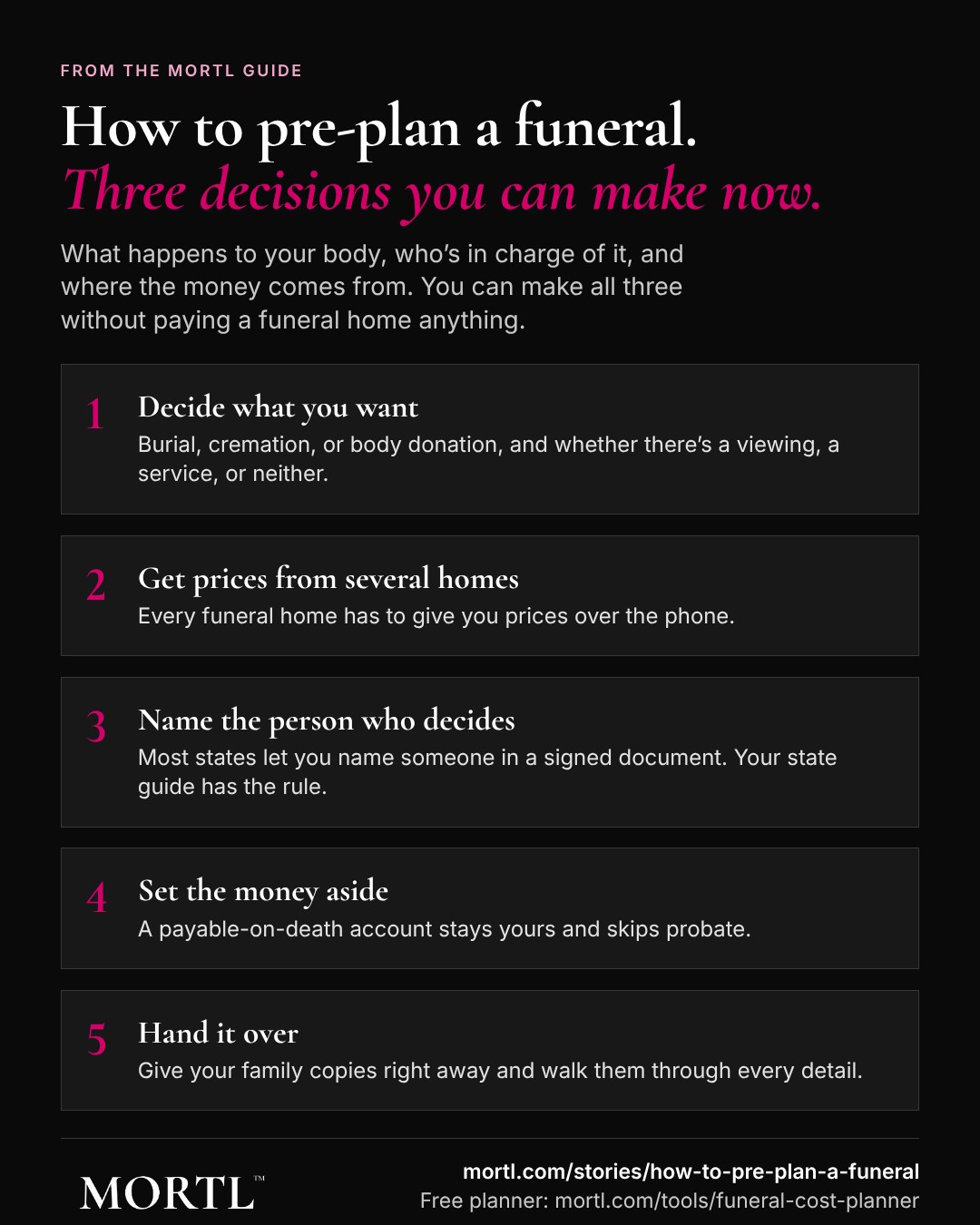
Card with five steps for pre-planning a funeral: decide what you want, get prices from several funeral homes, name the person who decides in a signed document, set the money aside in a payable-on-death account, and give your family copies.
The five steps in one image, for whoever you’re planning with. Open the full-size image.

Step 4: Decide where the money comes from

Paying ahead is optional. These are the common ways to set money aside:

  • A payable-on-death bank account. You name a beneficiary, the money stays yours while you’re alive, and the bank releases it to that person after your death without waiting for probate.[2] Savings in your name alone can be held up for months while an estate goes through probate.[2]
  • Life insurance. A policy pays your named beneficiaries a lump sum soon after your death, outside probate.[2] The Funeral Consumers Alliance cautions against burial insurance and preneed insurance in particular, because buyers usually pay as much as the policy pays out, or more.[2]
  • A prepaid funeral contract. You pay now, and the money goes into a trust account or buys an insurance policy or annuity that pays for the funeral later.[4] Prepaid funeral plans covers the protections and the risks in detail.

Medicaid is the exception. Buying a funeral contract or a burial plot can help you spend down assets to qualify, and money in an irrevocable funeral trust doesn’t count toward the asset limit.[1][4] Asset limits vary by state, so check with your state’s Medicaid office before you sign anything irrevocable.[1][4]

If you prepay, get these answers in writing

  • Is the seller licensed to sell prepaid contracts? Michigan’s consumer guidance warns that not every funeral home is. Check the license, and any disciplinary record, with your state’s licensing agency.[4]
  • Who holds the money, and how is it protected?[1][4]
  • Is the price guaranteed? If it isn’t, your family can be asked for more money later.[1][4]
  • Can you cancel, and how much comes back? If you cancel, move, or change the plan, you may not get a full refund.[1]
  • Can the contract move? Ask what happens if you move, change your mind, or the funeral home closes.[1][4]

Protection differs a great deal by state. The Funeral Consumers Alliance names New York and New Jersey as the two states whose preneed laws come closest to protecting consumers, and New York requires all of the money to be held in trust.[1]

Step 5: Write it down and hand it over

Put the plan on paper: the arrangement, the person in charge, where the money is, and any contract or policy numbers. Then get copies to the people who’ll use them. The Funeral Consumers Alliance says to walk your family through every detail and give them copies right away, and not to put the papers in a lockbox.[1] Families who don’t know a funeral was prepaid can end up paying a second funeral home.[1]

If you sign a prepaid contract, Michigan’s consumer guidance adds three steps: give a copy to someone you trust, keep the original with your important papers, and if you live in a nursing home, give the facility a copy too.[4]

Where MORTL fits

MORTL’s free planning pages cover each step. Plan your funeral starts with your wishes and your price rights. The funeral cost planner prices an arrangement line by line, in the same categories a General Price List uses. How to plan your funeral budget turns the price into a number you can save toward, and your state guide covers who decides and how to name them.

Common questions

How do I pre-plan a funeral without overpaying?

Get prices from several funeral homes for the same arrangement, buy only the items you want, and think hard before prepaying. The Funeral Rule lets you buy goods and services item by item, and the Funeral Consumers Alliance says some funeral homes charge twice as much as others in the same area for the same services.

Should I prepay for my funeral?

The Funeral Consumers Alliance advises planning ahead without paying ahead, unless you need to spend down assets to qualify for Medicaid. If you do prepay, get in writing how the money is protected, whether the price is guaranteed, and whether you can cancel or move the contract.

Who makes funeral decisions if I don’t name anyone?

State law does. Each state sets the order of next of kin who control the body. In most states, naming a person in the form your state accepts puts that person ahead of the order.

Can I put my funeral wishes in my will?

Many states allow it, but a will is often read after the funeral is over, so the wishes can arrive too late. Use a separate signed document if your state allows one, and give copies to your family now.

What’s the lowest-cost way to plan a funeral ahead?

Choose direct cremation or immediate burial, get price lists from several funeral homes, and set the money aside in a payable-on-death bank account. Neither includes embalming or a viewing, and an immediate burial has no ceremony beyond a graveside service.

Does my family have to use the funeral home I planned with?

If you planned without paying, your family can use any funeral home. If you prepaid, it depends on the contract and your state’s law. Many contracts can move to another funeral home, but the new one doesn’t have to honor the first one’s prices.

Sources & References

Research & Citations

All factual claims in this article are sourced from peer-reviewed research, government data, and named institutions. Citations follow APA 7th edition format.

  1. [1]Funeral Consumers Alliance. (n.d.). Pre-planning and pre-paying. ↗ Source Retrieved November 4, 2026
  2. [2]Funeral Consumers Alliance. (n.d.). How to pay for a funeral or other arrangements. ↗ Source Retrieved November 4, 2026
  3. [3]Funeral Industry Practices, 16 C.F.R. Part 453. Electronic Code of Federal Regulations. ↗ Source Retrieved November 4, 2026
  4. [4]State of Michigan. (n.d.). Prepaid funeral contracts. Reinvent Retirement. ↗ Source Retrieved November 4, 2026
  5. [5]Funeral Consumers Alliance. (n.d.). State by state: Assigning an agent to control disposition. ↗ Source Retrieved November 4, 2026
  6. [6]National Funeral Directors Association. (2023, December 8). 2023 NFDA General Price List Study shows inflation increasing faster than the cost of a funeral [Press release, PDF]. ↗ Source Retrieved November 4, 2026

Share this story

Post it, or send it straight to the person who needs it. The link goes with it.

Keep reading on MORTL

Planning

What Is a Prepaid Funeral Plan? How It Works, What It Covers, and What to Check in 2026

A prepaid funeral plan may lock in prices for covered items or help with Medicaid planning. Contract protections, refunds, transfers, and guarantees vary, so review the terms before paying.

10 min read
Planning

How to Choose and Compare Funeral Homes: Services, Prices, and Trust Checks

The same funeral can cost thousands more at one funeral home than at the next. How to get every home's prices, compare them line by line, and check who you're trusting with the body.

9 min read
Planning

How to Plan a Funeral Budget in 2026: A Line-by-Line Worksheet

A funeral budget starts with the arrangement, then the funeral home's lines, then everything the funeral home doesn't set. The national figures for each line, the help that offsets the bill, and a worksheet to fill in.

10 min read
Planning

How Much Does a Funeral Cost in 2026? The Complete US Guide

What a funeral costs in the US, line by line: the national medians for burial and cremation, what they include and leave out, regional prices, what drives the total, and how to budget.

14 min read
Law & Policy

The Funeral Rule: Your Federal Funeral-Price Rights

Federal law gives you rights to itemized prices, telephone quotes, individual services, and outside caskets and urns. Here’s how to use them.

5 min read
Planning

How to Arrange a Funeral, Step by Step

Somebody has to make the calls. Here’s the order that saves money and second trips, and what the law requires versus what the funeral home wants you to think it requires.

9 min read