
Planning

How to Talk to Your Parents About End-of-Life Planning, Step by Step

Most people say the conversation matters and most haven't had it. How to start it with your parents, what to cover, which documents turn it into a plan, and what to do when they say not yet.

An adult son talks with his mother and father at their kitchen table over cups of tea, in black and white

In The Conversation Project’s national survey, 92 percent of Americans say it’s important to talk about their wishes for end-of-life care, and 32 percent have had that conversation.[1] The same 2018 survey found more than half of Americans, 53 percent, would feel relieved if a loved one started it.[2]

Your parents may be waiting for you to go first. Here’s how to start, what to cover, and how to turn the answers into a plan.
Why this conversation stalls

A main reason people put it off, The Conversation Project found, is that it feels too soon.[2] Families also assume they already know what a parent would want. They’re often wrong: in one study cited by the National Institute on Aging, people guessed nearly one out of three end-of-life decisions for a loved one incorrectly.[3]

The institute says people who talk about their future medical care and put a plan in place are more likely to get the care they want, and that it can help their families grieve with less burden, guilt and depression.[3]

Step 1: Start with your own plan

Do the thing you’re about to ask them to do. Name your own health care agent, sign your own documents, and write down where your papers are. Then the conversation opens with something you’ve already done.

The National Institute on Aging says advance care planning is for any age, because a medical crisis can leave anyone unable to make their own health care decisions.[3]

Step 2: Pick the moment and the first line

Choose a calm, private time with nowhere else to be, before a hospital visit forces the subject. Then open with a reason that’s yours:

  • “I just finished my own will and health care forms. Can I ask you how you’ve set yours up?”
  • “A friend’s dad went into the hospital and nobody knew what he wanted. I don’t want that to be us.”
  • “If something happened and you couldn’t speak for yourself, who would you want making the calls?”

Ask what matters to them before you ask about paperwork. The documents follow from the answers.

Step 3: Cover the four things that matter

  1. Medical care. What treatment they’d want or refuse if they were seriously ill and couldn’t speak, and who should make those decisions for them. That person is called a health care proxy, agent or surrogate.[3][4]
  2. Money and legal documents. Whether they have a will, a durable power of attorney for finances, and a living trust, and who they named in each.[4]
  3. Where the papers are. The will with its original signature, insurance policies, account information, deeds and titles, and the key to any safe deposit box.[4] They don’t have to tell you what’s in the accounts, only where to find the papers.[4]
  4. The funeral. Burial or cremation, the kind of service, and any religious or cultural traditions they want followed.[4] How to pre-plan a funeral covers the rest.

You don’t have to finish in one sitting. One topic a visit is still progress.

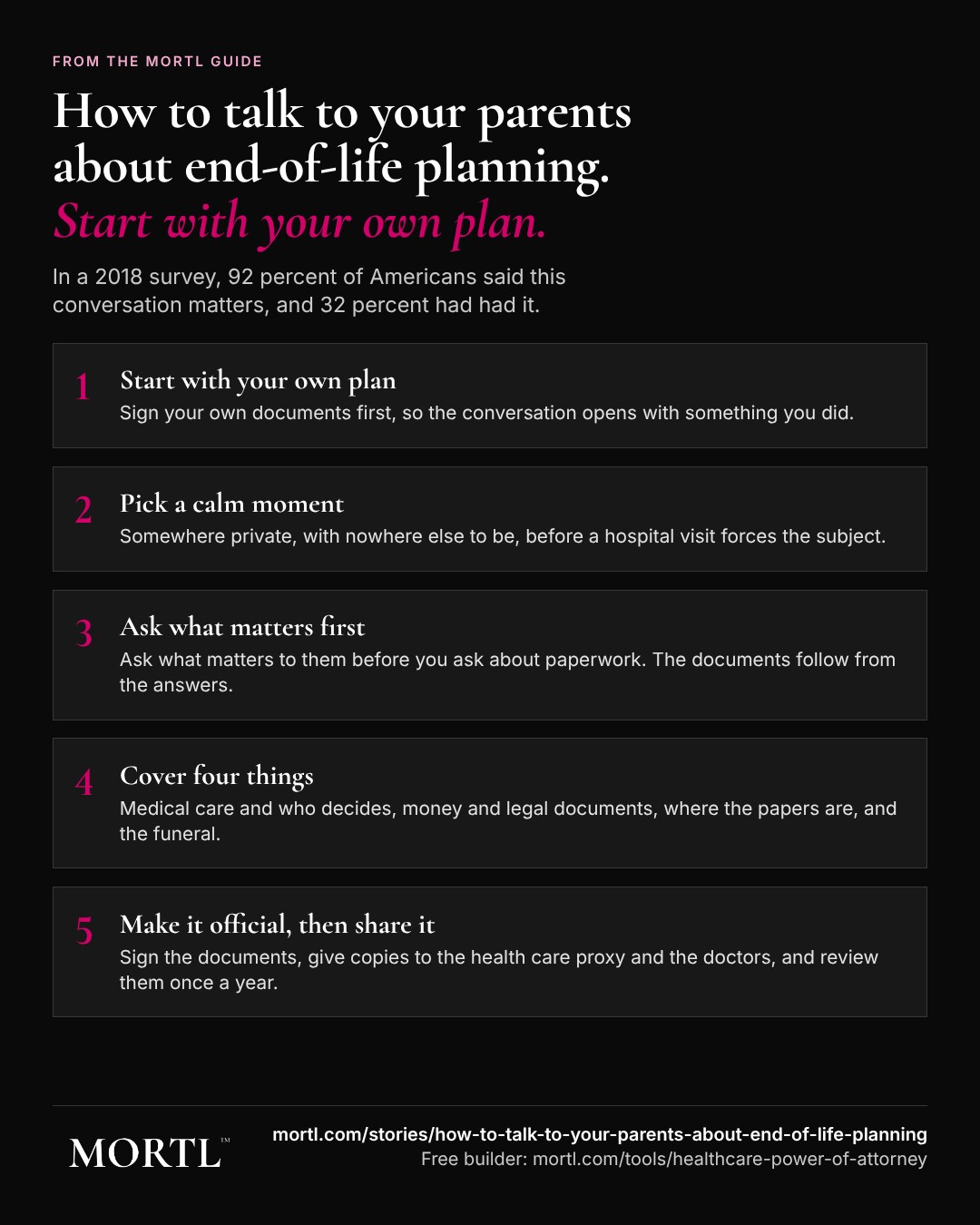
Card with five steps for talking to your parents about end-of-life planning: start with your own plan, pick a calm moment, ask what matters first, cover medical care, money, papers and the funeral, then sign the documents and share copies.
The five steps in one image, for whoever goes with you. Open the full-size image.

Step 4: Turn the answers into documents

The conversation is the most important part of advance care planning, the National Institute on Aging says, and the documents make it official.[3] The common ones:

  • A living will tells doctors which treatments to use or avoid, and when.[4]
  • A durable power of attorney for health care names the health care proxy.[4]
  • A durable power of attorney for finances names someone to make financial decisions when your parent can’t.[4]
  • A will says who gets the estate and can cover funeral wishes. Without one, state law decides.[4]

Your parents don’t need a lawyer for the health care documents. Most states provide the forms for free, and people can complete them themselves.[4] Each state has its own signing rules, such as witnesses or a notary, so use the form and rules for the state they live in. How to get power of attorney for a parent covers who can sign and when.

Step 5: Share copies and keep talking

Once the forms are signed, the National Institute on Aging says to make copies, store them somewhere safe, and give copies to the health care proxy, the doctors and the lawyer.[3] If the originals sit in a bank safe deposit box, keep copies at home.[4]

Then put a date on the calendar. The institute suggests reviewing advance directives at least once a year and after a major life event such as retirement, a move to another state, or a significant change in health.[3]

If they say not yet

Accept the no calmly, and say you’ll come back to it. Then come back with one smaller question. Who would they want to speak for them in a hospital? Where’s the will? A practical question about who to call can be easier to answer than a question about dying.

If a parent’s memory or judgment is slipping, don’t wait long. Signing a power of attorney takes the capacity to understand what it does.[5] If a parent can no longer sign, the family may need a court to name a guardian. What happens when a parent can no longer sign covers the process.

Where MORTL fits

MORTL’s free planning checklist lists every document and step in one place. Its free builders make a will, a living will, a health care power of attorney and a financial power of attorney, and the last three show the signing rules for your parents’ state. Their state guide covers the rest of the state’s rules.

Common questions

How do I start an end-of-life conversation with my parents?

Pick a calm moment before any crisis, and lead with a reason that’s yours: something you just did for your own plan, or a story from a friend. Ask what matters to them before you ask about documents. More than half of Americans in a 2018 survey said they’d feel relieved if a loved one started the conversation.

What should we talk about?

Four things: the medical care they’d want and who should speak for them, their money and legal documents, where the important papers are, and what they want for their funeral or memorial.

What documents should my parents have?

The common ones are a will, a durable power of attorney for finances, and advance directives for health care, usually a living will and a durable power of attorney for health care. Most states provide advance directive forms for free.

What if my parents refuse to talk about it?

Say you’ll come back to it, then do. Ask one smaller question next time, such as who they’d want to speak for them if they couldn’t, and share your own plan first.

How often should we revisit the plan?

The National Institute on Aging suggests reviewing advance directives at least once a year and after a major life event such as a move, retirement or a significant change in health.

Sources & References

Research & Citations

All factual claims in this article are sourced from peer-reviewed research, government data, and named institutions. Citations follow APA 7th edition format.

  1. [1]The Conversation Project. (n.d.). About. Institute for Healthcare Improvement. ↗ Source Retrieved November 4, 2026
  2. [2]The Conversation Project. (2018, April 10). Most Americans “relieved” to talk about end-of-life care [Press release, PDF]. ↗ Source Retrieved November 4, 2026
  3. [3]National Institute on Aging. (2022, October 31). Advance care planning: Advance directives for health care. ↗ Source Retrieved November 4, 2026
  4. [4]National Institute on Aging. (2023, February 1). Getting your affairs in order checklist: Documents to prepare for the future. ↗ Source Retrieved November 4, 2026
  5. [5]Lone Star Legal Aid. (2024). Conservatorship, guardianship, and power of attorney: What is the difference? [PDF]. ↗ Source Retrieved November 4, 2026

Share this story

Post it, or send it straight to the person who needs it. The link goes with it.

Keep reading on MORTL

Planning

How to Get Power of Attorney for an Aging Parent

Power of attorney is something your parent gives you, by signing while they can still make their own decisions. How the financial and health care versions work, the steps, and what happens if it's too late to sign.

9 min read
Planning

What Is an Advance Directive? Your State’s Form, Your Choices, and How to Sign It

What an advance directive is, what goes in it, where to get your state’s form for free, and how to sign it so it counts.

11 min read
Grief

Nobody Warns You That Your Parents Start Dying in Your 30s

One phone call and you're suddenly the adult. What to actually ask, what to set up before the crisis, and why you feel like a kid and the CEO at the same time.

11 min read
Planning

How to Pre-Plan a Funeral Without Overpaying: A Step-by-Step Guide

Pre-planning a funeral means three decisions: what happens to your body, who's in charge of it, and where the money comes from. You can make all three without paying a funeral home anything.

9 min read
Law & Policy

Are You Responsible for Your Parents' Debt When They Die?

In almost every case you're not responsible for your parents' debt when they die. Their estate pays what it can; if it can't, the debt usually goes unpaid, and a collector who says you must pay is often wrong.

6 min read
Law & Policy

What Happens If You Die Without a Will in 2026

When someone dies without a valid will, state intestacy law controls probate assets. Learn who may inherit, which assets follow other rules, and where state-specific advice matters.

5 min read