
Planning

How to Get Power of Attorney for an Aging Parent

Power of attorney is something your parent gives you, by signing while they can still make their own decisions. How the financial and health care versions work, the steps, and what happens if it's too late to sign.

A woman sits beside her father at an office desk as he signs a legal document, in black and white

Power of attorney is something your parent gives you, by signing a document that names you as their agent, and they have to have the capacity to sign it: to understand what they’re signing and what they’re letting you do.[6] If they no longer can, the family may need a court to name a guardian or conservator to manage their money, and state law decides who makes their medical decisions, typically a spouse, a parent or an adult child.[2][5]

Here’s how it works, step by step, and what to do if it’s already too late to sign.
The two powers of attorney a parent can sign

  • A durable power of attorney for finances names someone to make financial decisions when your parent can’t.[4] “Durable” means it stays valid after your parent loses the ability to make decisions, which is the point for an aging parent.[1]
  • A durable power of attorney for health care names a health care agent, also called a proxy, to make medical decisions when your parent can’t, such as which doctors, treatments and care settings.[1][4]

Some financial powers of attorney take effect when they’re signed. A springing one lets your parent keep managing their own money as long as they can make sound decisions.[2] Either way, the Alzheimer’s Association says a power of attorney doesn’t let the agent override your parent’s decisions while your parent still has legal capacity.[1]

A will is a separate document. The executor it names has no authority while your parent is alive.[1]

Step 1: Talk it through with your parent

Your parent picks the agent, and the agent should understand the job before saying yes. The Alzheimer’s Association recommends that the agent and your parent talk through what the responsibility involves, and that the document name a successor agent in case the first can’t serve.[1] How to talk to your parents about end-of-life planning covers how to start.

Step 2: Your parent signs, while they still can

The person signing a power of attorney has to understand what they’re signing and what they’re authorizing the agent to do.[6] A person living with dementia keeps the right to make their own decisions as long as they have legal capacity, so a diagnosis alone doesn’t end the chance to sign.[1]

Once capacity is gone, your parent can’t sign one, and the family may need a court to name a guardian or conservator.[2][6] The National Institute on Aging tells families of someone with dementia to start these discussions as early as possible.[5]

If you’re not sure your parent can still sign, talk to an elder law attorney before the signing.

Step 3: Follow your state’s signing rules

Laws vary from one state to another.[1] Each state sets its own rules for who signs, whether a notary or witnesses are needed, and which form to use. Use the rules of the state your parent lives in.

MORTL’s free financial power of attorney builder and health care power of attorney builder show the signing rules for your parent’s state, with the official source behind them. Most states provide advance directive forms for health care for free, and people can complete them without a lawyer.[4]

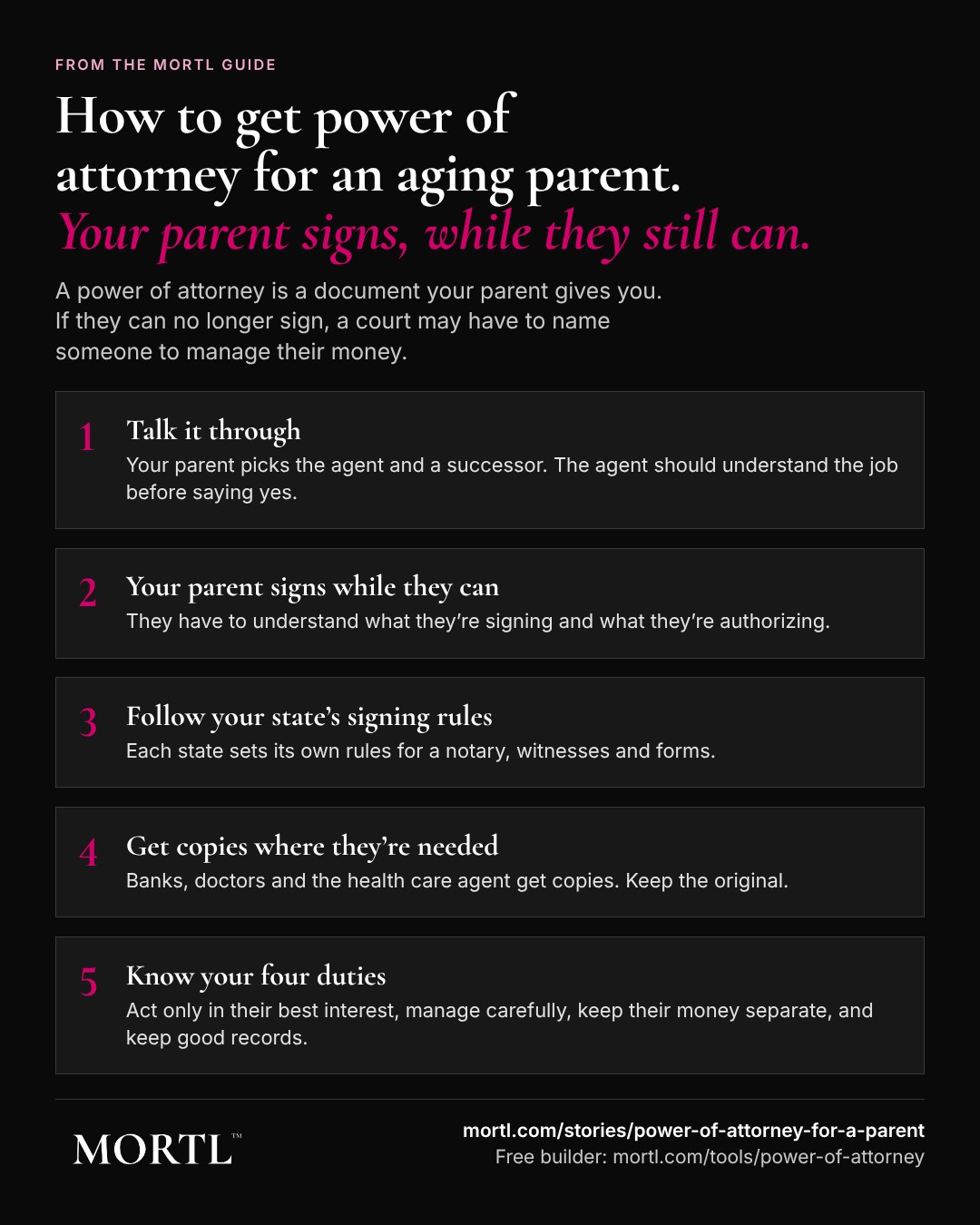
Card with five steps for getting power of attorney for an aging parent: talk it through, your parent signs while they have capacity, follow your state’s signing rules, get copies to banks and doctors, and know the agent’s four duties.
The steps and the agent’s duties in one image. Send it to your siblings. Open the full-size image.

Step 4: Get copies to the people who need them

  • Health care documents go to the health care agent, the doctors and the lawyer, with copies stored somewhere safe.[5]
  • The financial power of attorney goes to the banks and other businesses your parent deals with, as soon as you need to act. Give them copies and never give away the original. You can get certified copies.[3]
  • Permission to talk. Your parent can also give doctors, lawyers, insurers and banks permission in advance to talk with you, which may mean signing their forms.[4]

Some banks refuse a power of attorney and want their own form signed, which is a problem once your parent can’t sign anything. If a business won’t accept your authority, ask for a supervisor, then talk to a lawyer. State law may require it to accept the power of attorney.[3]

If your parent can no longer sign

A court can name a guardian or conservator to manage your parent’s money and property if it finds they can’t manage it themselves and there’s no power of attorney in place, and it can give financial and health care decisions to one person or to different people.[2] Medical decisions may not need a court: when there’s no advance directive, state law names who decides, typically a spouse, a parent or an adult child.[5]

Guardianship takes time. It involves an attorney and testimony in court, the guardian is supervised by the court, and the rules vary by state.[1] Lone Star Legal Aid calls it a last resort, for when a person can’t sign a power of attorney or use another option.[6] The Alzheimer’s Association says any family considering it should talk to an elder care attorney who knows the process in that state.[1]

Your duties once you’re the agent

An agent is a fiduciary. The Consumer Financial Protection Bureau lists four basic duties: act only in your parent’s best interest, manage their money and property carefully, keep their money and property separate from yours, and keep good records.[3]

Your authority ends if your parent revokes it, and it ends when they die. Tell the bank and the other businesses you dealt with when that happens.[3] What happens to power of attorney at death covers what comes next.

Where MORTL fits

MORTL’s free builders make a financial power of attorney, a health care power of attorney and a living will, and each one shows the signing rules for your parent’s state with the official source behind them. The planning checklist tracks what’s signed and what isn’t, and your parent’s state guide covers the rest of their state’s rules.

Common questions

Can I get power of attorney for my parent without them signing?

No. A power of attorney is a document your parent signs to give you authority. If your parent can no longer make decisions and never signed one, a court can appoint a guardian or conservator instead.

Can a parent with dementia sign a power of attorney?

Yes, as long as they still have legal capacity: they understand what they’re signing and what they’re authorizing. A diagnosis alone doesn’t end that. Sign as early as possible, and ask an elder law attorney if capacity is in doubt.

What’s the difference between power of attorney and guardianship?

Your parent chooses the agent in a power of attorney and signs it. A guardian or conservator is appointed by a court, after a court process that takes time, and answers to the court.

Does power of attorney end when my parent dies?

Yes. The agent’s authority ends at death. After that, the executor named in the will, or an administrator the court appoints if there’s no will, handles the estate.

What if the bank won’t accept the power of attorney?

Ask for a supervisor. If they still refuse, talk to a lawyer: state law may require the bank to accept it. Give the bank a copy and keep the original.

Sources & References

Research & Citations

All factual claims in this article are sourced from peer-reviewed research, government data, and named institutions. Citations follow APA 7th edition format.

  1. [1]Alzheimer’s Association. (n.d.). Legal documents. ↗ Source Retrieved November 4, 2026
  2. [2]Consumer Financial Protection Bureau. (2021, May). Considering a financial caregiver? Know your options [PDF]. ↗ Source Retrieved November 4, 2026
  3. [3]Consumer Financial Protection Bureau. (n.d.). Managing someone else’s money: Help for agents under a power of attorney [PDF]. ↗ Source Retrieved November 4, 2026
  4. [4]National Institute on Aging. (2023, February 1). Getting your affairs in order checklist: Documents to prepare for the future. ↗ Source Retrieved November 4, 2026
  5. [5]National Institute on Aging. (2022, October 31). Advance care planning: Advance directives for health care. ↗ Source Retrieved November 4, 2026
  6. [6]Lone Star Legal Aid. (2024). Conservatorship, guardianship, and power of attorney: What is the difference? [PDF]. ↗ Source Retrieved November 4, 2026

Share this story

Post it, or send it straight to the person who needs it. The link goes with it.

Keep reading on MORTL

Planning

How to Talk to Your Parents About End-of-Life Planning, Step by Step

Most people say the conversation matters and most haven't had it. How to start it with your parents, what to cover, which documents turn it into a plan, and what to do when they say not yet.

9 min read
Law & Policy

Power of Attorney, Explained

A power of attorney decides who can act for you while you're still alive. Here's the durable vs. springing choice, what your agent can and can’t do, what it costs, and how to undo it. The free version runs under $30.

8 min read
Law & Policy

Your Power of Attorney Dies When You Do

The most common misconception in estate planning: that a power of attorney keeps working after death. It doesn't. At death, the document no longer gives the agent authority. Here's what takes over.

5 min read
Planning

What Is an Advance Directive? Your State’s Form, Your Choices, and How to Sign It

What an advance directive is, what goes in it, where to get your state’s form for free, and how to sign it so it counts.

11 min read
Law & Policy

Are You Responsible for Your Parents' Debt When They Die?

In almost every case you're not responsible for your parents' debt when they die. Their estate pays what it can; if it can't, the debt usually goes unpaid, and a collector who says you must pay is often wrong.

6 min read
Grief

Nobody Warns You That Your Parents Start Dying in Your 30s

One phone call and you're suddenly the adult. What to actually ask, what to set up before the crisis, and why you feel like a kid and the CEO at the same time.

11 min read