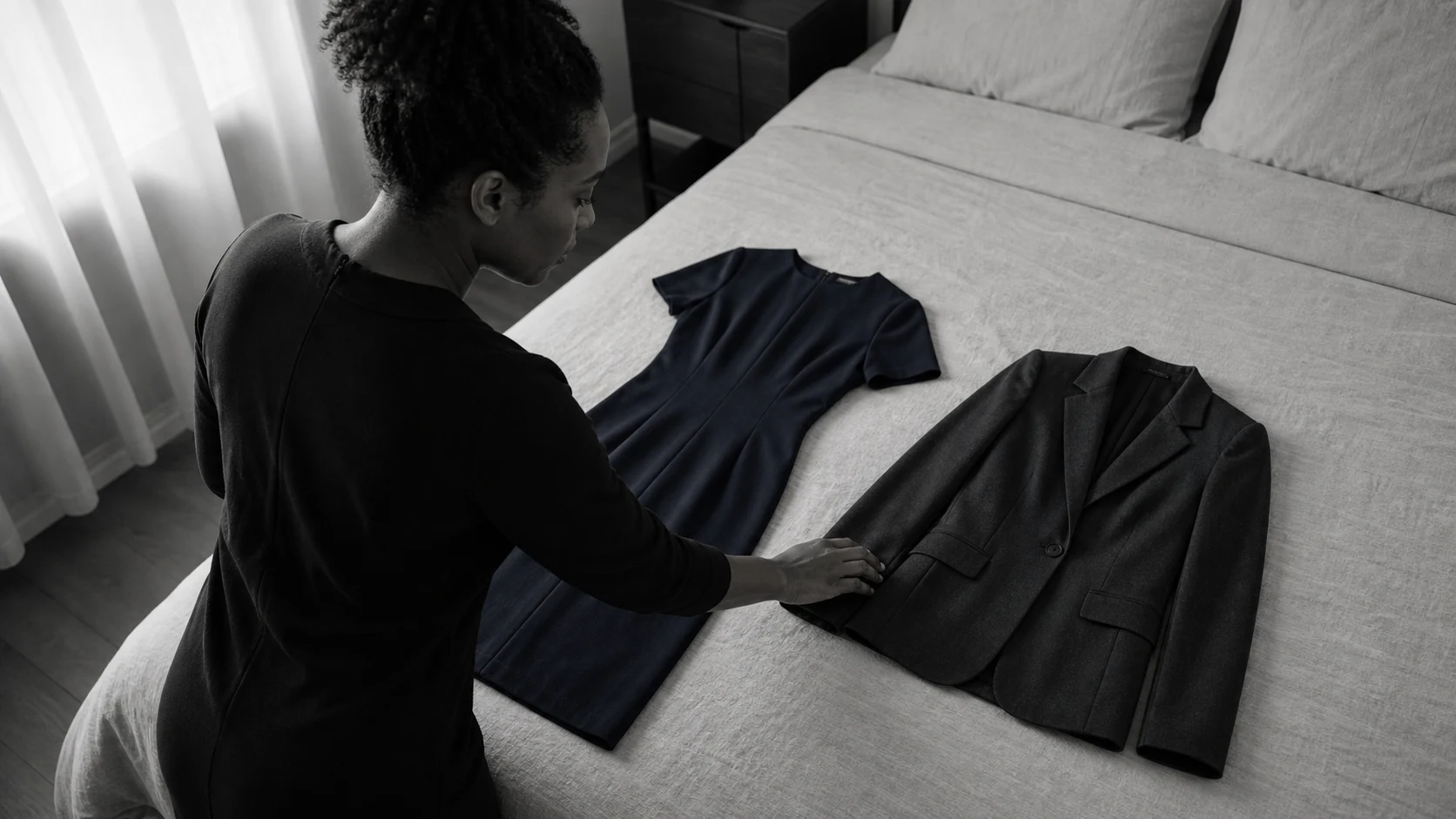
Dark, plain, clean, covered. That's what to wear to a funeral, and everything below is detail. The test for a funeral outfit is simple: if nobody remembers what you wore, you dressed correctly. The family should hold the room's attention.
The Short Answer
For men: a dark suit if you own one. If you don't, dark slacks or chinos, a collared shirt, and a tie or dark sweater cover nearly every funeral in America. Clean, dark shoes.
For women: a dark dress, or dark slacks or a skirt with a quiet top. A layer over bare shoulders, hemlines at the knee or longer, and shoes you can stand in for an hour, because you will stand for an hour. Simple jewelry.
For anyone: clean, pressed, and fitted well enough that you won't tug at it. Comfort counts more than people admit. You'll sit, stand, hug strangers, and possibly walk on grass, and an outfit that needs constant adjusting will distract you all day.
Funeral Attire for Women
The baseline is a dark dress, or dark slacks or a skirt with a quiet top. Black, navy, and charcoal all work, and dark business clothes you already own, including a pants suit, pass at nearly every American service.
- Shoulders and hemline. Bring a layer for bare shoulders: a cardigan, blazer, or wrap, especially in a house of worship. Knee length or longer is the safe hemline.
- Shoes. You'll stand more than you sit: the receiving line, the lobby, the graveside. Flats, low block heels, or clean dark boots. Thin heels sink into cemetery grass.
- Jewelry and makeup. Simple. Funerals involve hugging, crying, and hugging people who are crying. Waterproof mascara is the practical pick.
- A bag with room. Tissues, water, phone on silent. A small dark shoulder bag beats a clutch you'll juggle through a receiving line.
Nothing on this list requires shopping. The darkest, plainest, cleanest things already in your closet almost always add up to a correct outfit.
Funeral Attire for Men
For guys, the answer is short. A dark suit if you own one, a muted shirt, a dark tie, dark shoes. That's correct at every funeral in America and you can stop reading here.
If you don't own a suit: dark slacks or chinos, a collared shirt, and a dark sweater or blazer if you have one. A tie helps at formal and religious services and can stay home at casual ones. If your only decent shoes are work boots, clean them and wear them without apology.
- Fit beats formality. A pressed shirt that fits beats a borrowed jacket that doesn't.
- Hats come off indoors, unless the tradition says otherwise: a kippah stays on in a synagogue. When in doubt, watch the room.
- Belt matches shoes. Dark with dark. Nobody's inspecting, and it's one less thing.
- Skip the statement watch and the cologne. Both pull attention, and attention belongs on the family.
What Kids and Teens Should Wear
Kids don't need funeral clothes. Dark or muted school clothes, clean and free of characters and slogans, are correct for any child at any service. Clean sneakers pass; nobody checks a seven-year-old's feet.
For teens, the standard is what they'd wear to a scholarship interview: dark jeans or slacks, a plain shirt or sweater, real shoes if they own them. Don't force a teenager into a suit that doesn't fit. An uncomfortable kid fidgets, and a comfortable kid in plain dark clothes draws no attention, which is the goal for everyone.
Let kids ask what they should wear. It's often their first funeral, and picking clothes is a concrete way to get ready for a day nobody's explained to them. The rest of that preparation is in your first funeral: what to expect.
Does It Have to Be Black? The Colors That Are Safe
No. Black is the traditional Western mourning color and it's always safe, but the actual standard at American funerals is dark and muted. Navy, charcoal, deep brown, forest green, and burgundy all pass without comment. A dark pattern that reads quiet from across a room is fine at most services.
Muted matters more than the exact shade. A charcoal sweater belongs at a funeral. A black sequined dress doesn't, even though it's black. Judge the outfit by how much attention it asks for, and pick the one that asks for none.
Two cautions. Bright red asks for more attention than any other color, so leave it home unless the family requested color. And a full white outfit reads wrong at a conventional American funeral, while white is the expected mourning color at many Hindu, Buddhist, and Chinese services. The tradition hosting the funeral decides what white means that day; the section on other traditions below covers how to find out.
Can You Wear Jeans to a Funeral?
The honest answer is sometimes, and here's how to tell.
Jeans pass when they're dark, clean, and intact, worn with a collared shirt or sweater and real shoes, at a casual service: a small-town funeral, a graveside gathering, a celebration of life at a brewery. In plenty of rooms, dark jeans worn well beat a borrowed suit that fits badly, and the family won't spend one second thinking about your pants.
Jeans fail when the service is in a house of worship, when the family runs formal, or when the announcement uses words like "service" and "liturgy" without any softening. Ripped, faded, or light-wash jeans fail everywhere.
When you can't tell, dress one step up. Overdressing at a funeral reads as respect. Underdressing reads as a statement, even when you didn't mean to make one.
Funeral, Memorial Service, or Graveside: What Changes
The federal Funeral Rule draws the line plainly: a funeral ceremony is a service commemorating the deceased with the body present, and a memorial service is a ceremony without the body present.[1] That one difference moves the dress code.
A funeral is the most formal version of the event, especially in a house of worship. Dress at the top of your range: the suit, the dark dress.
A memorial service happens without the body, often weeks or months after the death, and often somewhere other than a funeral home: a community hall, a restaurant, a park, a backyard. The baseline stays dark and plain, and the venue sets the formality. A memorial in a church calls for funeral dress. A memorial in the family's backyard calls for what you'd wear to dinner at that house, in quiet colors. The announcement names the venue for a reason; read it as instructions.
A graveside or committal service is the short ceremony at the grave, held after the funeral or as the whole event. It has its own physical demands, covered next.
Attending a wake or visitation instead? Same rules as the funeral, or one small step less formal.
What to Wear to a Burial Ceremony
A burial ceremony, the graveside service, happens outdoors, standing, on grass. Dress for those three facts and you've got it.
- You'll stand. Seating at a graveside is usually a few chairs under a canopy, and those go to the immediate family, so assume you'll be on your feet the whole time. At VA national cemeteries the committal service generally runs 20 minutes.[2] Wear shoes you can stand still in for at least that long.
- You'll stand on grass. Cemetery ground is soft and uneven. Thin heels sink. Flats, low block heels, wedges, or clean dark boots.
- You'll walk to get there. The grave is often a few hundred feet from where you park, across lawn. Pick shoes for the walk and give yourself five extra minutes.
- Weather decides part of the outfit. There's no indoors to retreat to. Sun in July, wind in January, mud after rain. A dark umbrella, a real coat, sunglasses you'll take off during the service. A grieving family has never once been offended by a parka.
If the burial follows a funeral service, you don't change clothes between them. One outfit covers both; just make sure the shoes can do the cemetery.
Summer Funerals, Winter Funerals
Summer: lightweight dark fabrics, and skip the jacket at all but the most formal services. A dark short-sleeved collared shirt or a breathable dress beats visibly sweating through wool. Bring water for a graveside service in July.
Winter: the graveside portion happens outside. Wear the warm coat, a dark one if you own it. Gloves, boots, and a scarf are all fine.
Outdoor services, any season: the announcement usually names the setting for a reason. A trail memorial or a beach scattering comes with an implied dress code, and sturdy shoes are part of it.
What to Wear to a Celebration of Life
Check the announcement first, every time. Families increasingly design services around the actual person,[3] and that includes telling you what to wear: bright colors because she hated black, Hawaiian shirts because that's all he owned, the team jersey. When a family sets a dress code, follow it exactly. Showing up in black to a "wear orange, it was her favorite color" gathering refuses the one request a grieving family made of you.
With no stated code, wear what you'd wear to a nice dinner, in quieter colors. A celebration of life runs less formal than a funeral, but it's still a room built around a death, and club wear misreads it in either direction.
What a celebration of life involves, and how it differs from a funeral, is covered in our celebration of life guide.
When the Funeral Comes From a Tradition You Don't Know
Mourning colors are cultural, and black is only one tradition's answer.
White is the mourning color across much of South and East Asia. At many Hindu funerals, mourners of both sexes wear white, and black is considered inappropriate.[4] Guidance written for Hindu services held in the US says the same thing: dress simply and conservatively, white preferred, black never required.[5]
In the Sri Lankan Theravada Buddhist tradition, white cloth marks the funeral and mourners arrive dressed in white.[6] In Chinese tradition, white clothes have been the primary symbol of mourning for over two thousand years.[7] If you show up to one of these services in your funeral black, nobody will scold you, but the goal is to do better than tolerated.
Head coverings and modesty rules vary too. At Jewish funerals it's customary for men to wear a head covering, the kippah, and kippot are generally available at the funeral home or cemetery, so take one at the door and wear it.[8] Wearing one as a guest shows respect for the room. It doesn't declare a belief.
At services in a mosque, visitors remove shoes before entering the prayer hall, clothing covers shoulders and knees, and many mosques ask women to cover their hair inside the prayer area,[9] so women can carry a scarf. Wear socks you're willing to be seen in. Some churches still expect covered shoulders.
All you have to do is find out, and finding out is easy: the obituary often says, the family's announcement often says, and the funeral home answers this exact question every single day. Call and ask "what's customary for guests?" That question is respectful, normal, and takes ninety seconds. When all else fails, arrive slightly early, watch the room, and copy it.
When You Don't Own Anything Right
Skip the store. The correct funeral outfit is almost always already in your closet: the darkest pants you own, the plainest shirt or sweater, the cleanest shoes. Ironed. That combination, in any dark colors, outranks a brand-new suit you can't move in.
If your darkest clothes are gray, dark green, or brown, wear them. If your only pants are jeans, wear the dark pair with the best top you own. If everything you own has a logo, pick the smallest one. Every one of these beats staying home, because showing up matters and your outfit will be forgotten by dinner.
Nobody at a funeral is pricing your clothes. The event itself is the expensive part: the 2023 national median was $8,300 for a funeral with viewing and burial, excluding cemetery costs.[10] Your part costs nothing. Clean, dark, plain, present.
If you have a few days and want one upgrade, a plain dark sweater or dark slacks from a thrift store covers the gap, and borrowing from someone your size works just as well.
What Not to Wear
The short list, honestly kept:
- Logos, slogans, and graphic prints. The casket gets the room's attention today.
- Gym clothes, athleisure, shorts, and flip-flops, unless the family's stated dress code says otherwise.
- Anything you'd wear out on a Saturday night. If it's designed to attract attention, it's designed for a different room.
- Strong perfume or cologne. Funerals pack a lot of people into still air, and someone in that room is already nauseated from grief and no sleep.
- Brand-new shoes. You'll stand longer than you think, and a funeral is a bad place to break in leather.
- Anything that needs constant adjusting. If you'll fidget with it, leave it home.
Dressed and still nervous about the day itself? The full walkthrough is in your first funeral: what to expect.
Common questions
What is proper funeral attire?
Dark, muted, clean, and modest. For men, a dark suit or dark slacks with a collared shirt. For women, a dark dress, or dark slacks or a skirt with a quiet top, shoulders covered, hemline at the knee or longer. Black, navy, charcoal, deep brown, and forest green all qualify. Clean dark shoes finish it.
What should a woman wear to a funeral?
A dark dress, or dark slacks or a skirt with a quiet top. Cover bare shoulders with a layer, keep hemlines at knee length or longer, and wear shoes you can stand in for an hour. Keep jewelry and makeup simple.
What should a man wear to a funeral?
A dark suit if you own one. If you don't, dark slacks or chinos with a collared shirt, plus a tie or dark sweater if you have them, work at nearly every service. Clean, dark shoes. A jacket helps but a clean, pressed shirt matters more.
What do you wear at a funeral for guys?
A dark suit with a muted shirt and dark tie if you own one. If you don't, dark slacks or chinos, a collared shirt, and a dark sweater or blazer pass at nearly every American funeral. Clean dark shoes, belt to match. Skip the cologne, and take the hat off indoors unless the tradition says otherwise.
What should kids wear to a funeral?
Dark or muted school clothes, clean, with no characters or slogans. Kids don't need suits or funeral dresses, and clean sneakers are fine. Teens dress like they would for a scholarship interview: dark pants, a plain shirt or sweater. Comfort matters; an itchy outfit makes a long service longer for everyone.
Do you have to wear black to a funeral?
No. Black is always safe, but navy, charcoal, deep brown, forest green, and other dark muted colors all work at American funerals. Muted matters more than the exact color. The goal is that nobody remembers what you wore.
Can you wear jeans to a funeral?
Sometimes. Dark, clean jeans with no rips, worn with a collared shirt or sweater and real shoes, pass at casual, rural, and celebration-style services, and they beat a badly fitting suit you borrowed. Skip jeans when the service is in a house of worship or the announcement reads formal. When you can't tell, dress one step up.
What do you wear to a burial ceremony?
Dark, plain clothes you can stand in outdoors. A graveside service happens standing on grass, in whatever weather the day brings. Flat or low shoes, because thin heels sink into turf. In winter wear the warm coat; in summer, lightweight dark fabrics. If the burial follows the funeral service, the same outfit covers both.
What do you wear to a memorial service?
The same baseline as a funeral: dark, plain, clean. A memorial service happens without the body present, often weeks after the death, and the venue sets the formality. A church memorial calls for funeral dress. A memorial at a restaurant, park, or home calls for what you'd wear to a nice dinner, in quiet colors. Check the announcement; families often say exactly what they want.
What do you wear to a celebration of life?
Check the announcement first. Families often set a dress code on purpose: bright colors, Hawaiian shirts, the person's team jersey. If they did, follow it, because wearing black to a "wear orange" party refuses a grieving family's request. With no stated code, wear what you'd wear to a nice dinner, in quieter colors.
Is it disrespectful to wear bright colors to a funeral?
At a standard American funeral, yes, bright colors pull attention, and attention belongs on the family. The exceptions are services where the family requests color, and traditions with their own conventions. At many Hindu services, white is the expected mourning color. When in doubt, the obituary or the funeral home will tell you.
What are proper clothes for a funeral?
The darkest, plainest, cleanest clothes you own, pressed and fitted well enough that you won't tug at them. No logos, slogans, athleisure, or anything designed to draw attention. A suit isn't required at most American services; dark slacks and a collared shirt, or a simple dark dress, meet the standard.
Sources & References
Research & Citations
All factual claims in this article are sourced from peer-reviewed research, government data, and named institutions. Citations follow APA 7th edition format.
- [1]Legal Information Institute, Cornell Law School. (n.d.). 16 CFR § 453.1: Funeral industry practices, definitions. Code of Federal Regulations. ↗ Source Retrieved August 8, 2026
- [2]U.S. Department of Veterans Affairs, National Cemetery Administration. (n.d.). The committal service. ↗ Source Retrieved August 8, 2026
- [3]National Funeral Directors Association. (2026, June). NFDA study finds families seek more personalized, transparent end-of-life services [Press release]. The National Law Review. ↗ Source Retrieved August 8, 2026
- [4]Funeralwise. (n.d.). Hindu funeral customs. ↗ Source Retrieved August 8, 2026
- [5]Hollywood Forever Cemetery. (n.d.). What to expect at a Hindu funeral in the US. ↗ Source Retrieved August 8, 2026
- [6]Lion's Roar. (n.d.). Buddhist funeral traditions. ↗ Source Retrieved August 8, 2026
- [7]Timothy S. Y. Lam Museum of Anthropology, Wake Forest University. (n.d.). White. In Poems made to wear: Traditional colors in East Asia. ↗ Source Retrieved August 8, 2026
- [8]My Jewish Learning. (n.d.). Jewish funerals: What to expect when you go. ↗ Source Retrieved August 8, 2026
- [9]Jamia Masjid Chicago. (n.d.). What to wear to a mosque. ↗ Source Retrieved August 8, 2026
- [10]National Funeral Directors Association. (2023). 2023 NFDA General Price List Study shows inflation increasing faster than the cost of a funeral. ↗ Source Retrieved August 8, 2026
Share this story
Post it, or send it straight to the person who needs it. The link goes with it.