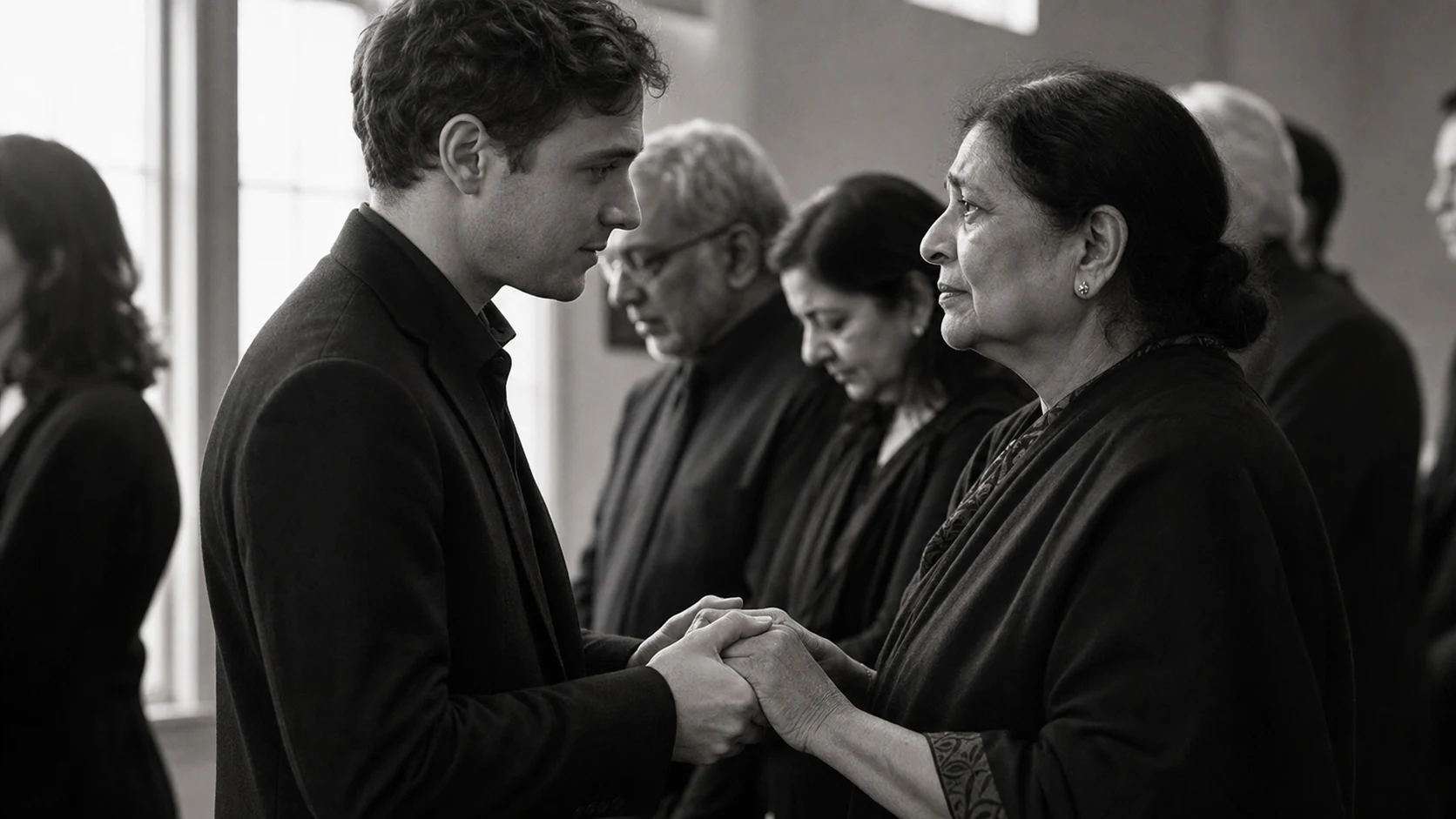
One true sentence, your name, and how you knew them. That's the whole job, and everything below is refinement. People rehearse funeral words in the car because they believe the family needs something profound. The family needs the opposite: short, true, and kind, from a person who showed up.
What You're Actually There to Say
The family will meet dozens of people in an hour, running on no sleep, and they'll remember almost none of what gets said to them. That's the design constraint. Short and true beats eloquent every time.
The template: the sorrow, your name, the connection.
- "I'm so sorry. I'm Dana, I worked with Mike at the plant for ten years."
- "I'm James, I lived next door to your mom. She was so good to us."
- "We're heartbroken. Ellen taught both our kids. I'm Priya."
And yes, "I'm sorry for your loss" is fine. It gets mocked as a cliché by people who've never stood in the line. It's short, it's true, it's kind, and the two hundredth person to say it that day is still helping. If you upgrade it, upgrade toward specific, never toward fancy.
If You Add Anything, Add a Memory
One specific memory, told in a sentence or two, is the best thing a grieving family hears all day.
- "He taught me to back a trailer in the church parking lot. Never raised his voice once."
- "She covered my shifts for a month when my dad was sick. A whole month."
- "Your dad wrote me a recommendation letter in 1998. I still have it."
A memory does what no condolence phrase can: it shows the family their person is remembered as a person, in specific scenes, by people they didn't even know about. Grief experts consistently point to hearing the person's name and stories as one of the things mourners actually want.[1] Two sentences. The family will repeat them to each other tonight.
What to Skip
The funeral-day list, kept short and honest:
- "How did they die?" Never. If the family wants you to know, they'll tell you.
- Anything starting with "at least." "At least she lived a long life." "At least he isn't suffering." Every "at least" asks the family to shrink their grief for your comfort.[2]
- Explanations. "Everything happens for a reason." "They're in a better place." "God needed an angel." Religious comfort belongs only where you know it's shared, and explanations of a death belong nowhere.
- Your own loss story, in the line. "I know exactly how you feel, when my mother died..." makes the moment about you. Save it for a later conversation the griever chooses to have.
- "Let me know if you need anything." Well meant, and it hands an exhausted person a job: figuring out what to ask you for. Name the thing instead. "I'm bringing dinner Thursday." "I've got the school pickup next week."
The full inventory of grief phrases that fail, and what to say instead, is in what to say to someone who is grieving and grief quotes that don't lie.
What to Write in the Sympathy Card
Three sentences carry a whole card:
- The sorrow: "I'm so sorry about Ray."
- A specific memory: "I'll never forget him teaching half the neighborhood to drive a stick shift, laughing the whole time."
- Something ongoing: "I'll call you next month to take you to lunch."
Then sign it. Done. A specific memory in plain handwriting outperforms every printed poem in the card aisle. If you're including money for the family or a gift card for food, add one line so it doesn't read as strange: "Please put this toward whatever this month needs."
Timing: a card at the funeral is good, and a card in month two is better. The family's mailbox fills for three weeks and then empties. The card that arrives after everyone else stopped writing tells them the remembering didn't end with the casseroles.
When Talking Happens, and When It Doesn't
Each part of the day has its own volume, and knowing it beats guessing:
- The wake or visitation: talking is the point. Greet the family, then hold quiet, normal conversation with the other guests, stories included. What a wake involves is covered in what is a wake.
- The service: no talking. Your presence is the entire message for this hour.
- The reception: talking again, and this is where the stories belong. Tell the family the specific one you've been carrying.
- The parking lot: keep it to a hug or a sentence. The family has been performing composure for six hours and they're done.
And if you never get a word with the family at all, you haven't failed. The guest book recorded you, your face in the room did the work, and a card next week finishes it. Never force the moment; the line was long because their person was loved, and that's the point of the day.
The Words That Matter Most Come Later
Everything above covers one day. The family's grief lasts far longer than that, and the words that help most get said after the crowd goes home.[1]
A month out, send a text with the person's name in it: "Thinking about Ray today. That stick-shift story still makes me laugh." People avoid saying the name because they're afraid of reminding the family. The family hasn't forgotten. They're afraid everyone else has, and hearing the name from you disproves it.[1]
Mark the calendar for the hard dates too: the birthday, the holidays, the anniversary of the death. One sentence on each of those days, for the first year, makes you one of the people who stayed. The complete guide to those later conversations, including what to text, is in what to say to someone who is grieving.
Common questions
What do you say to the family at a funeral?
One true sentence, your name, and how you knew their person. "I'm so sorry. I'm Dana, I worked with Mike for ten years." If you add anything, add one specific memory in a sentence or two. Then step aside; the line behind you is long and the family is exhausted.
What do you say at a viewing or wake?
The same as at the funeral, with a little more room to talk. Introduce yourself, say how you knew the person, offer one memory. At the casket you can say something silently or nothing at all. Quiet conversation with other guests about the person is what a wake is for.
What do you write in a sympathy card?
Three sentences: the sorrow, a specific memory, and something ongoing. "I'm so sorry about Ray. I'll never forget him teaching half the neighborhood to drive a stick shift. I'll call you next month." Specific beats long, and a card that arrives in month two, after everyone else has stopped, lands hardest.
What should you not say at a funeral?
Don't ask how they died. Skip every sentence that starts with "at least." Don't explain the death with "everything happens for a reason" or "they're in a better place," don't compare it to your own loss in the condolence line, and don't say "let me know if you need anything," which hands a grieving person a job. Name a concrete thing instead: "I'm bringing dinner Thursday."
Is "sorry for your loss" okay to say?
Yes. It's short, true, and kind, and the family will hear it two hundred times that day without minding once. Add your name and how you knew the person and it does exactly what funeral words are supposed to do. Skip it only in favor of something more specific, never something fancier.
Do you have to talk to the family at a funeral?
No. If the line is long, the moment never comes, or you can't do it, the guest book already recorded that you were there, and that's what the family keeps. A card mailed the following week finishes the job better than a forced sentence would have.
Sources & References
Research & Citations
All factual claims in this article are sourced from peer-reviewed research, government data, and named institutions. Citations follow APA 7th edition format.
Share this story
Post it, or send it straight to the person who needs it. The link goes with it.
