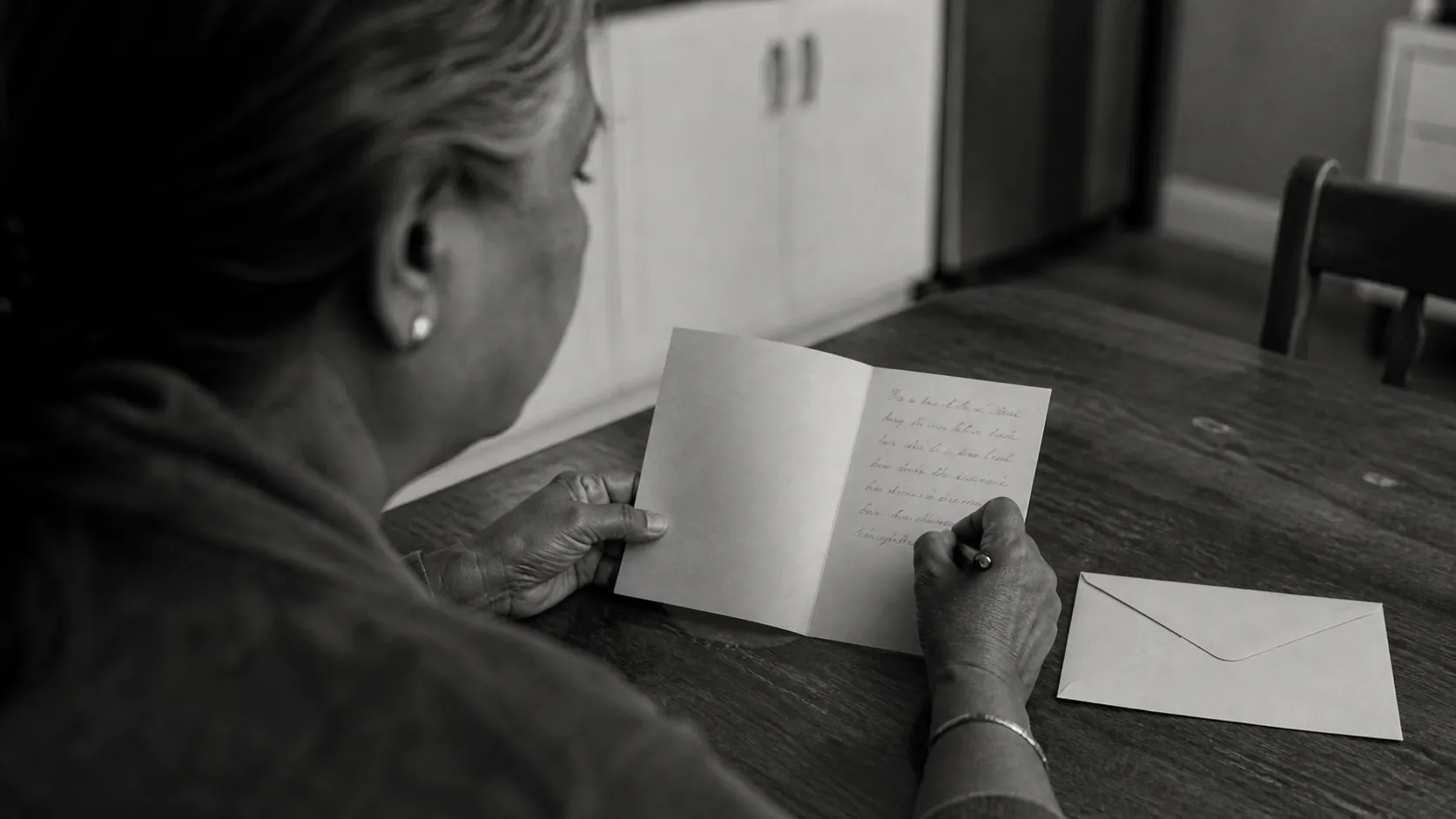
Write the same card. The sorrow, the name, the memory, the offer. What changes is the list of things to keep out, and it's strict.
- Never write why. A suicide is never the result of one thing. AFSP is direct about it: research shows no one takes their life for one single reason.[9] Don't name a cause, don't name a diagnosis, and don't write a sentence that reads as an explanation.
- Never write about how. AFSP tells supporters not to ask intrusive questions about how the person died, and not to ask for details beyond what the survivor volunteers.[8] That applies in ink too.
- Never speculate about what they were thinking, what they wanted, or what a note meant.
- Write "died by suicide." AFSP asks people to avoid "committed," which carries the stigma of suicide as a crime.[9]
- Never call it selfish, a sin, or an act of weakness. AFSP lists all three.[8]
- Never write that they're at peace now or that their pain is over. "She's in a better place," "everything happens for a reason," and "you'll get over it" are on AFSP's list of lines to avoid with a loss survivor.[8]
- Skip "I know how you feel" unless you're also a suicide loss survivor.[6]
What to write instead:
- "I'm so sorry about Nate. I don't know what to say and I'm not going to pretend I do. I loved him, and I want to hear about him whenever you want to talk. I'll call Sunday."
- "I'm so sorry about your mom. I still have every birthday card she sent me, in her handwriting, going back to when I was nine. I'll be at your door Thursday with dinner."
- "I have no idea what you're going through. I care about you and I want to be here for you, this month and next year." AFSP recommends almost exactly that sentence.[6]
Then stay. The part most people skip is on AFSP's list too: keep checking in over the weeks and the months, because the hardest stretch often comes after the initial shock fades, and don't put a timeline on it.[6][8] AFSP also runs a peer program called Healing Conversations that connects loss survivors with people who've had the same kind of loss, which is a better thing to offer than advice.[6]
One more thing, said plainly. People bereaved by suicide carry raised risk themselves. In a UK study of 3,432 bereaved young adults, those bereaved by suicide had higher odds of a suicide attempt than those bereaved by sudden natural causes (adjusted odds ratio 1.65, 95% CI 1.12 to 2.42), and the finding held whether or not they were blood relatives of the person who died.[10]
So if you're the one who got the card, or you're writing it and you're not doing well yourself: the 988 Suicide and Crisis Lifeline answers calls, texts, and chats, free, 24 hours a day, every day of the year.[11] Using it on a hard night is an ordinary thing to do, and you don't have to be in danger to call.
What these first months are like is in sudden death grief.