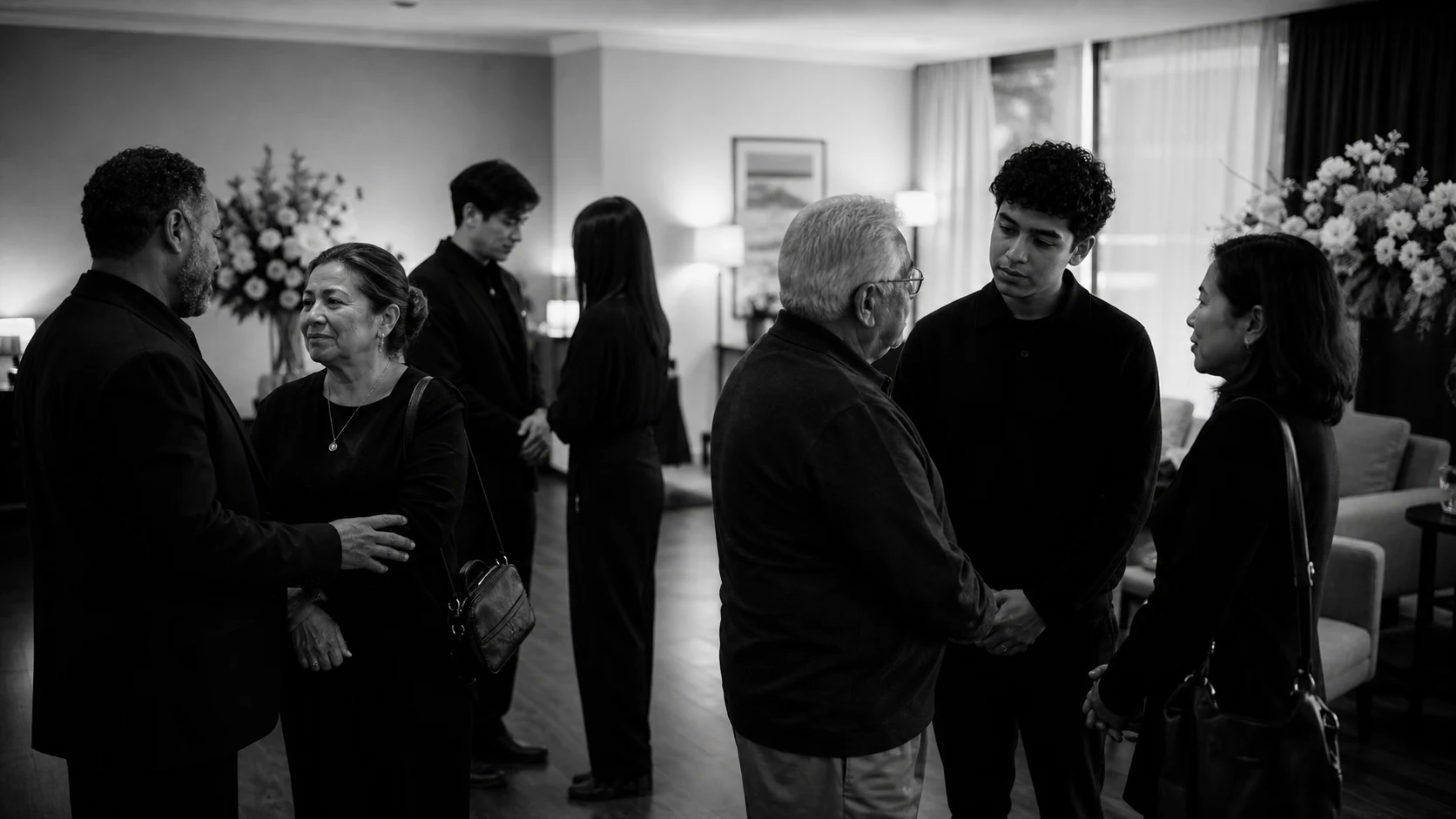
A wake is the come-and-go gathering held before a funeral, usually at the funeral home, usually with the casket in the room. You arrive within the posted window, greet the family, stay twenty or thirty minutes, and leave. That's the entire format. The word sounds heavier than the event is.
What a Wake Is
Today's wake happens at a funeral home, either the evening before the funeral or in the hours just ahead of it. The casket is usually present, open or closed. The family stands or sits near it, and visitors flow through: sign the guest book, greet the family, pay respects at the casket if they choose, find the people they know, talk quietly, leave.
The word comes from the older practice of sitting with the body through the night before burial, keeping watch. Irish Catholic families kept the tradition and the word in wide American use, and in Catholic practice a wake may include a vigil service or a rosary, led by a priest or deacon, partway through the evening. If that happens while you're there, stop talking, stand or sit with the room, and let it finish. It runs fifteen or twenty minutes.
Nothing about a wake requires you to be religious, to know the person's family, or to stay long. It's built for exactly the person who wants to pay respects without sitting through a formal service.
Wake vs. Viewing vs. Visitation
A viewing or visitation is set hours around the service when you can see the deceased and greet the family.[1] Wake is the older, more social word for the same window. The shades of difference, for when you want them:
- A viewing emphasizes the body. The casket is typically open, and paying respects at it is a central part of the visit.
- A visitation emphasizes the family. The casket may be closed, and at some visitations the body isn't present at all. You're there to see the living.
- A wake is the older, more social word, and in Catholic families it often implies the vigil or rosary described above.
In practice, funeral announcements use whichever word the family or the funeral home prefers, and your job is identical at all three: same dark clothes, same quiet volume, same short kind words to the family. If the announcement lists "visitation 4 to 7, service at 7," that's a wake followed by a funeral, whatever it's called.
Wake vs. Funeral
The wake comes first and runs loose. There's a posted window, often two or three hours, and you're expected to use a slice of it, arriving and leaving on your own schedule. Conversation is the point. You'll hear laughter at a good wake, and that's the event working correctly.
The funeral is a scheduled service with a start time, and you sit through the whole thing: music, readings, eulogies, an officiant. It usually runs 30 to 60 minutes and rewards arriving early. The full walkthrough, from the guest book to the graveside, is in your first funeral: what to expect.
Attending either one counts. You don't owe the family both appearances, and nobody cross-references the sign-in books.
What You Actually Do at a Wake
In order:
- Sign the guest book. Name, plus how you knew the person if there's room. The family reads it later.
- Greet the family. One or two sentences: who you are, how you knew their person, one kind thing. "I'm Priya, I taught with Ellen for six years. She made that school better." Then move, because a line is forming behind you. Exact scripts live in what to say at a funeral.
- The casket is optional. Go up if you want the moment. Skip it freely if you don't. Both are done constantly and nobody keeps score.
- Talk to people. Quiet, normal conversation about the person, about anything. Wakes are the social half of mourning, and telling a funny story about the dead at their own wake is a compliment.
- Leave when you're done. Twenty to thirty minutes is a full visit. If the family's receiving line is long, leaving without a formal goodbye is fine; the guest book already recorded you.
Dress like you would for the funeral, or one small step down: the specifics, including the jeans ruling, are in what to wear to a funeral.
Wake, Funeral, or Both?
Close family and close friends usually attend both. Everyone else picks the one that fits their relationship and their schedule, and the wake exists partly for exactly this: it gives coworkers, neighbors, old classmates, and everyone with a Tuesday-morning job a way to pay respects during evening hours without taking a day off for the funeral.
If you can't attend either, you still have moves. Send a card with something specific in it about the person, and check on the family in the weeks after, when the visitors have stopped coming. What to say to someone who is grieving covers what that looks like.
Memorial Services, Shiva, and Celebrations of Life
A few neighboring events, so you can tell them apart when the announcement arrives:
A memorial service runs like a funeral without the body in the room; the burial or cremation already happened.[1] With the U.S. cremation rate projected at 63.4 percent for 2025 and climbing, services without a body present keep getting more common.[2]
Shiva is the Jewish mourning period, traditionally seven days, observed at home after the burial. Visiting during shiva has its own rhythm: you enter without ringing ceremony, bring or send food rather than flowers, sit with the mourners, and let them lead the conversation, including leading it nowhere. Follow the house.
A celebration of life happens weeks or months later, without the body, built around the person's actual life, and often with instructions to wear color and bring stories. It has its own guide: celebration of life: what it is and how to plan one.
Common questions
What is a wake?
A wake is a gathering held before the funeral, usually at the funeral home the evening prior or in the hours before the service, where people come and go, greet the family, and often view the casket, open or closed. The word comes from the older practice of sitting with the body overnight. Today "wake," "viewing," and "visitation" mostly describe the same event.
Is the body present at a wake?
Usually, in a casket that may be open or closed. Walking up to the casket is optional; many visitors greet the family, talk quietly with other guests, and leave without going up. At some wakes and most visitations, the casket stays closed or the body isn't present at all.
How long do you stay at a wake?
Twenty to thirty minutes is a normal visit. Sign the guest book, greet the family briefly, pay your respects however you choose, talk with people you know, and leave. Wakes are come-and-go by design; nobody stays the whole posted window except the family, who have no choice.
What is the difference between a wake and a funeral?
Timing and structure. The wake comes first and is informal: people arrive and leave within a posted window and conversation is the point. The funeral is a scheduled service you sit through: music, readings, eulogies. Attending either one counts as paying your respects; you don't owe the family both.
What do you wear to a wake?
The same as a funeral, or one small step less formal: dark, plain, clean clothes. Dark jeans with a collared shirt or sweater pass at most wakes. The funeral itself usually runs more formal.
Do you bring anything to a wake?
Nothing is required. A sympathy card, dropped in the basket or handed quietly to a family member, is the most useful thing to bring. Flowers typically go to the funeral home ahead of time rather than through the door with you, and food goes to the family's house in the following weeks, when the crowd is gone and it's needed most.
Sources & References
Research & Citations
All factual claims in this article are sourced from peer-reviewed research, government data, and named institutions. Citations follow APA 7th edition format.
Share this story
Post it, or send it straight to the person who needs it. The link goes with it.