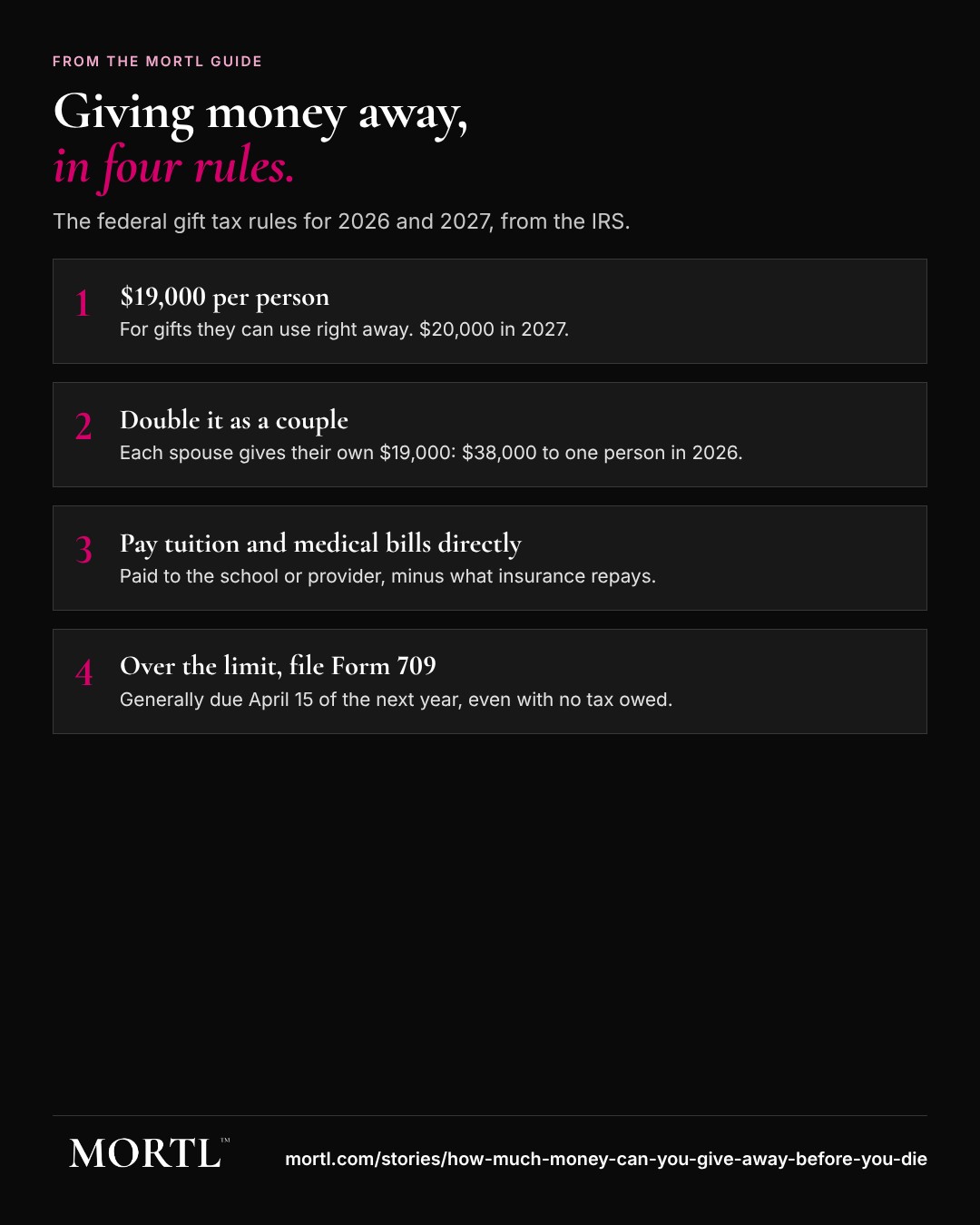
In 2026, you can give up to $19,000 to any one person without filing a gift tax return, as long as it's a gift they can use right away and nothing else on the IRS's filing list applies. In 2027, the amount rises to $20,000.[1] The limit is per person who gets the gift, and there's no cap on how many people you give to. Give each of your three children $19,000 in cash in 2026 and the exclusion covers each gift.[2]
Three things can mean filing Form 709 even under the limit: a gift the person can't use until later, choosing to split gifts with your spouse, and a gift to your spouse that ends on some later event. Filing doesn't always mean paying. The IRS says you may have to file a gift tax return even when no gift tax is due.[1]
The person who gives the gift is generally the one responsible for any gift tax.[2] An outright gift to your spouse, theirs to keep, generally qualifies for the marital deduction.[2] A gift that ends on some later event is different. A life estate, where your spouse uses a house for life and it then passes to someone else, is a terminable interest, and it can mean filing Form 709 even when your spouse is a U.S. citizen.[1][3]
The Form 709 instructions cover the exceptions and the QTIP election. If your spouse isn't a U.S. citizen, a yearly limit applies to outright gifts: $194,000 in 2026 and $201,000 in 2027.[1]