You want your kids to have something. You've heard the nursing home takes the house and the savings first, and that a trust can stop it. Here's how much of that is true.
A nursing home bills you for care, and Medicare doesn't pay for long-term care.[1] You pay from your own money until you qualify for Medicaid, the primary payer for more than 6 in 10 people living in nursing facilities.[2] After you die, your state has to seek repayment from your estate for the nursing home care Medicaid covered once you were 55 or older.[3] A house in your name alone when you die is part of that estate.[4]
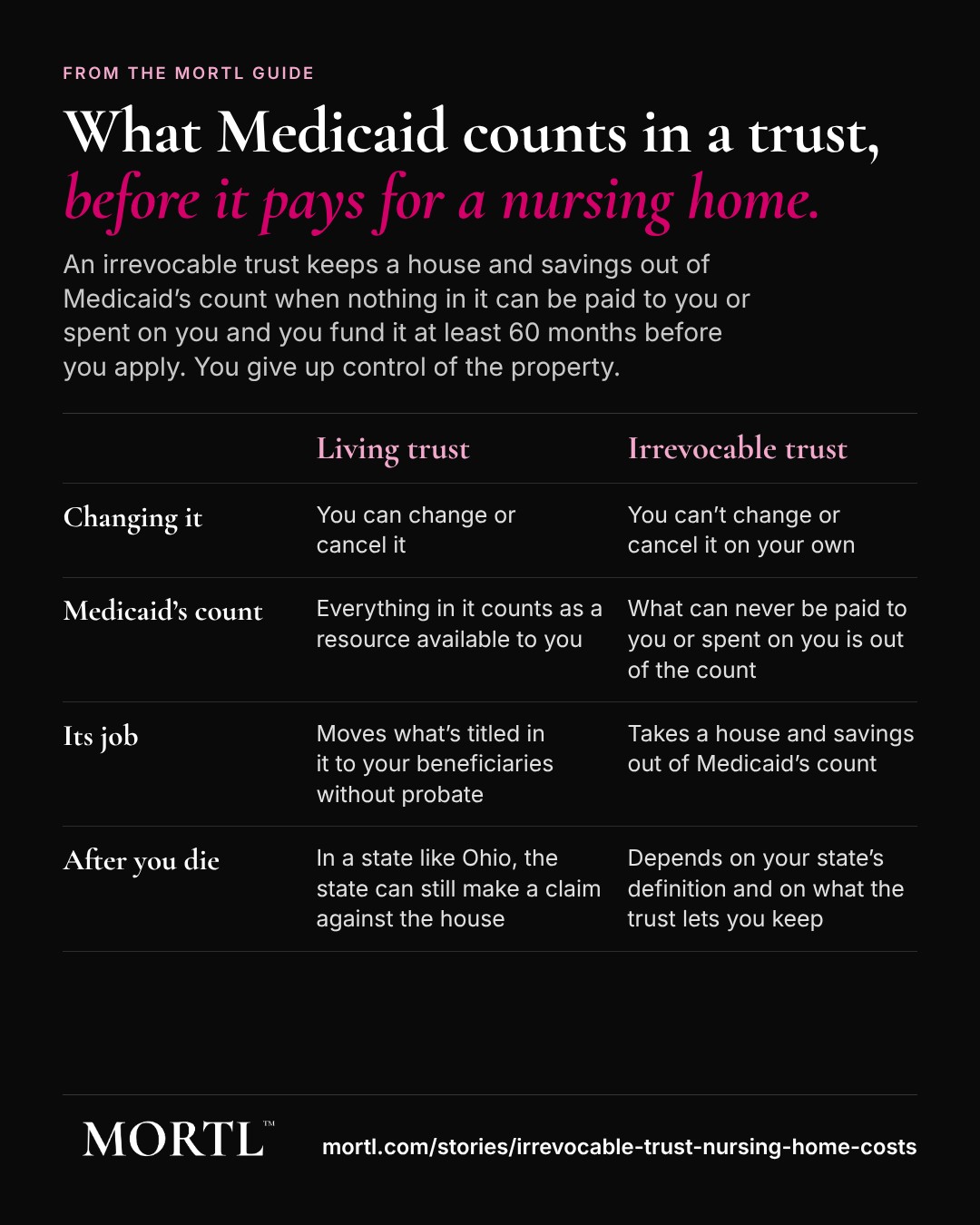
An irrevocable trust can take a house and savings out of Medicaid's count. Lawyers call the kind built for this a Medicaid asset protection trust. Two things have to be true for it to work. The trust is written so that what you put in can never be paid to you or spent on you, and you put it in at least five years before you apply.[4] If any part of it can be, Medicaid counts that part as yours. If you apply inside the five years, Medicaid treats the transfer as a gift and makes you wait for coverage.[4]
In exchange, you give up control of the property. This page covers how the rules work, what you give up, what your state can still claim, and the questions to bring to a lawyer. MORTL publishes information. A lawyer licensed in your state gives legal advice.