
Law & Policy

Filing a Final Tax Return for Someone Who Died

First find out whether a final return is required or a refund is due. Here’s who can file, how to sign, and when the estate needs its own return.

A middle-aged Latina woman sorts bills, forms, folders, and envelopes at her kitchen table after a death

Start by checking whether the person was required to file for the year they died, based on age, filing status, gross income, and special filing rules. For example, self-employment can create a filing requirement even when income is low. Even if filing is optional, it can be worth doing to recover an overpayment or refundable credit.[1][5]

For a calendar-year taxpayer who dies in 2026, the usual federal deadline is April 15, 2027. Check the instructions for the tax year, including any applicable relief. You can request more time to file. An ordinary filing extension leaves the payment deadline in place.[1][12]
Who files it

The personal representative is the executor, administrator, or other person responsible for the deceased person's property. Who signs depends on the situation.[1]

  • An appointed representative signs. On a joint return, the surviving spouse also signs.
  • When no representative has been appointed and a surviving spouse files jointly, the spouse signs and enters “Filing as surviving spouse” in the signature area.
  • With no appointed representative or surviving spouse, the person responsible for the property signs as personal representative.

Follow the instructions for the year you’re filing. On a paper form with a Deceased box, check it and enter the date of death for the correct person. With tax software, enter the date where prompted. Generally keep the death certificate with your records when filing the return.[2][5]

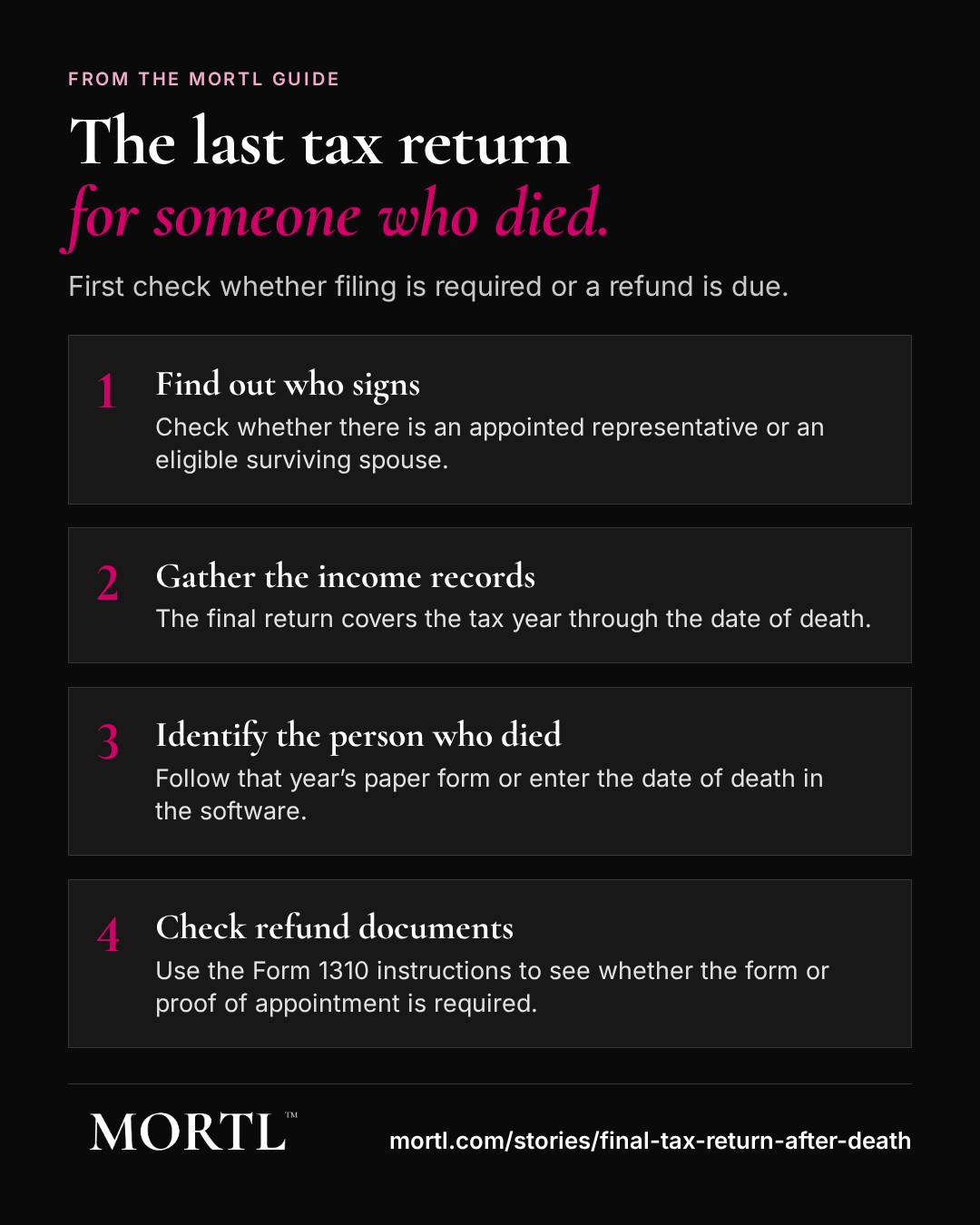
Four steps for a final individual tax return: establish who signs, collect income records, enter the date of death as directed, and check which refund documents are required.
The final individual return covers the year through the date of death. Open the full-size image.

What goes on the return

The final Form 1040 or 1040-SR covers the start of the tax year through the date of death. If someone used the usual cash method, income they received or could access during their life generally goes on their return. A final paycheck first made available after death can instead be taxable to the estate or beneficiary who receives it.[1]

Check medical expenses paid before death for any itemized deduction the person could claim. If the estate paid the person’s medical bills within a year after death, ask the preparer about an election to deduct eligible costs for the year the expenses were incurred. The estate must give up the federal estate-tax deduction for costs covered by the election.[1]

Look for earlier unfiled returns too. If someone died in January 2026 before filing a required 2025 return, the representative may have two returns to prepare: the earlier 2025 return and the final 2026 return.[1]

If records are missing, follow the IRS instructions for obtaining a deceased person’s transcripts. To have a transcript mailed to you, use Form 4506-T. Include a copy of the death certificate and the documents the IRS requests to establish your authority.[10]

If you're the surviving spouse

An eligible surviving spouse can file jointly for the year of death. The return includes the deceased spouse's income through death and the survivor’s income for the full year. If no personal representative has been appointed by the return’s due date, the surviving spouse can generally file it alone. A spouse who remarried by year-end cannot file jointly with the person who died.[1][6]

For the next two years, you may qualify for the qualifying surviving spouse filing status. Generally, you must have been eligible to file jointly in the death year, remain unmarried at the end of the year you’re filing for, and pay more than half the cost of a home where your qualifying child or stepchild lived all year.

A legally adopted child counts. A foster placement alone does not meet this test. Publication 501 explains the dependency rules, temporary absences, and exceptions for birth and death during the year.[6][11]

Getting a refund

Usually the person claiming the refund files Form 1310. A surviving spouse filing an original or amended joint return generally qualifies for an exception. A court-appointed representative filing the original individual return can attach the court certificate of appointment instead. If that representative claims the refund on Form 1040-X or Form 843, the IRS requires both Form 1310 and the court certificate.[3][7]

Telling the IRS you're in charge

Use Form 56 to notify the IRS when a fiduciary relationship begins or ends. If you act for both the person who died and the estate, file a separate Form 56 for each. For the person, use their SSN or ITIN. For the estate, use its employer identification number and follow the special identification instructions if handling Form 706.[4][8]

The estate's own return

The estate may earn interest, rent, or other income after the death. A domestic estate generally must file Form 1041 if it has at least $600 of annual gross income or any nonresident-alien beneficiary. The $600 threshold measures the estate’s income for the tax year. An estate that held a qualified investment in a Qualified Opportunity Fund during the year must also file with Form 8997.[9]

What to do now

  1. Gather the prior returns, income forms, and withholding or estimated payment records.
  2. Check filing requirements and whether there is an overpayment or refundable credit to claim.
  3. Identify who signs and follow the correct year’s instructions for the date of death.
  4. Check whether Form 1310 and court documentation are required for the refund.
  5. Review Form 56, any separate Form 1041 filing obligation, and state tax requirements.

If several years of returns are missing, or the estate has a business or cross-border beneficiaries, a qualified tax professional can help determine what to file. Our guide to what an executor does covers the rest of the job. If you received money or property yourself, see which parts of an inheritance can be taxable.

Sources & References

Research & Citations

The sources used for this article are listed below. Open a source to check its context and publication date. If you find an error, please tell us.

  1. [1]Internal Revenue Service. (2026). Publication 559 (2025), Survivors, executors, and administrators. ↗ Source Retrieved November 20, 2026
  2. [2]Internal Revenue Service. (2026). File the final income tax returns of a deceased person. ↗ Source Retrieved November 20, 2026
  3. [3]Internal Revenue Service. (2026). About Form 1310, Statement of person claiming refund due a deceased taxpayer. ↗ Source Retrieved November 20, 2026
  4. [4]Internal Revenue Service. (2026). About Form 56, Notice concerning fiduciary relationship. ↗ Source Retrieved November 20, 2026
  5. [5]IRS, Instructions for Form 1040 and 1040-SR ↗ Source Retrieved November 20, 2026
  6. [6]IRS, Publication 501, Dependents, Standard Deduction, and Filing Information ↗ Source Retrieved November 20, 2026
  7. [7]IRS, Form 1310 and instructions ↗ Source Retrieved November 20, 2026
  8. [8]IRS, Instructions for Form 56 ↗ Source Retrieved November 20, 2026
  9. [9]IRS, Instructions for Form 1041 ↗ Source Retrieved November 20, 2026
  10. [10]IRS, Request deceased person's information ↗ Source Retrieved November 20, 2026
  11. [11]26 U.S.C. § 2(a), Surviving spouse ↗ Source Retrieved November 20, 2026
  12. [12]Internal Revenue Service. (2026). File your tax return. ↗ Source Retrieved November 20, 2026

Share this story

Post it, or send it straight to the person who needs it. The link goes with it.

Keep reading on MORTL

Planning

What Does an Executor Actually Do?

An executor gathers records, protects estate property, handles probate, pays valid debts and taxes, reports to beneficiaries, and distributes what remains.

10 min read
Law & Policy

Letters Testamentary: What They Are and How to Get Them

Letters testamentary prove the court put you in charge of an estate. The will alone won't move a bank. How the petition works, what courts charge, the four-to-six-week wait in California, and why to buy extra certified copies.

9 min read
Planning

Who to Notify When Someone Dies

A practical notification map after a death: what may need attention first, who may have authority to act, and which government, financial, tax, credit, and household contacts can wait.

9 min read
Law & Policy

Inherited an IRA? The 10-Year Rule and What's Due by December 31

Most people who inherit an IRA have ten years to empty it. Some also owe a withdrawal every year, and that one is due December 31. How to tell which rules are yours, from the IRS's own publication.

7 min read