GriefBy Stephanie Werner · August 9, 2026 · 13 min read

What to Write in an Obituary for a Mother

Six complete obituary examples for a mother at different lengths and different relationships, including a complicated one and an estranged one, plus what to do about her maiden name, stepchildren, a second marriage, and what publishing it actually costs.

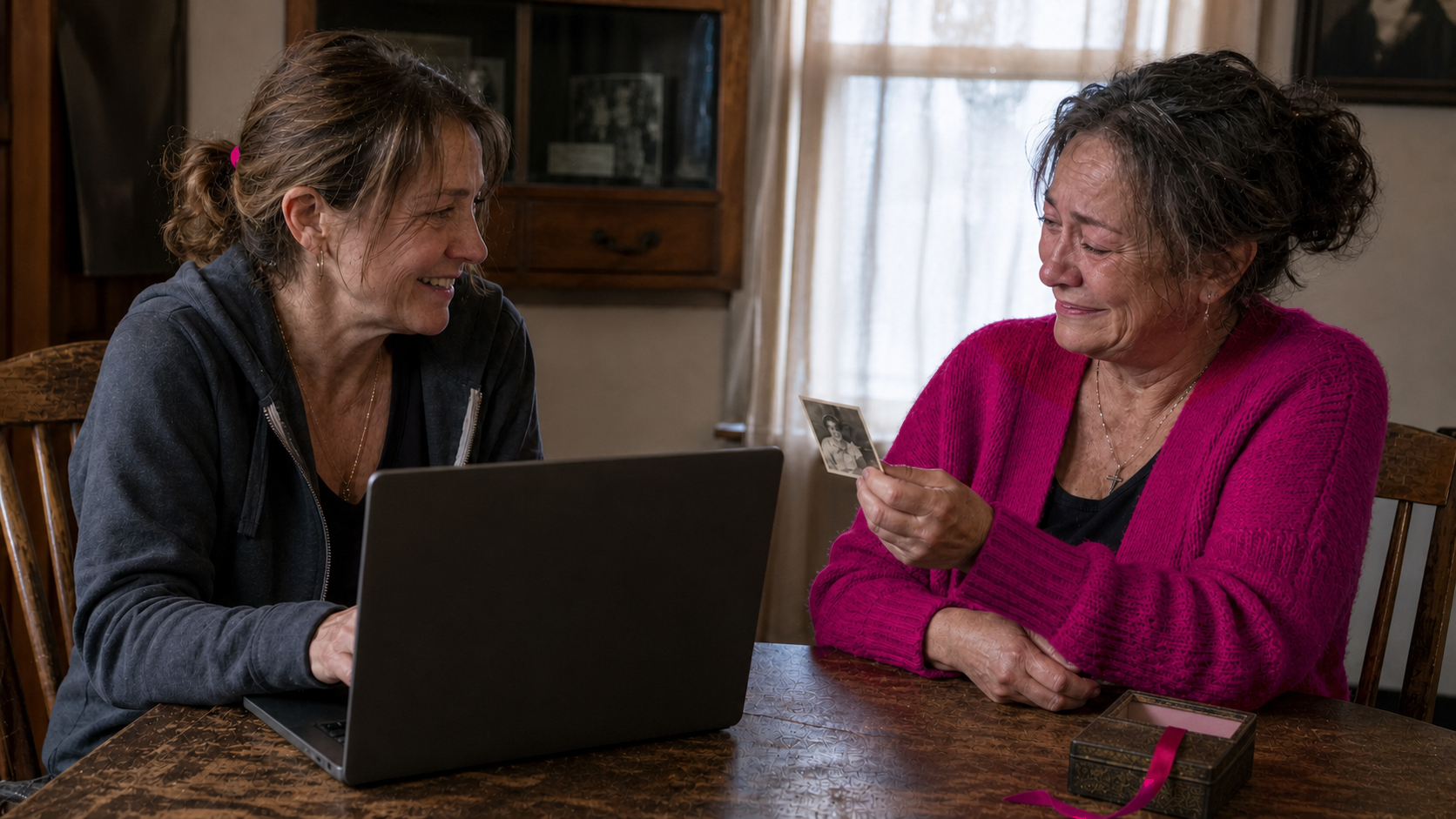
Two sisters respond to the same old photograph while writing their mother's obituary

Start here

An obituary for your mother needs six facts at a minimum: her full name including her maiden name, her age, where she lived, the date she died, who survives her, and the service details. Everything past that is your choice, and the part people remember is one specific true sentence about how she actually was.

The format takes ten minutes. Writing 200 words about the person who raised you, or didn't, while you're also picking a casket and calling her bank, takes longer. Most people get stuck in the same three places: her maiden name, her second husband's kids, and whether to say how she died. All three are answered below.

You'll find six complete obituaries for a mother here, at different lengths and different relationships: a 75-word death notice, a standard one, one after eight years of Alzheimer's, one for a complicated mother, one for an estranged mother, and one for a woman who raised other people's children. The names are invented. For other relationships, see the obituary examples in our guide to writing one. To draft yours with the fields already laid out, use the free obituary maker.

The facts every obituary needs

Papers and funeral homes want the same core information. Write these eight down first, in any order, before you try to write sentences.

  • Her full name. First, middle, maiden, married. Add what people actually called her: Margaret "Peg" Doyle.
  • Age and city. "81, of Nashua." That's enough. The full birth date and the town she was born in are the parts that get harvested by scammers.[6]
  • The date she died. Write "died." Every euphemism makes the sentence longer and the fact no softer.
  • Work and the long-running facts. 29 years as a school nurse. 40 years in the same house. The church, the union, the Tuesday shift at the food pantry.
  • Survivors. Spouse, children, stepchildren, grandchildren, siblings, in the order your family would say them out loud.
  • Who died before her. Her husband, her parents, a child.
  • Service details. Date, time, place. Read the section on what to leave out before you publish the address of a house that will be empty during it.[6]
  • Where to send money. A charity, a scholarship fund, the hospice, the church.

If you have those eight things, you have an obituary. Everything after this is about making it sound like her.

The one line that makes it her

"She was a loving mother who cherished her family" fits millions of women. It tells her grandchildren nothing they'll want in twenty years.

Write one or two sentences that only fit her. The test: could this sentence be lifted and dropped into a stranger's obituary without anyone noticing? If yes, cut it and write something with a number, a place, or a specific object in it.

Questions that produce usable sentences:

  • What did she cook that nobody else could get right?
  • What did she say so often that her kids can still do the voice?
  • What did she do every week for thirty years?
  • What did she own that everyone recognized? The car, the coat, the chair, the purse and everything in it.
  • What was she cheerfully wrong about her entire life?
  • What did she do for other people that she never mentioned?

Answer two of those in plain words and put them in the middle of the obituary. "She kept a drawer of clean gym shorts for kids who needed them and never said whose they were" does more than a paragraph of adjectives.

Her maiden name

Print it. The standard forms are "Margaret Ann Doyle (née Fitzgerald)" or "Margaret Ann Doyle, formerly Fitzgerald." Née is French for born and is used to identify a woman by her maiden family name, as in "Mrs. Jane Doe, née Smith."[10] If it looks fussy to your family, write "born Margaret Fitzgerald" instead. All three are correct.

If she was married more than once, lead with the surname she died under and list the rest: "Margaret Ann Doyle (née Fitzgerald, formerly Brennan)." That way people who knew her in 1979 can find her.

Here's why it matters past the funeral. Obituaries get read as records for a century, and FamilySearch notes that obituaries for married women occasionally list them solely as "Mrs. [Husband's Name]," sometimes omitting their first or maiden names entirely.[11] Her maiden name is the one thing that connects her to every record of her life before she married. Leaving it out erases the first twenty years of her.

There's a real tradeoff, so decide it on purpose. Experian lists maiden names among the details identity thieves pull from obituaries, along with middle names, place of birth, place of death, education history, work history, military service details and relatives' last names.[7] AARP goes further and says to leave out the date and place of birth, the middle name, the maiden name, and the mother's maiden name.[6]

What we'd do: print her own maiden name, and skip her mother's maiden name, her full birth date, and her birthplace. That combination is what answers bank security questions. Her maiden name on its own is the record.

Second marriages, stepchildren, who gets listed

The survivors list is where families fight. Two rules keep it clean: name people by what they are, and ask before you print.

The standard order. Spouse, children, stepchildren, grandchildren, great-grandchildren, siblings. Spouses of children go in parentheses: "Nicole Brennan (Tom)."

Stepchildren. If she raised them from childhood, most families write "her children" and list everyone together with no label. If the relationship started when everyone was already an adult, "her stepchildren, Marisol and Danny" is accurate and nobody is offended by an accurate word. Call the stepchildren and ask which they want. Ten minutes on the phone beats a printed slight that lasts forever.

Her second husband and her first husband's kids. List the living spouse first, then all the children together. Nobody reading it needs to know which marriage produced which child.

An ex-husband who's still family. "Her former husband and friend, Michael Brennan" is fine if the family agrees. Skip it if it will start something.

Grandchildren. Name them or count them. Fourteen names costs real money in a print notice, so many families write "14 grandchildren" in the paper and name every one in the funeral program and the online version.

Who died first. "She was preceded in death by her first husband, Michael Brennan, and her son Kevin." Naming a child who died before her is how families keep that child in the record.

A blended-family list, written out:

"She is survived by her husband, Ray Alvarez; her children, Nicole Brennan (Tom) of Chicago and Sean Brennan of Denver; her stepchildren, Marisol Alvarez and Danny Alvarez, both of Naperville; eight grandchildren; and her sister, Patricia Kowalski. She was preceded in death by her first husband, Michael Brennan, and her son Kevin Brennan."

How much to say about how she died

You're never required to say. "Died at home on March 4" is a complete sentence and a complete obituary line.

Say something if the family has spent months answering the question anyway, if the illness is the reason you're asking for donations, or if she wanted it said. "After eight years with Alzheimer's disease" and "after a two-year illness with ovarian cancer" both do that work in six words.

Naming a disease is common and it makes the donation request make sense. Some families name an overdose plainly: "died of an accidental fentanyl overdose."

If she died by suicide, the wording rules are not preferences. Write "died by suicide." Don't use the word "committed" for it. The American Foundation for Suicide Prevention says that word perpetuates the stigma of suicide as a crime and indicates moral judgment.[8] Don't print the method or the means, don't print the location, and don't print what a note said.[8]

Don't name a reason, and that includes a diagnosis, a divorce, or a job loss. AFSP is direct about it: no one takes their life for one single reason.[8] The safe sentence is that she died by suicide. Then stop.

Put the number where your family will see it, in the obituary, the program, or the email you send the relatives: the 988 Suicide and Crisis Lifeline, call or text 988, free and confidential, 24 hours a day, every day.[9] It's for everyone, including the people who just lost her, and calling is a reasonable thing to do on a hard week.[9]

What to leave out

An obituary is a public document that stays online. Scammers read them on purpose.

  • Her full date of birth and her birthplace. AARP lists both as details to leave out.[6] Her age does the same job for readers.
  • Her mother's maiden name. That's a security question answer, printed.[6]
  • Her home address.[6]
  • Relatives' full names, if you're worried. Experian's suggestion is to use only first names for relatives, and to mention military service without the regiment number or other details.[7]
  • The exact hours the house will be empty. AARP notes that published service times tell burglars when to break into a presumably empty house.[6] Ask a neighbor to be there, or leave the home address out of it entirely.
  • Grievances. Write the angry version if you need to. Keep it. Don't publish it. It reads as an attack forever, and you can't take it back.
  • Anything you can't verify. Wrong dates and misspelled names outlive everyone involved.

Three examples: short, standard, long illness

1. The short death notice, about 75 words

Margaret Ann Doyle (née Fitzgerald), 81, of Nashua, died at home on March 4, 2026. She was a school nurse in the Nashua district for 29 years and a Red Sox season ticket holder for 40. She is survived by her children, Kevin, Erin and Rose, and six grandchildren. Visiting hours are Saturday, March 7, from 2 to 4 p.m. at Sullivan Funeral Home. Memorial gifts may go to the Nashua Soup Kitchen and Shelter.

That's a full obituary. It says who she was, it tells people where to go, and it's the cheapest version to put in print.

2. The standard version, about 220 words

Margaret Ann Doyle (née Fitzgerald), 81, of Nashua, died at home on March 4, 2026, with her three kids in the room and the Sox game on.

For 29 years she was the school nurse at Elm Street Middle School, where she kept a drawer of clean gym shorts for kids who needed them and never said whose they were. She married Thomas Doyle in 1968 and they had 44 years before he died in 2012. She made a pot roast every Sunday until she was 78, and she never used a recipe or admitted that she was guessing.

She is survived by her children, Kevin Doyle (Anna) of Nashua, Erin Vasquez (Rob) of Portland, Oregon, and Rose Doyle of Boston; six grandchildren, Thomas, Maeve, Iris, Danny, Joel and Beatrice; and her sister, Kathleen Sullivan of Lowell. She was preceded in death by her husband, Thomas, and her brother, Francis Fitzgerald.

Visiting hours are Saturday, March 7, from 2 to 4 p.m. at Sullivan Funeral Home, with a funeral Mass at St. Christopher Church on Sunday at 10 a.m.

In place of flowers, the family asks for donations to the Nashua Soup Kitchen and Shelter, where she volunteered every Tuesday for 22 years.

3. After a long illness

Carol Ann Whitfield (née Prescott), 79, of Boise, died on February 9, 2026, at Rosewood Memory Care, where she lived for four years.

Carol was diagnosed with Alzheimer's disease in 2018. She stopped recognizing her children in 2023 and stopped speaking in 2025. She hummed along to Patsy Cline until the last week of her life. Her family wants two things on the record: Carol was more than the eight years of the disease, and the aides at Rosewood, especially Grace Mbeki and Tony Alvarez, treated her like a person every day of them.

Before the diagnosis, Carol taught fourth grade in the Boise School District for 31 years and ran the school's science fair for 19 of them. She could name every bird at her feeder and she was ruthless at cribbage.

She is survived by her husband of 54 years, Douglas Whitfield, who came at 11 a.m. every day and read her the paper; her son, Peter Whitfield of Boise; her daughter, Susan Whitfield-Osei (Kwame) of Seattle; and four grandchildren.

A service will be held at Cloverdale Funeral Home on February 15 at 1 p.m. Donations may go to the Alzheimer's Association.

Three harder examples: complicated, estranged, other people's children

4. A complicated mother

You can be honest without airing the whole file. Say the true good things and let one accurate sentence carry the rest.

Diane Marie Petrov (née Kowalczyk), 68, of Akron, died on May 2, 2026, at Summa Health.

Diane worked 41 years at Goodyear and retired at 62 with a pension she was clear she had earned. She was funny, and she aimed it at whoever was standing closest. She was hard on her children, and she knew it. In the last two years she said so out loud more than once, which took her some effort.

She kept a garden that took up the whole back lot and gave away most of what it grew.

She is survived by her daughter, Alexis Petrov of Cleveland, her son, Mark Petrov of Columbus, and three grandchildren she was gentler with than she had been with anyone.

A graveside service will be held at Glendale Cemetery on May 10 at 11 a.m. The family asks for no flowers.

5. An estranged mother

About 27% of American adults have cut off contact with a family member, and 10% are estranged from a parent or a child.[12] If that's your family, you're not required to produce warmth you don't have, and you're not required to write anything at all.

Barbara Jean Kroll, 74, of Toledo, died on January 12, 2026. She worked as a bookkeeper for Lucas County for 19 years. She is survived by two children and one grandchild. There will be no service. Arrangements are by Walker Funeral Home.

That's the whole thing, and it's allowed. Facts, no adjectives, no "beloved," no "devoted." A funeral home will place a notice this short for you, and it does everything a notice has to do. If you'd rather publish nothing, publish nothing. Probate doesn't require an obituary. The legal notice an estate has to publish is a separate paid ad.[5]

6. A mother who raised other people's children

Ruth Ellen Sanders (née Coleman), 88, of Jackson, died on June 19, 2026.

Ruth and her husband, the Reverend James Sanders, were licensed as a foster home in 1974 and kept the license for 31 years. Thirty-eight children lived in the house on Bailey Avenue in that time. Nine of them stayed through high school. Two she adopted. She cooked for all of them at once and she went to every graduation, including the ones for kids who had already aged out and moved away.

She sang alto at Mount Calvary Baptist Church for 60 years and worked in the cafeteria at Lanier High School until she was 71.

She is survived by her children, Andre Sanders (Tamika) of Jackson, Yolanda Sanders-Reyes of Houston, Curtis Sanders of Atlanta, and Nia Sanders of Memphis; by Michelle, Devon, Trina, Rashad, Ana, Joseph, Keisha, Marcus and Lorraine, who came to her through foster care and call themselves hers; by 14 grandchildren and nine great-grandchildren; and by her sister, Doris Coleman Whitaker. She was preceded in death by her husband, James, and her son Terrence.

A homegoing service will be held at Mount Calvary Baptist Church on June 27 at 11 a.m. Donations may go to the church's youth fund.

The move that makes this one work is naming the fostered children in the survivors list. Who she raised is the test, and the survivors list is the only place it gets written down.
What it costs to publish

Newspapers set their own prices and the spread is wide. Two examples, taken from the papers' own order pages on August 9, 2026:

  • Keene Sentinel (NH): a base price of $175 for an obituary of 10 column inches or less, running one day in print, then $8 for every column inch after that. A photo costs $15. Flag emblems for veterans are free. Paying by credit card adds 2.5%.[2]
  • The Washington Post: a print death notice is $725 for four inches and $225 for each additional inch. An online notice is $475. No extra charge for a photo, for color, or for the day of the week.[1]

Notice what both papers are counting. Print is sold by the column inch, so the bill follows the space the notice takes up. Neither one quotes a price per word.[1][2]

Read that against the examples above. The 220-word standard version has about three times the text of the 75-word notice, and in print you pay for the space that text fills. So write the long one for the family, the funeral program, and the funeral home's permanent online page, then cut a short version for the paid print notice.

If the funeral home places it for you, the obituary is what the FTC Funeral Rule calls a cash advance item: the funeral home pays the newspaper and bills you.[3] If they charge you more than they paid, the Rule requires them to disclose it on your statement with the line "We charge you for our services in obtaining: (specify cash advance items)."[3] Ask what the paper charged and what you were charged. The two numbers should match or the difference should be printed on the form.

Where to publish it and who submits it

Most papers take obituaries three ways: through the funeral home, through an online submission form on the paper's own site, or by phone or email to an obituary desk. The funeral home route is the default because papers verify the death with them, and the online forms ask for it. The Keene Sentinel's form has a required field for the funeral home or cremation service.[2]

If you're not using a funeral home, call or email the desk directly and say so. The Washington Post takes death notices at 202-334-4122 and deathnotices@washpost.com.[1] The Keene Sentinel's obituary team answers at classified@keenesentinel.com.[2] Look for the same contact on your own paper's obituary page.

Ask for the deadline in the first call. Every paper sets its own, and a notice that misses it runs after the service it was announcing. Get the cutoff from the paper or the funeral home before you start writing, then file before you're finished polishing the wording. If the service is Saturday, the notice usually has to be in days ahead, and that's the real reason families rush this.

Ask for the total, not the base price. The extras are separate line items and they differ by paper. The Keene Sentinel charges $15 for a photo and adds 2.5% for a credit card, and charges nothing for a veteran's flag emblem.[2] The Washington Post charges nothing extra for a photo, for color, or for the day of the week.[1]

The obituary has no legal effect. It doesn't notify Social Security. The Social Security Administration says a funeral home will usually tell them when someone dies, so you may not need to report the death yourself.[4] It also isn't the legal notice that probate requires. In California, the notice of petition to administer an estate has to run three times in a newspaper published once a week or more often, with at least five days between the first and last publication dates, not counting the publication dates themselves.[5]

That's a separate paid ad, filed by the estate's representative, and buying an obituary doesn't cover it.

Editing it, and what to do if you can't write it

Five things, in order:

  • Read it out loud. Anything you can't say without wincing comes out.
  • Check every name against something written down. A birthday card, a Christmas list, a text thread. Not your memory at 2 a.m.
  • Check every date twice. Years of marriage, years of work, the date she died.
  • Send it to two people: one who knew her well and one who didn't know her at all. The first catches the wrong facts. The second catches the sentences that don't say anything.
  • Cut every adjective that could apply to anybody. If "kind," "loving," and "devoted" are doing the describing, replace one of them with something she actually did.

If you can't write it, that's normal and it's not a failure of love. Hand a sibling or a niece the eight facts from the top of this page and let them draft it. Or open the free obituary maker, fill in the fields, and then rewrite two sentences in the middle so they sound like your family instead of a form. Two sentences is enough to make it hers.

Nobody writes a good obituary the week their mother dies. You write an accurate one, you publish it on time, and you say the rest out loud at the service or in your own kitchen for the next thirty years.

Common questions

How long should an obituary for a mother be?

75 to 250 words covers almost everything. A 75-word notice carries her name, age, city, date of death, survivors, and service details, and that's a complete obituary. Length costs money in print because papers sell space rather than words: the Keene Sentinel in New Hampshire charges a base $175 for 10 column inches or less and $8 for every column inch after that, and the Washington Post charges $725 for a four-inch notice and $225 for each inch after that. Write the long version for the funeral program and the funeral home's online page, then cut a short version for the paid print notice.

Do you include a mother's maiden name in her obituary?

Yes. Write it as "Margaret Ann Doyle (née Fitzgerald)" or "born Margaret Fitzgerald." Her maiden name is the one thing that connects her to every record of her life before she married, and obituaries for married women have been published listing them solely as "Mrs. [Husband's Name]," sometimes leaving out their first and maiden names entirely. Skip her mother's maiden name, her full birth date, and her birthplace, which is the combination identity thieves use to answer security questions.

What do you write in an obituary if you weren't close to your mother?

Facts only, and that's allowed. Name, age, city, date of death, what she did for work, who survives her, service information or a line saying there won't be one. No "beloved," no "devoted," no invented warmth. About 27% of American adults have cut off contact with a family member and 10% are estranged from a parent or child, so this is more common than the obituary page makes it look. You can also publish nothing. Probate doesn't require an obituary, and the legal notice an estate has to publish is a separate paid ad.

How do you list stepchildren in a mother's obituary?

If she raised them from childhood, most families list everyone together as "her children" with no distinction. If the relationship began when everyone was already an adult, "her stepchildren, Marisol and Danny" is accurate and normal. Call the stepchildren and ask which they prefer before you file it. The standard order is spouse, children, stepchildren, grandchildren, then siblings, with spouses of children in parentheses.

Should you say the cause of death in an obituary?

You're never required to. "Died at home on March 4" is enough. Naming an illness makes sense if the family has been answering the question for months or if you're asking for donations to a disease charity. If she died by suicide, write "died by suicide" and don't use the word "committed" for it. Don't print the method, the location, or anything a note said, and don't name a cause. No one takes their life for one single reason. Put 988, the Suicide and Crisis Lifeline, in the notice or the program: call or text 988, free and confidential, 24 hours a day, and it's a reasonable number for anyone in the family to call.

How much does it cost to publish an obituary for my mom?

It depends on the paper, and print is sold by space rather than by the word. Two current examples: the Keene Sentinel charges a base $175 for 10 column inches or less, $8 for each column inch after that, and $15 for a photo; the Washington Post charges $725 for a four-inch print notice and $475 for an online one. Ask for the full price, including photo fees and any credit card charge, before you file.

Who submits the obituary, the family or the funeral home?

Usually the funeral home, because newspapers verify the death through them and the online submission forms ask which home is handling it. Families not using a funeral home can call or email the paper's obituary desk directly and say so. Every paper sets its own deadline, so ask for the cutoff in the first call and file the notice before you finish polishing the wording.

Does publishing an obituary notify Social Security or handle any legal steps?

No. An obituary has no legal effect. The Social Security Administration says a funeral home will usually report the death, so you may not need to report it yourself. The legal notice in probate is a separate paid ad: California, for example, requires the notice of petition to administer an estate to run three times in a newspaper published once a week or more often, with at least five days between the first and last publication dates, not counting the publication dates themselves. Paying for an obituary doesn't cover that.

Sources & References

Research & Citations

All factual claims in this article are sourced from peer-reviewed research, government data, and named institutions. Citations follow APA 7th edition format.

  1. [1]The Washington Post. (n.d.). Death notice standard options: Rates for paid death notices [Rate sheet PDF]. Washington Post Self-Service Advertising. ↗ Source 2026-08-09
  2. [2]The Keene Sentinel. (n.d.). Obituary announcement [Submission form and order details]. keenesentinel.com. ↗ Source 2026-08-09
  3. [3]Federal Trade Commission. (n.d.). Complying with the Funeral Rule. FTC Business Guidance. ↗ Source 2026-08-09
  4. [4]Social Security Administration. (n.d.). Survivors benefits: What to do when someone dies. ↗ Source 2026-08-09
  5. [5]California Probate Code § 8121. Publication of notice of petition to administer estate. California Legislative Information. ↗ Source 2026-08-09
  6. [6]AARP. (n.d.). Grieving loved ones targeted in obituary scams. AARP Scams & Fraud. ↗ Source 2026-08-09
  7. [7]Experian. (n.d.). What you need to know about obituaries and identity theft. Ask Experian. ↗ Source 2026-08-09
  8. [8]American Foundation for Suicide Prevention. (n.d.). How to talk safely about suicide. ↗ Source 2026-08-09
  9. [9]988 Suicide & Crisis Lifeline. (n.d.). Home page. ↗ Source 2026-08-09
  10. [10]Merriam-Webster. (n.d.). Née. In Merriam-Webster.com dictionary. ↗ Source 2026-08-09
  11. [11]FamilySearch. (n.d.). United States obituaries. FamilySearch Research Wiki. ↗ Source 2026-08-09
  12. [12]Friedlander, B. (2020, September 9). Pillemer: Family estrangement a problem 'hiding in plain sight'. Cornell Chronicle. ↗ Source 2026-08-09

Share this story

Post it, or send it straight to the person who needs it. The link goes with it.

Keep Reading

Grief

How to Write an Obituary: A Practical Guide That Actually Helps

Writing an obituary is one of the hardest things you'll do in the days after someone dies. Here's how to do it well. Without losing yourself in the process.

10 min read
Planning

Who to Notify When Someone Dies

A practical notification map after a death: what may need attention first, who may have authority to act, and which government, financial, tax, credit, and household contacts can wait.

9 min read
Planning

How to Arrange a Funeral, Step by Step

Somebody has to make the calls. Here’s the order that saves money and second trips, and what the law requires versus what the funeral home wants you to think it requires.

9 min read
Planning

How Much Does a Funeral Cost in 2026?

Planning a funeral? We break down current national median costs, common line items, your rights under the FTC Funeral Rule, and ways to stay within your budget.

10 min read

The Death Dispatch

More stories like this, weekly.

A newsletter about death you'll actually look forward to reading.