GriefBy Stephanie Werner · August 9, 2026 · 21 min read

Obituary Examples: Eight Complete Obituaries You Can Copy

Eight complete obituaries you can copy and change, from 77 words to 436: a mother, a father, a young person, a death after a long illness, and a family that wasn't close. Every name is invented. Real newspaper rates included, because some papers charge by the line and some by the word.

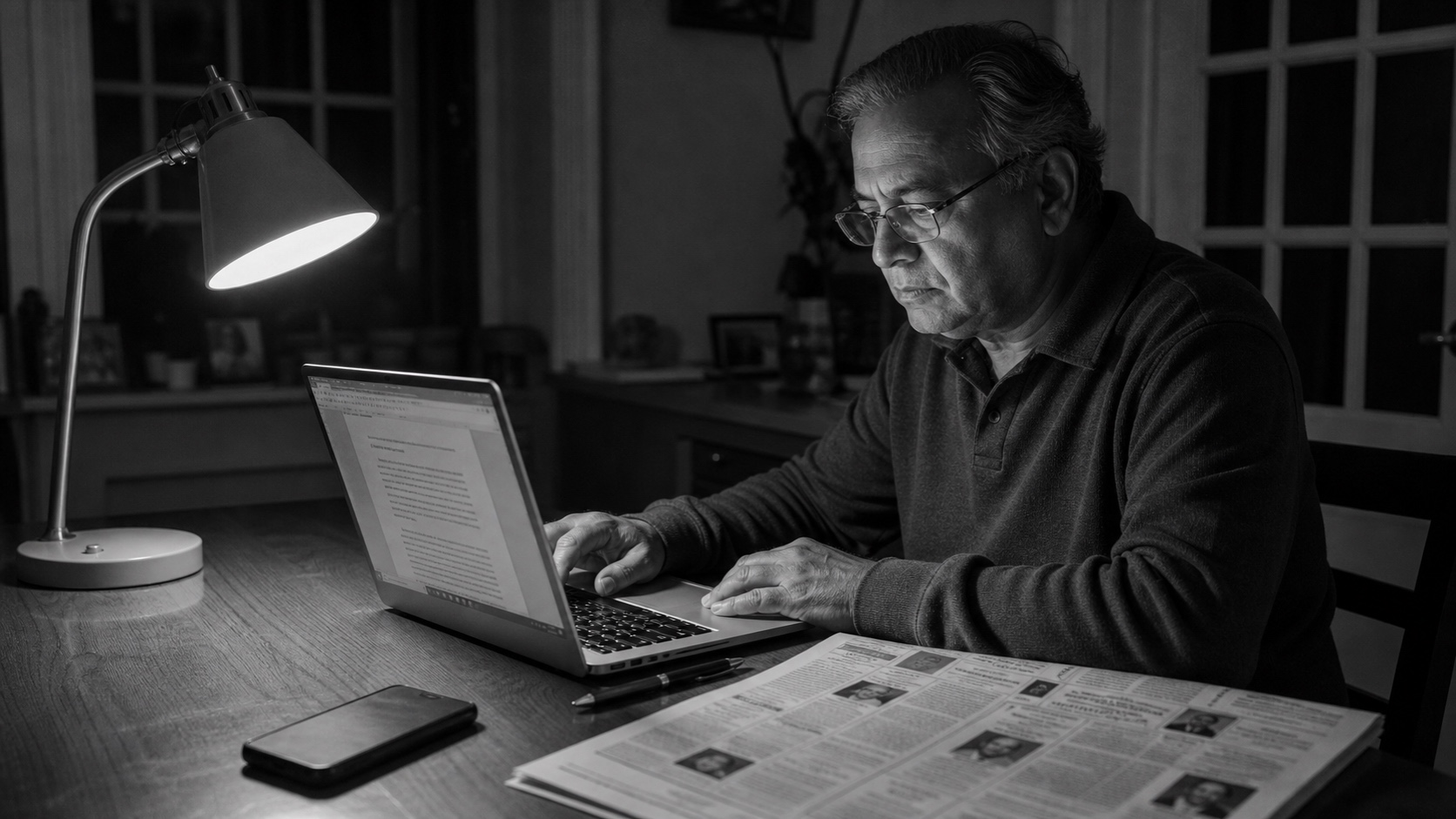
A man at a laptop with a printed newspaper obituary page beside him, part-written

Start here

Below are eight complete obituaries you can copy, change the names in, and send to a funeral home or a newspaper today. They run from 77 words to 436, and they cover a mother, a father, a young person, a death after a long illness, and a family that hadn't spoken in years.

Every name, town, date, and detail on this page is invented. None of these people existed. They're written as real obituaries so you can hear the rhythm and steal the sentences that fit, then delete the rest.

Two things before you read them.

First, length is a budget decision. Some obituaries are priced per line and some per word.[5] At the Tampa Bay Times, the difference between the 77-word version and the 436-word version is about $1,260.[1] The real 2026 rates are further down the page, with the math done.

Second, this page is the examples. If you want the process, the questions to ask relatives, and what to do when you're stuck on the first line, read how to write an obituary. If you'd rather answer a set of prompts and get a draft back, the free obituary maker does that. Your funeral director can also write the notice from information you give them.[12]

Short obituary example (77 words)

This is the version you write when the paper charges by the line and you have four other bills to pay. It has the six things a notice has to do: who died, when, where, how old, who's left, and when the service is.

Marguerite Ellery Boone died on March 4, 2026, at her home in Duluth, Minnesota. She was 88. Born in Hibbing on July 12, 1937, she worked 31 years as a school nurse in the Duluth public schools. She is survived by her son, Paul Boone, of Superior, Wisconsin; two grandchildren; and her sister, Ann Vukelich. Her husband, Roy, died in 2011. A graveside service will be held at Forest Hill Cemetery on March 14 at 11 a.m.

What to change:

  • Swap the job. One specific job with a number of years does more work than three adjectives.
  • If there's no service yet, write "A service will be announced." Don't invent a date to fill the line.
  • You don't have to say what she died of. None of the papers we checked require it, and AFSP tells families the decision is theirs.[9]

Standard obituary example (209 words)

This is the length that fits most of what a family wants to say without running the bill up. It's long enough for one or two details that only the people who knew him would recognize, and short enough that the bill won't shock you.

Dennis Ray Okafor died on January 19, 2026, at a hospital in Green Bay, Wisconsin. He was 67.

Dennis was born on April 2, 1958, in Gary, Indiana, to Samuel and Betty Okafor. He moved to Green Bay in 1981 for a job at the paper mill and stayed for the rest of his life. He worked in the maintenance shop for 34 years and knew every machine on the floor by sound.

He married Rosalie Fontaine in 1984. They raised three kids in a house on Doty Street, and Dennis spent most Saturdays in the garage fixing whatever the neighbors dragged over. He coached his daughter's softball team for six seasons and never once yelled at an umpire. He was a bad cook and made pancakes anyway.

He is survived by his wife, Rosalie; his children, Ben Okafor (Tara), Camille Okafor, and Nathan Okafor; four grandchildren; and his brother, Michael Okafor, of Gary. He was preceded in death by his parents and by his sister, Denise Okafor Hall.

Visitation will be held Friday, January 23, from 4 to 7 p.m. at Blaney Funeral Home. A funeral Mass follows Saturday at 10 a.m. at St. Agnes Catholic Church. Memorial gifts may be sent to the Brown County Humane Society.

What to change:

  • The two lines carrying this one are "knew every machine on the floor by sound" and "never once yelled at an umpire." Find your two. They're usually a habit.
  • "He was a bad cook and made pancakes anyway" is the kind of line families cut because it feels disrespectful. Keep it. It's the only sentence that sounds like a person.
  • Names in the survivor list get spouses in parentheses. Your funeral director can review the notice for standard formatting before it goes in.[12]

Long obituary example (436 words)

Long obituaries need specifics to be worth the money: dollar amounts, counts, street names, the number of years. If you're writing long and the sentences are still general, you're paying by the line for nothing.

Rosa Alcantara Vega died on June 8, 2026, in Tucson, Arizona. She was 79.

Rosa was born on September 30, 1946, in Nogales, Sonora, the third of seven children of Efrain and Carmen Alcantara. The family crossed into Arizona in 1954 and settled in Tucson's Barrio Hollywood. Rosa learned English in a year and then spent the next decade translating for her parents at the bank, the doctor's office, and the school district.

She graduated from Pueblo High School in 1964 and went to work at a hardware counter downtown. She married Ignacio Vega in 1968. They bought a house on West Speedway for $14,500 and lived in it for fifty-one years.

Rosa spent 28 years as a bilingual teacher's aide at a Tucson elementary school. She wasn't a certified teacher. She ran a reading group anyway, out of a supply closet, with donated books. Former students still stopped her in the grocery store into her seventies. She never remembered their names right away and she always remembered what they read.

She was a serious cook. Her tamales were a December operation involving four card tables, an assembly line of nieces, and rules about masa thickness that nobody was allowed to question. She made 40 dozen most years and gave nearly all of them away.

She cared about her block. She ran the neighborhood association's phone tree for 22 years, called the city about the same broken streetlight eleven times, and got it fixed. She voted in every election, including the ones for the water district.

Rosa was stubborn about small things and generous about large ones. She would argue for twenty minutes over who was paying for lunch. She quietly covered two funerals for families on her street and told nobody.

Ignacio died in 2019. Rosa stayed in the house, kept the garden, and learned to use a smartphone so she could see her great-grandchildren on video.

She is survived by her children, Elena Vega Marquez (Danny) of Tucson, Ruben Vega (Kim) of Phoenix, and Cristina Vega of Albuquerque; nine grandchildren; four great-grandchildren; and her sisters, Alma Alcantara Ruiz and Lupita Alcantara. She was preceded in death by her husband, Ignacio; her parents; and her brothers Efrain Jr., Tomas, Miguel, and Beto.

A rosary will be said Thursday, June 11, at 6 p.m. at Santa Cruz Catholic Church, followed by a funeral Mass Friday at 10 a.m. Burial at Holy Hope Cemetery. A reception follows at the parish hall, and yes, there will be tamales.

In place of flowers, the family asks that you give books to a school library, or read to a kid.

What to change:

  • Every paragraph here answers one question: where she came from, what she did for money, what she did for people, what she was like to argue with. Use those four questions on your person.
  • The numbers do the work: 28 years, 40 dozen, 22 years, eleven times, $14,500. Get the real ones. Don't round them into vagueness.
  • The last line is a request the reader can act on. "She will be dearly missed" isn't one.
  • At 436 words this is the expensive version. Read the rates section before you submit it.
Obituary example for a mother

Obituaries for mothers usually describe nothing but the mothering. She had a job, opinions, and a team she yelled at. Put those in.

Yolanda Pierce Whitfield died on February 27, 2026, at her home in Cleveland Heights, Ohio. She was 74. Her three daughters were with her.

Yolanda was born on May 8, 1951, in Birmingham, Alabama, to Curtis and Ernestine Pierce. The family moved north in 1959. She graduated from Glenville High School and from Cuyahoga Community College, and she worked 29 years as a medical records supervisor at a Cleveland hospital.

She married Andre Whitfield in 1974. He died in 2016.

Yolanda raised three daughters on a supervisor's salary and a lot of coupons. She checked homework at the kitchen table every night, including the nights she'd worked a double. She sang alto in the choir at her church for 41 years and ran its food pantry for nine. She had a rule that nobody left her house hungry, and she enforced it.

She followed Cleveland baseball closely and complained about it constantly. She did crossword puzzles in pen. She gave advice you didn't ask for and were usually glad to have.

She is survived by her daughters, Tamika Whitfield Ross (Marcus) of Shaker Heights, Danielle Whitfield of Atlanta, and Robin Whitfield Osei (Kwame) of Columbus; seven grandchildren; her brother, Curtis Pierce Jr.; and a great many people who called her Aunt Yo without being related to her.

Services will be held Saturday, March 7, at 11 a.m. at Antioch Baptist Church, with a viewing one hour prior. Burial at Highland Park Cemetery.

Donations may be made to the Greater Cleveland Food Bank.

What to change:

  • "Her three daughters were with her" is optional and it's the line people remember. Only use it if it's true.
  • Name her work and how long she did it, before you name her children.
  • The "Aunt Yo" line covers the people who aren't legally family and were family. Most obituaries have no room for them, and this is how you make room in fourteen words.

Obituary example for a father

Fathers get written up in job titles and military service, and then the notice stops. The specifics that make him recognizable are usually small and repetitive: what he did every weekend for thirty years.

Gerald Anthony Novotny died on October 14, 2025, at a hospital in Omaha, Nebraska. He was 81.

Gerry was born on June 3, 1944, in Wahoo, Nebraska, to Frank and Helen Novotny, and grew up on the family farm on Highway 77. He served in the Army from 1965 to 1967. He came home, married Judy Kastner in 1969, and spent 38 years as a lineman for the local power district. He was on a pole in every ice storm from 1972 to 2007.

Gerry didn't talk much. He showed up. He drove four hours to a granddaughter's volleyball game and drove back the same night. He fixed things without being asked and refused to be thanked for it. He kept a running list of every deer he'd ever seen on the property, dated, in a spiral notebook.

He made bad coffee, watched Nebraska football with the sound off and the radio on, and told the same three jokes for fifty years.

He is survived by his wife, Judy; his children, Steve Novotny (Amy) of Lincoln and Karen Novotny Diaz (Rafael) of Denver; five grandchildren; and his sister, Marilyn Novotny Sladek. He was preceded in death by his parents and his brother, Larry.

Visitation is Friday, October 17, from 5 to 7 p.m. at Roeder Mortuary. Funeral service Saturday at 10 a.m. at St. Wenceslaus Church. Burial with military honors at Bohemian National Cemetery.

Memorials may be sent to a lineman apprenticeship scholarship fund in his name.

What to change:

  • Military service goes in with branch and years. If you want honors at the burial, tell the funeral home early; they arrange it.
  • "Gerry didn't talk much. He showed up." Seven words and the reader knows him. Find the equivalent for your father and put it in paragraph three.
  • The spiral notebook is the detail that makes him a person on the page. Everybody has one thing like that. Ask his siblings. They remember different material than his kids do.

Obituary example for a young person

There's no career section and no fifty-year marriage, so the obituary for someone in their twenties is built almost entirely out of how they were with people. That's harder to write and it's the material you have.

Jonah Ellis Kim died on August 3, 2026, in Portland, Oregon. He was 22.

Jonah was born on January 17, 2004, in Beaverton, to David Kim and Sarah Ellis Kim. He graduated from Sunset High School in 2022 and was going into his final year at Portland State, studying environmental science. He'd just finished a summer job counting salmon on the Sandy River and had told everyone who would listen exactly how many.

He was funny in a way that took people a second. He was the friend who answered the phone at 2 a.m. He made playlists nobody asked for and everybody kept. He was a bad driver, a good cook, and the only person in his family who could talk his grandmother into anything.

He had 11 tattoos and could explain all of them, at length, whether or not you'd asked.

He is survived by his parents, David and Sarah; his sister, Hannah Kim; his grandmother, Kyung-Ja Kim; and more friends than this space allows.

A memorial gathering will be held Saturday, August 15, at 2 p.m. at Laurelhurst Park, near the pond. Wear whatever he'd have made fun of.

In place of flowers, the family asks that you donate to the Sandy River Basin Watershed Council, or that you call someone you've been meaning to call.

What to change:

  • Notice there's no cause of death. You never have to include one, at any age, and people will ask anyway. Deciding in advance what you'll say saves you from deciding on the phone.
  • Friends belong in the survivor list when the person was young. Write "and his friends" or name a few. Ask your paper whether they'll run it.
  • An obituary for someone in their twenties is often the first one their friends have ever read. Say where to show up and what to wear, plainly.

Obituary example after a long illness

When someone was sick for years, most of the obituary ends up being about the illness. You can name it once, early, and then spend the rest of the space on the nineteen years she was also doing other things.

Meera Balakrishnan Iyer died on May 21, 2026, at home in Edison, New Jersey. She was 61. She had lived with multiple sclerosis for 19 years.

Meera was born on November 2, 1964, in Chennai, India, to Balakrishnan and Saroja Venkataraman. She came to the United States in 1988 for a master's degree in chemistry and stayed. She married Anand Iyer in 1991. She worked 21 years as an analytical chemist at a pharmaceutical lab in Piscataway, including the last six from a home office after her hands stopped cooperating with a keyboard.

She learned to cook Gujarati food because a neighbor taught her, and she got better at it than the neighbor. She read 60 to 80 books a year and kept a numbered list. She sat on the Edison library board for eight years and argued, successfully, for a bigger large-print section.

She was blunt. She thought "brave" was a strange word for having an illness she didn't choose. She'd rather you asked about the books.

She is survived by her husband, Anand; her son, Vikram Iyer, of Jersey City; her daughter, Anjali Iyer, of Boston; and her brother, Ravi Venkataraman, of Chennai.

A service will be held Tuesday, May 26, at 11 a.m. at the family home, followed by cremation.

The family asks for donations to the National Multiple Sclerosis Society or to the Edison Public Library.

What to change:

  • One sentence for the diagnosis and the number of years. Then move on. "After a long battle" tells the reader nothing. "19 years" tells them everything.
  • "Her hands stopped cooperating with a keyboard" is concrete and doesn't ask for pity. That's the register to aim for.
  • If she hated a word, say so. Families are allowed to correct the record in an obituary, and this is the last chance.

When the family was estranged, or the person was difficult

Two bad options get taken here. Families either write a warm obituary that everyone who knew him will read as a lie, or they skip the notice entirely and then field questions for a year. There's a third version. It's short, it's true, and it doesn't argue with anyone.

Raymond Dale Hutchins died on July 9, 2026, in Bakersfield, California. He was 70.

Ray was born on February 22, 1956, in Taft, California, to Dale and Wanda Hutchins. He worked oil field maintenance in Kern County for most of thirty years. He played guitar well. He could rebuild a carburetor in an afternoon and often did, for people who couldn't pay him.

He married Linda Reyes in 1979. They divorced in 1994.

Ray and his children weren't in contact for many years. That wasn't a small thing and this notice won't pretend otherwise. To the men who worked beside him he was funny, reliable, and generous with his time.

He is survived by his son, Aaron Hutchins, of Fresno; his daughter, Nicole Hutchins Pratt, of Sacramento; and three grandchildren he never met. He was preceded in death by his parents and his brother, Gary Hutchins.

There will be no service. Aaron and Nicole will scatter his ashes privately. The family asks for privacy and no phone calls.

Anyone who wants to do something can donate to the Kern County Museum, where Ray volunteered on the vehicle restoration crew for six years.

What to change:

  • "They weren't in contact for many years" is enough. Say the fact and stop. No reasons, no diagnosis, no version of the argument.
  • Give the true good things. A person can have been a bad father and a good coworker. Both belong.
  • "The family asks for privacy and no phone calls" is a real sentence you're allowed to publish. Use it if it's what you need.
  • You can also publish a four-line death notice with the name, dates, and nothing else. Some papers run those free.[3]

If the person died by suicide

You don't have to name a cause of death in an obituary. The American Foundation for Suicide Prevention's guidance to families is that including it is your call: "Do what feels comfortable to you." Their practical argument for naming it is that it heads off repeated questions and rumors later, and it lets people support you in a way that actually fits.[9]

If you do name it, follow four rules:

  • Write "died by suicide." Never the verb "committed," which is the language of crime, and never describe an attempt as successful or failed.[7][8]
  • Leave out method, means, location, and any note. AFSP is explicit that details about lethal means or the method raise contagion risk, and that location and notes can glamorize the death.[7][8]
  • Don't give a reason. Not a job loss, not a divorce, not a diagnosis. AFSP puts it plainly: "no one takes their life for a single reason."[7][8] A single named cause reads, to another family whose person had no diagnosis, as an accusation that they missed something.
  • Don't speculate about what he was thinking, what she wanted anyone to feel, or what any of it meant.

Wording that does the job:

  • "Daniel Ruiz Ochoa died by suicide on March 3, 2026, at the age of 34."
  • "Priya Menon died on March 3, 2026. She was 29." (No cause named. This is complete and correct.)
  • "The family asks that donations go to the American Foundation for Suicide Prevention."

988. If you're struggling right now, or you're worried about someone, or you've just lost someone this way, call or text 988, or chat at chat.988lifeline.org. It's free, confidential, and staffed 24 hours a day, every day.[10] People bereaved by suicide are themselves at raised risk.

In a UK study of 3,432 bereaved young adults, those bereaved by suicide were more likely to attempt suicide than those bereaved by sudden natural causes.[11] Calling is an ordinary thing to do in an ordinary bad week. You don't have to be in danger to use it.

What newspapers actually charge

Newspapers sell obituary space the way they sell advertising, by the line or the column inch. A 209-word obituary runs about $734 for one day at the Tampa Bay Times, and the Seattle Times starts at $366.45 for 12 lines.[1][4] The Seattle Times' own guidance page says there's usually no length limit and that "some obituaries are priced per word or per line," so check before you write.[5]

Three real 2026 rate cards, straight from the papers:

  • The Denver Gazette: $6.50 per line, Monday through Sunday. Publish two or more days and you get 50% off the second day and each additional day within seven days. Photos are free. Death notices run free, limited to 12 lines.[3]
  • Tampa Bay Times: obituaries start at $80, which covers one print day and a five column line minimum. Additional lines are $12 each. A column line holds about 20 characters, counting letters, numbers, spaces, and punctuation. A photo is $50 per photo per day and adds three lines. There's a $30 automatic guest book charge on every paid obituary starting at six lines. Copy has to be submitted, approved, and paid by 1 p.m. the day before it runs.[1] A death notice at the same paper starts at $0, in the digital edition only.[2]
  • The Seattle Times: an obituary starts at $366.45 for one day in print, which buys one inch, or 12 lines. Rates go up from there.[4]

Run the Tampa Bay numbers against the examples on this page and the budget stops being abstract. Their published inputs are $80 for the first five lines, $12 per line after that, about 20 characters to a line, and a $30 guest book charge.[1] So:

  • The 77-word short obituary is 419 characters, about 21 column lines. Five come with the $80 base, 16 more at $12 is $192, plus the $30 guest book. Roughly $302 for one day.
  • The 209-word standard obituary is 1,137 characters, about 57 lines. Roughly $734.
  • The 436-word long obituary is 2,511 characters, about 126 lines. Roughly $1,562.

Each paragraph starts a new line and bills as a whole one, so a multi-paragraph notice runs a few lines above these numbers. Ask the paper for a count before you pay.

Same paper, same day, three lengths. Add $86 if you want the photo: $50 for the photo plus the three lines it adds.[1]

Two more things worth knowing before you hand a draft to anyone:

  • Your funeral home is probably placing this for you, and that's a billable line. Under the FTC's Funeral Rule, obituary notices are a "cash advance item," money the funeral home pays a third party on your behalf. If the home charges you for the service of obtaining it, or keeps a commission, discount, or rebate from the paper, it has to disclose that on your itemized statement, in the words "We charge you for our services in obtaining" the item.[6] Look for that sentence. Ask what the markup is.
  • The free version exists. The Denver Gazette runs death notices at no charge, up to 12 lines. The Tampa Bay Times runs a free death notice online only, up to five lines.[2][3] Post the long obituary where it's free, on the funeral home's site, and print the 77-word one where it costs money.

How to make one of these yours

Pick the example closest to your situation and work through it in this order.

  • Replace the facts first. Name, dates, city, parents, spouse, children, job, years. Get these right; they're the part people check.
  • Then delete every sentence that could describe anyone. "She loved her family" goes. "She made 40 dozen tamales most years and gave nearly all of them away" stays.
  • Then add two details only your people would recognize. The Seattle Times' own advice to families is to include the thing a reader might not have known about your person.[5] Call his brother. Siblings remember different material than children do.
  • Then count. Paste it into a word counter, multiply by about 5.5 characters a word to get characters, divide by your paper's characters per line, and multiply by the line rate. Cut to fit the number you're willing to spend.
  • Then read it out loud. If you can't say a sentence without wincing, it's wrong, and it'll be wrong at the service too.

If you'd rather answer questions than face a blank page, the free obituary maker builds a draft from your answers and you edit from there. Writing your own instead? The write-your-own obituary tool does the same thing from your own answers. For the full process, including how to interview relatives and what to do about the parts nobody agrees on, read how to write an obituary. And if you're at the very beginning of this, the when someone dies checklist tells you what has to happen this week.

Common questions

What is a good short obituary example?

A short obituary needs six things and nothing else: who died, when, where, how old they were, who survives them, and when the service is. Here's 77 words that covers all six: "Marguerite Ellery Boone died on March 4, 2026, at her home in Duluth, Minnesota. She was 88. Born in Hibbing on July 12, 1937, she worked 31 years as a school nurse in the Duluth public schools. She is survived by her son, Paul Boone, of Superior, Wisconsin; two grandchildren; and her sister, Ann Vukelich. Her husband, Roy, died in 2011. A graveside service will be held at Forest Hill Cemetery on March 14 at 11 a.m." The name is invented. The structure works for anyone.

How many words should an obituary be?

There's no rule. The eight examples on this page run 77 to 436 words. Papers usually set no length limit; the limit is what you're willing to pay, because some obituaries are priced per word or per line. Check your paper's rate before you write, then write to that number. If the obituary is going on a funeral home website instead of in print, length is free and you can write as much as you want.

How much does it cost to put an obituary in the newspaper?

It depends entirely on the paper, and the spread is wide. The Denver Gazette charges $6.50 per line and runs free death notices up to 12 lines. The Tampa Bay Times starts at $80 for a five-line minimum, then $12 per column line of about 20 characters, plus $50 per photo per day and a $30 guest book charge. The Seattle Times starts at $366.45 for one day in print, which buys 12 lines. On Tampa Bay's published rates, a 209-word obituary works out to roughly $734 for a single day.

What do you write in an obituary for a mother?

Write her as a whole person. She had a job, opinions, and habits that had nothing to do with her kids. Lead with the facts, then give her job and how long she did it, then two or three specific habits: what she cooked, what she argued about, what she did every Sunday for 41 years. The line families most often remember afterward is the smallest one, something like "she did crossword puzzles in pen." Save the children's names for the survivor list near the end.

Can you write an obituary without saying the cause of death?

Yes. None of the papers we checked require a cause of death, and plenty of obituaries don't include one. "Jonah Ellis Kim died on August 3, 2026, in Portland, Oregon. He was 22" is a complete and correct opening. People will still ask, so decide as a family in advance what you'll say, and let one person handle the question.

How do you word an obituary when someone died by suicide?

Use the phrase "died by suicide." Never the verb "committed," and never describe an attempt as successful or failed. Leave out the method, the means, the location, and any note. Don't give a reason, because a suicide is never the result of one thing. "Daniel Ruiz Ochoa died by suicide on March 3, 2026, at the age of 34" is enough. You're also free to name no cause at all. If you're struggling, or you've just lost someone this way, call or text 988. It's free, confidential, and open 24 hours a day.

What do you say in an obituary when the family was estranged?

Say the fact and stop. "Ray and his children weren't in contact for many years" is a publishable sentence, and it beats a warm obituary that everyone who knew him will read as false. Include the true good things, because a person can have been a bad parent and a good coworker. Skip the reasons entirely. You're also allowed to write "There will be no service" and "The family asks for privacy and no phone calls," or to publish a four-line death notice with the name and dates and nothing else.

Is there a free obituary template?

There are eight complete obituaries on this page you can copy and change, covering short, standard, long, a mother, a father, a young person, a death after a long illness, and an estranged family. MORTL's obituary maker is also free: you answer a set of questions and it builds a draft you can edit. Your funeral director can also write the notice from information you provide.

Sources & References

Research & Citations

All factual claims in this article are sourced from peer-reviewed research, government data, and named institutions. Citations follow APA 7th edition format.

  1. [1]Tampa Bay Times. (2026). Submit an obituary. ↗ Source Retrieved August 9, 2026
  2. [2]Tampa Bay Times. (2026). Obituary: Adportal self-service advertising. ↗ Source Retrieved August 9, 2026
  3. [3]The Denver Gazette. (2026). Obituaries: Adportal self-service advertising. ↗ Source Retrieved August 9, 2026
  4. [4]The Seattle Times. (2026). Select notice type. ↗ Source Retrieved August 9, 2026
  5. [5]The Seattle Times. (2026). How to write an obituary. ↗ Source Retrieved August 9, 2026
  6. [6]Federal Trade Commission. (2024). Complying with the Funeral Rule. ↗ Source Retrieved August 9, 2026
  7. [7]American Foundation for Suicide Prevention. (2026). Ethical reporting guidelines for media. AFSP Storytelling. ↗ Source Retrieved August 9, 2026
  8. [8]American Foundation for Suicide Prevention. (2026). How to talk safely about suicide. ↗ Source Retrieved August 9, 2026
  9. [9]American Foundation for Suicide Prevention. (2026). Practical information for immediately after a loss. ↗ Source Retrieved August 9, 2026
  10. [10]988 Suicide & Crisis Lifeline. (2026). 988 Suicide and Crisis Lifeline. ↗ Source Retrieved August 9, 2026
  11. [11]Pitman, A. L., Osborn, D. P. J., Rantell, K., & King, M. B. (2016). Bereavement by suicide as a risk factor for suicide attempt: A cross-sectional national UK-wide study of 3432 young bereaved adults. BMJ Open, 6(1), e009948. ↗ Source Retrieved October 2, 2026
  12. [12]National Funeral Directors Association. (2026). Writing an obituary or death notice. Remembering A Life. ↗ Source Retrieved August 9, 2026

Share this story

Post it, or send it straight to the person who needs it. The link goes with it.

Keep Reading

Grief

How to Write an Obituary: A Practical Guide That Actually Helps

Writing an obituary is one of the hardest things you'll do in the days after someone dies. Here's how to do it well. Without losing yourself in the process.

10 min read
Planning

How to Arrange a Funeral, Step by Step

Somebody has to make the calls. Here’s the order that saves money and second trips, and what the law requires versus what the funeral home wants you to think it requires.

9 min read
Planning

What to Do When Someone Dies at Home

What you do when someone dies at home depends on one thing: whether it was expected. If the person was on hospice, you call the hospice line and 911 stays out of it. Here’s what happens either way.

6 min read
Planning

How Much Does a Funeral Cost in 2026?

Planning a funeral? We break down current national median costs, common line items, your rights under the FTC Funeral Rule, and ways to stay within your budget.

10 min read
Culture

Cremation vs. Burial: What Nobody Tells You

Forget the euphemisms. Let's talk about what really happens to your body, your wallet, and the planet when you choose cremation or burial.

15 min read

The Death Dispatch

More stories like this, weekly.

A newsletter about death you'll actually look forward to reading.